Zero Liquid Discharge: Why "Zero" Is the Wrong Thing to Chase
Most factories we work with don't actually want zero liquid discharge. They want the pollution board to stop calling. Those two things sound identical, and they..
Contents
Most factories we work with don't actually want zero liquid discharge. They want the pollution board to stop calling. Those two things sound identical, and they are not — and almost everything that goes wrong with a ZLD plant lives in the gap between them.
Let me explain what I mean.
Zero liquid discharge, or ZLD, means treating every drop of effluent your plant produces until nothing liquid ever leaves your gate. No drain to a river, no tanker to a CETP, nothing. It's a genuine engineering feat, and in India it's increasingly not a choice. The Central Pollution Control Board has made it mandatory for entire sectors — textile dyeing, tanneries, distilleries — so a plant manager gets a notice one Tuesday, feels his stomach drop, and by Friday he's collecting quotes for "a ZLD."
That Friday is where the trouble starts.
The problem with buying a punishment
When you buy something to make a threat go away, you buy the cheapest thing that makes the threat go away. This is completely rational and almost always wrong.
In ZLD it looks like this: you take a multi-effect evaporator — the single most expensive way to boil water that humans have ever devised — bolt it onto the end of your existing plant, and feed it everything. It works. The needle hits zero. And then the electricity bill arrives, and you spend the next decade quietly resenting the machine, running it as little as you can get away with, and wondering why everyone said ZLD was a good idea.
Here's the thing almost nobody tells you at the quote stage: the cost of a ZLD plant is decided upstream, long before the evaporator everyone fixates on. The cheapest litre to evaporate is the litre you never send to the evaporator at all. A plant that concentrates hard on membranes first — squeezing the volume down with reverse osmosis before anything gets boiled — can run a thermal stage a fraction of the size, at a fraction of the running cost, of a plant that just dumps raw effluent into an evaporator. Same "zero." Wildly different bill.
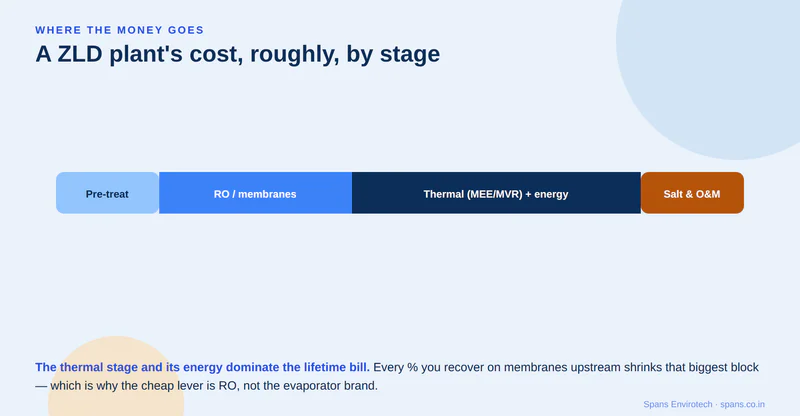
If you want to see how much that upstream choice actually moves the number, we built a ZLD cost calculator that lets you feel it for yourself.
A better question
The plants where ZLD quietly works — where nobody is secretly bypassing it at 2am — have one thing in common. Somebody in the room asked a different question. Not "how do we hit zero before the deadline," but "what is actually in this water, and what is it worth to us?"
Because effluent, looked at honestly, is three valuable things wearing a disguise.

Water. In a country where NITI Aayog estimates some 600 million people face high-to-extreme water stress, and where industrial water tariffs only ever go up, the water you recover from your own effluent has a real, risen, and rising price. A ZLD plant isn't only destroying a liability. It's manufacturing a utility you were otherwise buying from someone else.
Salt. The stuff that makes ZLD hard — the dissolved solids the evaporator has to crystallise out — is sometimes a product. Segregate your streams instead of mixing them, and a distillery or a textile unit can pull out sodium sulphate or other salts clean enough to sell or reuse, rather than paying to haul a mixed sludge to a landfill.
Energy. The evaporator's true cost is heat, and heat can be recovered, integrated, and in some plants partly supplied by the biogas your own anaerobic stage throws off. The waste stream can help pay to treat itself.
None of this is exotic. It's just what happens when you stop treating ZLD as a fine you're paying in installments and start treating it as a capital decision with an operating return — which is what it actually is.
"Zero" is the regulator's number. "Worth" is yours.
That's the whole idea, really. Zero is a number the CPCB chose. It's a compliance target, and if you optimise only for it, you'll get exactly what compliance-thinking always gets you: the cheapest box that ticks, and a running cost you'll spend years regretting.
Worth is a number your own plant chooses. When you design the system around what the water and its contents are worth to you — cheaper make-up water, sellable salt, recovered heat — the zero comes along for free, as a side effect of a plant that makes economic sense. Same equipment list, more or less. Completely different fifteen-year bill.
I'm not claiming ZLD is cheap. It isn't, and anyone who tells you otherwise is selling something. What I am claiming is that the factories that thrive under a ZLD mandate and the ones that suffer under it are usually running similar hardware. What separates them is which question they asked on that first Friday.
If you're staring at a ZLD notice and a quote that made your stomach drop, it's worth pressure-testing the number before you sign — a lot of that scary figure is upstream design, not destiny. Here's how we think about ZLD, and if it helps to talk it through with someone who has built these, we're around.
Spans
Spans empowers businesses around the world to grow faster and profitable while using less energy and water.
Visit Site