
The Water Treatment Process, Stage by Stage
A water treatment plant looks, from the road, like a set of large tanks doing something vague and continuous. What is actually happening inside is a sequence ..
Contents
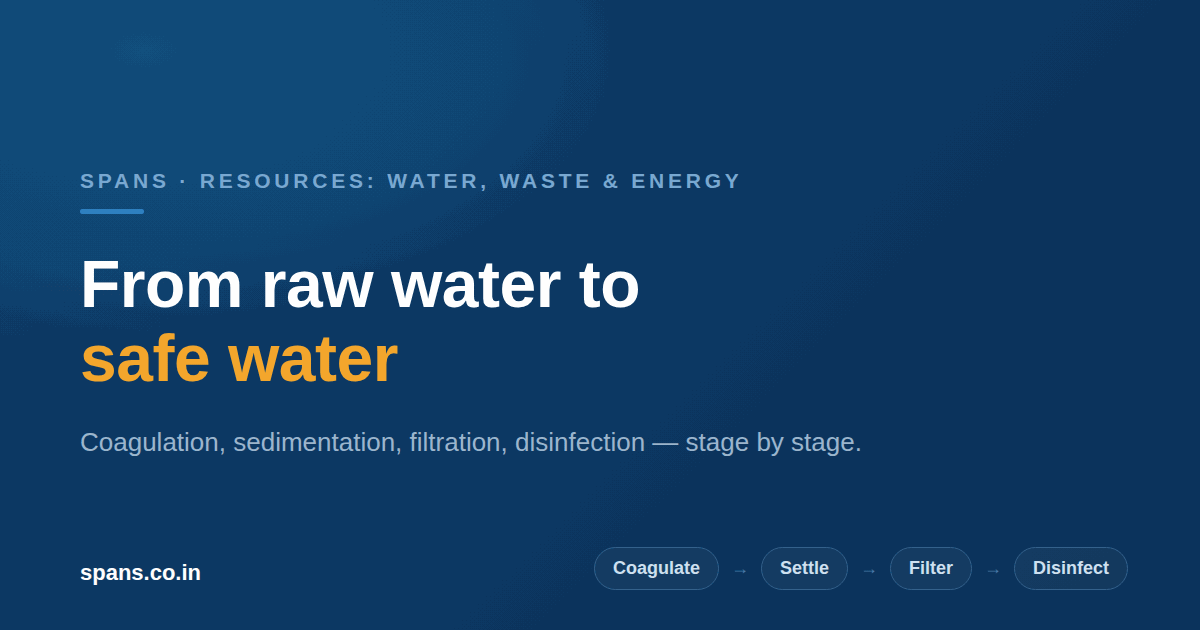
A water treatment plant looks, from the road, like a set of large tanks doing something vague and continuous. What is actually happening inside is a sequence — each stage removing a class of contaminant the previous stage could not, handing cleaner water to the next. The order is not arbitrary. Get it wrong and the expensive stages at the end drown trying to do the cheap stages' work. Here is the process as it actually runs, and why each step earns its place.
1. Screening and intake
Raw water — from a river, reservoir or well — arrives carrying the obvious: leaves, twigs, fish, plastic, grit. Screens and a grit chamber take these out first, because there is no sense pumping debris through delicate downstream equipment. It is the least glamorous stage and the one whose absence wrecks everything after it.
2. Coagulation and flocculation
Now the clever part. Much of what makes raw water cloudy is not large enough to settle on its own — fine clay, silt and organic particles, so small and so similarly charged that they repel each other and stay suspended indefinitely. You could let that water sit for a week and it would still be turbid.
Coagulation fixes this chemically. A coagulant (commonly an aluminium or iron salt) is dosed and rapidly mixed; it neutralises the charges keeping the particles apart. Then, in gentle flocculation, slow stirring lets the destabilised particles collide and clump into larger, heavier aggregates called floc. This stage is strongly pH-dependent — each coagulant works only in a certain window — which is why pH control sits right alongside it. The whole job here is to turn un-settleable particles into settleable ones.
3. Sedimentation and clarification
With the floc formed, gravity does the work. The water moves slowly through a sedimentation tank or clarifier, and the heavy floc sinks to the bottom as sludge, which is scraped off and removed. Clearer water flows off the top. A well-run coagulation stage makes this one look easy; a poor one leaves fine floc drifting through to overload the filters. Most of the turbidity that entered the plant is gone by the end of this step — cheaply, using little more than chemistry and time.
4. Filtration
Sedimentation removes the bulk, but fine particles always escape. Filtration is the polish. Water passes down through beds of sand, or sand over anthracite (a multimedia filter), which trap the remaining fine solids. Where the target is tighter — very low turbidity, or removal of specific contaminants — membrane filtration takes over from granular media. After filtration the water is clear. Clear, however, is not the same as safe.
5. Disinfection
Clarity says nothing about pathogens, so the final essential stage kills them. Chlorination is the workhorse: cheap, effective, and — importantly — it leaves a residual that keeps protecting the water through the distribution network, all the way to the tap. UV and ozone are alternatives that disinfect without adding chemicals, but they leave no residual, so they suit points of use rather than long pipe runs. Disinfection efficiency is itself pH-sensitive, which is one more reason pH is watched throughout.
6. Optional polishing
For drinking water, disinfection is usually the end. For specific uses, more follows: softening to remove hardness, or reverse osmosis and demineralisation where the water must be low in dissolved solids — boiler feed, process water, pharmaceutical grade. These stages are added only when the use demands them, because each one costs money and, in the case of RO, produces a reject stream to manage.
Why the order is the point
Read top to bottom and a logic emerges: each stage is cheaper than the one after it, and exists to protect it. Screening protects the pumps. Coagulation and sedimentation remove the bulk of the load cheaply so filtration is not overwhelmed. Filtration protects the disinfection and any membranes. Skip or skimp on an early, cheap stage and the load lands on a later, expensive one — filters that clog in hours, membranes that foul in weeks, disinfection that cannot cope. Most treatment-plant trouble is not an exotic failure; it is an early stage underperforming and a later stage paying for it.
One important distinction
This is the process for treating raw water into clean water. Treating dirty water back to a safe standard — sewage and industrial effluent — is a related but different train, built around biology to break down organic pollution, as we cover for sewage and effluent plants. The two are often confused because they share tanks that look alike. The giveaway is the goal: a water treatment plant makes water fit to use; a wastewater plant makes used water fit to return or reuse.
Understanding the sequence is what lets you diagnose a plant instead of guessing at it. If your treated water is not meeting spec and you want help finding which stage is actually letting you down — and the least-cost fix — that is a short conversation to have with us, or reach us at [email protected] or +91-98100 00233.
Spans
Spans empowers businesses around the world to grow faster and profitable while using less energy and water.
Visit Site