
Water Positive Is an Accounting Identity, Not a Slogan
Every other sustainability report we open now carries a line about being water positive by some round-numbered year. It has become the water version of net-zero..
Contents
Every other sustainability report we open now carries a line about being water positive by some round-numbered year. It has become the water version of net-zero: a phrase that sounds like a commitment and often behaves like a headline. And when we read the fine print, the claim is frequently doing something quietly dishonest. It is treating a distant watershed project, or a purchased credit, as if it were the same litre of water the factory actually pulled out of the ground this morning. It is not.
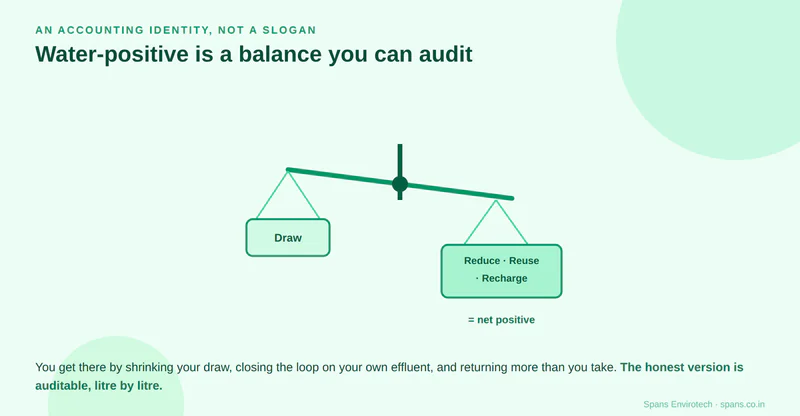
Here is the uncomfortable part. Water positive is not an adjective you earn by tone of voice. It is an accounting identity. Either the numbers close or they do not, and the honest version can be audited litre by litre.
Water positive is arithmetic, not adjectives
Strip away the branding and the definitions are refreshingly narrow. Water neutrality means your water debit, everything you withdraw, is balanced by an equal water credit, everything you return or save. Water positive simply moves the balance one notch further: you return more than you take. NITI Aayog's water-neutrality framework for Indian industry lays this out in almost bookkeeping terms, debits on one side, credits on the other, and the residual is your claim.
The trouble starts because a factory's water debit is bigger and less visible than most people assume. Your true water footprint has three colours to it. Blue water is the surface and groundwater you physically draw. Green water is rainwater. Grey water is the volume that would be needed to dilute the pollution you discharge back to a safe standard. That last one is the sneaky column. A plant can withdraw a modest amount of blue water and still carry an enormous grey footprint, because a litre of high-COD effluent contaminates far more than a litre of it when it leaves your boundary. If your water accounting only counts the intake meter, you are measuring the smallest number in the equation and calling it the whole.
So when a company announces it has gone water positive, the first question worth asking is: positive against which footprint? The blue one alone is easy to game. The full one is honest.
The three moves that actually close the gap
There are only three things you can do to a water balance, and they run in a strict order of preference. Shrink the draw. Close the loop. Return the surplus.
Shrinking the draw is efficiency, and it is unglamorous and enormously underrated. Every kilolitre you do not use is a kilolitre you do not have to source, treat, discharge or offset later. Cooling-tower cycles of concentration, better clean-in-place routines, recovering condensate, fixing the leaks nobody logs: none of it makes a press release, but it is the cheapest credit on the board. A rupee spent here is worth several spent downstream.
Closing the loop is where the real number lives, and it is where most greenwashed claims quietly avoid looking. Your effluent is not a waste stream to be minimised for the pollution board. It is, litre for litre, the cheapest new water source you own. It arrives already inside your fence, at a known volume, with a known contaminant load, at a temperature you can predict. Treating it and putting it back into the process, through RO and polishing on industrial wastewater or, where the salt balance demands it, all the way to zero liquid discharge, converts a grey-footprint liability into a blue-water credit. That is the move that shows up twice in the ledger: you draw less and you pollute less in the same stroke. Our industrial water reuse guide walks through where the recoverable litres usually hide, and they are almost always more than the plant manager first believes.
Returning the surplus is recharge, and it is the only one of the three that can legitimately push you past neutral into positive. Rainwater harvesting into the aquifer, restoring a local pond, engineered recharge shafts: done properly and measured properly, these put water back where the withdrawal came from. Done as a photo opportunity, they put a nice figure in a slide. The difference is whether anyone is metering the recharge and whether the water goes back into the same stressed basin you drew it from, rather than a convenient one three districts away.
Why the credit is not the same as the litre
Water and carbon are not the same molecule, and their offsets are not equivalent. Carbon mixes globally, so a tonne saved anywhere is, roughly, a tonne. Water is stubbornly local. A basin does not care that you funded a wetland in another state if you are draining the borewell under your own plant in Tamil Nadu faster than the monsoon can refill it. This is where the offset-first version of water positive collapses into the same trap the voluntary carbon market walked into: buying credits instead of doing the internal work, and then claiming neutrality on paper while the actual harm continues on the ground. Regulators and courts abroad have already started calling that bluff on carbon-neutral labels. Water claims are next, and they are easier to check, because the basin either has more water or it does not.
None of this is an argument against recharge projects. It is an argument for sequence. Reduce and reuse first, until you have honestly wrung out your own operation, and let recharge close the last, genuine gap. A company that skips straight to buying credits while its effluent still runs to drain has not gone water positive. It has bought a story.
Auditable, litre by litre
The reason this matters more every quarter is that the number is becoming a disclosed number. India runs on roughly four per cent of the world's freshwater for about eighteen per cent of its people, and NITI Aayog's own assessments have warned that demand could approach twice available supply within a few years. Groundwater draw now sits under Central Ground Water Authority permissions, and the top listed companies report water intake, discharge and recycling in their sustainability filings. The soft claim and the hard meter are being forced into the same room.
Which is why we keep telling clients to build the balance sheet before they write the headline. Meter the intake. Meter the discharge. Meter the recycled fraction and the recharge, separately, with instruments an auditor can read. Account for the grey footprint, not just the blue. When the figures are wired up that way, water positive stops being a claim you defend and becomes a quantity you report, the same way you report tonnes shipped. If you want to see whether your own effluent could carry more of that load than it does today, that is the conversation we most enjoy having, and it usually starts by reading your existing water balance rather than your existing brochure. There is often a second product hiding in the stream too, which is why we treat the whole effluent line as something to mine for value rather than merely to dispose of.
The factories that make water positive real all share one small shift in attitude. They stopped seeing their effluent as the thing the regulator makes them treat, and started seeing it as the cheapest new water they will ever buy. Everything auditable flows from that. The slogan is free. The identity has to balance.
Spans
Spans empowers businesses around the world to grow faster and profitable while using less energy and water.
Visit Site