
Water Conservation for Industry: Beyond the Poster
Say "water conservation" and most people picture posters in the canteen and a memo about closing taps. In a factory, that version of conservation saves almost n..
Contents
Say "water conservation" and most people picture posters in the canteen and a memo about closing taps. In a factory, that version of conservation saves almost nothing, because the taps are not where the water goes. Real industrial water conservation is not an awareness campaign; it is a measured engineering exercise with a strict order of operations, and it saves water in kilolitres, not drops. Here is what it actually looks like when it works.
The hierarchy that makes it work
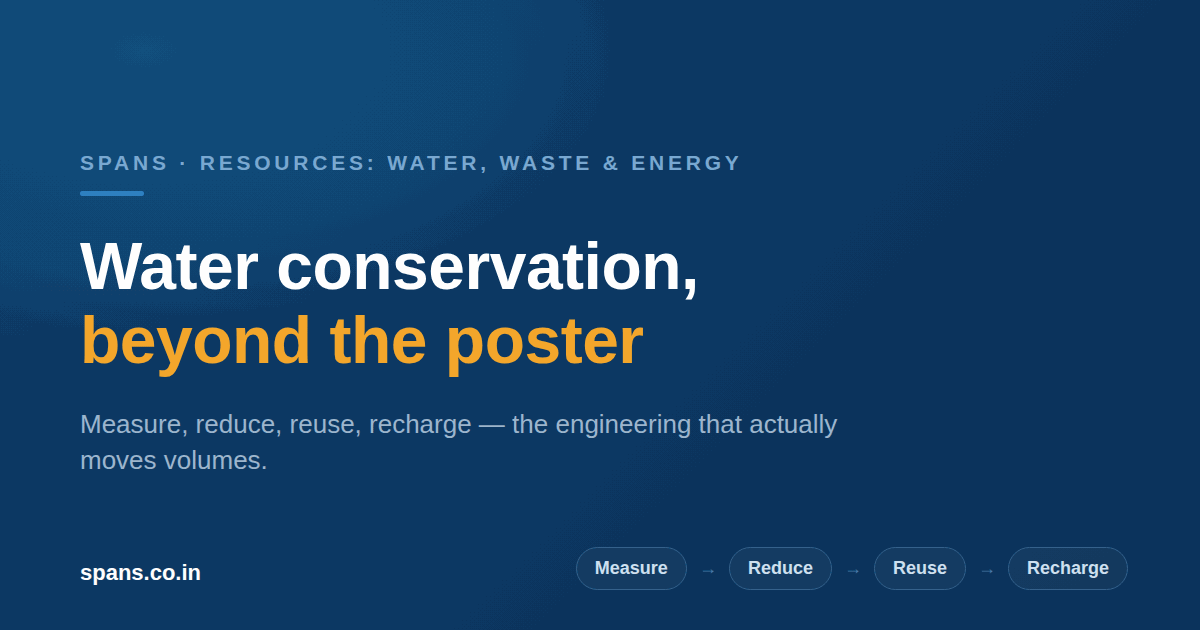
Conservation done well follows a sequence, cheapest and most effective first. Skip a step and you spend money solving a problem the previous step would have shrunk for free.
1. Measure before you touch anything. You cannot conserve a litre you have never counted. Most plants know their total intake and almost nothing about where it goes internally. A water audit — metering the major consumers and drawing a real water balance — is the unglamorous first step that reorders every spend after it, because it tells you which litres are big, which are cheap to save, and which are simply leaking away unaccounted. Conservation that skips the audit is guessing.
2. Reduce the draw. Once you can see the flows, the cheapest litres are the ones you stop using at all. This is efficiency, and in industry it is a handful of specific, high-impact levers rather than vague thrift:
- Cooling tower cycles of concentration. Cooling is the single largest water user on many sites, and running the tower at higher cycles of concentration — reusing the circulating water more times before blowing it down — directly cuts both make-up water and blowdown. It is often the biggest single saving available, gated only by water chemistry.
- Condensate recovery. Steam condensate is hot, near-distilled water. Returning it to the boiler instead of draining it saves water and fuel — one of the best paybacks in the plant.
- Counter-current rinsing in washing and plating lines — cascading rinse water backwards so fresh water enters at the last stage and works its way upstream, cutting rinse consumption dramatically.
- Fixing what leaks and runs unattended — the once-through cooling on a compressor, the hose left running, the float valve that never closed. The audit finds these; a wrench fixes them.
3. Reuse what you cannot avoid using. The water you do consume becomes, after treatment, your cheapest new source. Treating and recycling effluent through RO and polishing for cooling make-up, flushing or process use turns a discharge liability into supply. Even the reject from your own RO can often be cascaded to a lower-grade use before it leaves. This is where the large volumes live, and where India's reuse mandates are pushing bulk consumers anyway.
4. Recharge the balance. What you genuinely cannot reduce or reuse, you offset by putting clean water back — aquifer recharge, metered and sited in the basin you draw from. This is the last step, not the first, because recharging while your process still wastes water is refilling a leaking bucket.
Why the order is non-negotiable
The temptation is always to jump to the visible, capital-heavy step — build a big recycling plant, dig recharge pits — and skip the boring measurement and efficiency work. This gets the economics exactly backwards. Reuse designed on top of an un-reduced process means you build membranes to purify water you should never have used. Recharge claimed while cooling towers run at low cycles is a credit undone by an upstream waste. Every step is cheaper and smaller if the steps before it have done their work first. Measure, then reduce, then reuse, then recharge — in that order, each one shrinks the next.
Why it is now a business case, not a virtue
For years industrial water was effectively free once the borewell was drilled, so conservation stayed a poster. That era is closing. Groundwater now carries a real and rising price: the Central Ground Water Authority charges a water conservation fee that climbs with how much you abstract and how stressed your block is, meters your draw through its portal, and scrutinises renewals. Several states levy per-cubic-metre charges on industrial groundwater. When the meter and the tariff are both real, every unaccounted litre is a recurring line of pure loss, and every litre conserved is money that keeps coming back.
There is a second dividend that is easy to miss: the litres you never use are litres you never have to pump, heat, treat and discharge. Conservation cuts your energy bill and your effluent load at the same time as your water bill. It is one of the few plant interventions that shows up as a saving in three ledgers at once.
Conservation, done properly, is not restraint — it is engineering discipline applied to a resource that used to be treated as free. The plants that do it well are not the ones with the best posters; they are the ones that measured first, fixed the cheap things, reused the rest, and can prove all of it with meters. If you want a second pair of eyes on where your water actually goes and the order in which to attack it, that is a short and worthwhile conversation to have with us, or reach us at [email protected] or +91-98100 00233.
Spans
Spans empowers businesses around the world to grow faster and profitable while using less energy and water.
Visit Site