
UF as RO Pre-Treatment: The Membrane Before the Membrane
There is a quiet rule in membrane engineering that saves more money than almost any other: the cheapest way to protect an expensive membrane is to put a cheaper..
Contents
There is a quiet rule in membrane engineering that saves more money than almost any other: the cheapest way to protect an expensive membrane is to put a cheaper membrane in front of it. Nowhere is this truer than with reverse osmosis. An RO plant lives or dies on the quality of the water it is fed, and the single best thing you can do for it is to hand it clean, consistent feed — which is exactly what an ultrafiltration stage delivers.
Why RO is so fussy about its feed
Reverse osmosis membranes are tightly wound, high-pressure, and unforgiving. Their job is to reject dissolved salts at the molecular scale, and anything larger — suspended solids, colloids, iron, biological matter — does not get rejected cleanly; it accumulates on the membrane surface and fouls it. A fouled RO membrane loses flux, demands higher pressure to push the same water, needs more frequent chemical cleaning, and wears out early. Fouling is the number-one reason RO plants underperform, a theme we cover in membrane fouling and RO troubleshooting.
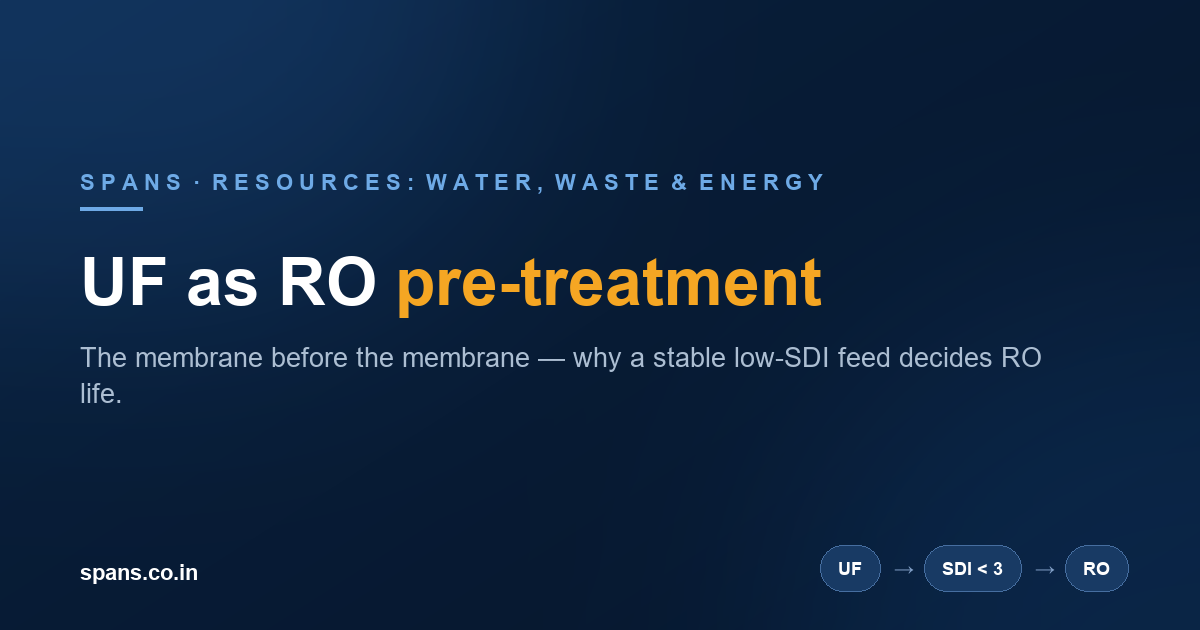
The industry measures this fouling risk with a single number: the Silt Density Index, or SDI. RO membrane makers typically want feed SDI below about 3 to 5. Above that, fouling accelerates and warranties get shaky. So the entire pre-treatment question reduces to: can you reliably keep the RO's feed SDI low, day in and day out, whatever the raw water is doing?
Why the old pre-treatment struggles
The traditional answer was a multimedia (pressure sand) filter followed by cartridge filters. On a good day, with steady, clean-ish feed, that gets you there. The problem is consistency. A sand filter's output quality drifts with the feed — after a rain event, an algae bloom, a slug of colloids, or a swing in a secondary-effluent source, the filtered water's SDI can climb well past what the RO can tolerate, and the sand bed simply cannot guarantee a number. You find out it failed when the RO starts fouling.
Conventional pre-treatment, in other words, is a best-effort barrier. RO needs a guaranteed one.
What UF changes
Ultrafiltration is an absolute physical barrier at roughly 0.01–0.1 micron. It removes suspended solids, colloids, and microbes regardless of how the feed swings, and it produces water with consistently low turbidity and low SDI — comfortably in the range RO wants — even when the raw water is having a bad day. Because UF removes particles but passes dissolved salts, it does not do the RO's job; it protects the RO's ability to do it. On the membrane spectrum, this is the coarse-protects-fine principle in its most valuable form.
The knock-on effects are all in the RO's favour:
- Stable, low SDI feed — the RO fouls far more slowly, so flux holds and pressure stays down.
- Fewer chemical cleans (CIP) — each avoided CIP is chemicals saved, downtime avoided, and membrane life extended.
- Longer RO membrane life — the single most expensive consumable in the plant lasts longer.
- Higher achievable recovery — a cleaner feed lets you run the RO harder without fouling penalties.
- Smaller footprint than deep media trains — a UF skid often replaces several stages of conventional pre-treatment.
Where UF-before-RO earns its keep
It is not mandatory everywhere. On a clean, stable, low-fouling feed — some borewell sources — good conventional pre-treatment can hold SDI fine, and adding UF is belt-and-braces. Where UF pays for itself quickly is exactly where the feed is variable or dirty:
- Surface water — rivers, canals, ponds, with seasonal and weather-driven swings.
- Treated wastewater going to reuse — secondary effluent is biologically active and variable; UF is what makes it safe RO feed.
- Seawater desalination — where aggressive biofouling makes a guaranteed barrier essential.
- Any site where RO fouling is already a recurring headache — UF retrofit is often the fix.
The economics in one line
Adding a UF stage is real capital and a little energy. But it is small money placed in front of big money. The RO membranes, their cleaning chemicals, their downtime and their replacement cycle are the expensive part of a membrane plant; UF spends a modest amount to make all of that last longer and run steadier. Framed as insurance on the RO, it is one of the easier calls in water treatment — which is why the modern default for anything but the cleanest feed is UF ahead of RO.
If you are running an RO that fouls too often, or scoping a new reuse or desalination train and weighing the pre-treatment, that is a worthwhile conversation to have with us — we can look at your feed, your SDI, and whether UF is the fix. Reach us at [email protected] or +91-98100 00233.
Spans
Spans empowers businesses around the world to grow faster and profitable while using less energy and water.
Visit Site