
Tertiary Treatment of Wastewater: Closing the Gap Between "Treated" and "Reusable"
A plant can pass its discharge test and still fail its reuse project. We have watched it happen more than once: the secondary effluent is clear, the lab report ..
Contents
A plant can pass its discharge test and still fail its reuse project. We have watched it happen more than once: the secondary effluent is clear, the lab report is clean, the pollution board is satisfied, and then the cooling tower it was meant to feed starts scaling, or the flushing lines go slimy, or the RO the client bought downstream chokes on its first monsoon. Nothing in the treatment plant broke. What broke was an assumption: that "treated" and "reusable" are the same word.
They are not, and the whole of tertiary treatment lives in the distance between them.
What the three stages are actually for
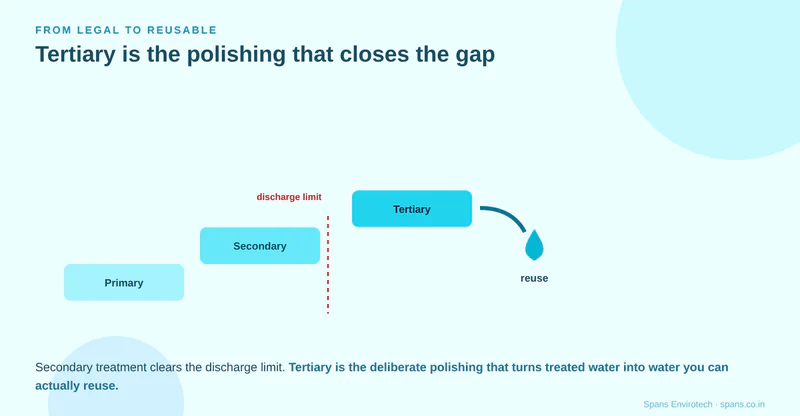
The cleanest way to hold the process in your head is by job, not by tank. Primary treatment removes the solids: grit, settleable matter, floating oil and grease, the material that would otherwise wreck pumps and smother the biology. Secondary treatment removes the dissolved organics, and it does it with biology, aerobic bacteria eating the BOD and COD, whether that biology sits in an activated sludge tank, an MBBR or an MBR. Primary is physics. Secondary is life.
Tertiary is neither of those. It is deliberate polishing. By the time water leaves a well-run secondary stage it is genuinely low in organics, but it still carries fine suspended solids that never quite settled, residual nutrients, a full population of bacteria and viruses, and often a faint colour or trace of dissolved metal. That is exactly the material a discharge norm tolerates and a reuse application will not. Tertiary treatment, sometimes called polishing or effluent polishing, is the stage that goes after those last stubborn contaminants. On Wikipedia you will see it filed under reclaimed water, and that filing is the honest one: tertiary is the stage where wastewater stops being waste you are getting rid of and becomes water you intend to use again.
Why this stage is suddenly the one that matters
For twenty years tertiary treatment was optional in most Indian plants, because the only number anyone was chasing was the discharge limit, and good secondary treatment mostly gets you there. That era is ending. The CPCB effluent and STP standards have tightened, pushing BOD, suspended solids and fecal coliform low enough that disinfection stops being a nicety and becomes part of the base design. And separately, reuse has gone from virtue to obligation: bulk water consumers are being told, in phases, to treat and put a rising share of their wastewater back to work rather than discharge it. You can read the shape of that shift on CPCB's own site, in the way the US EPA frames water reuse as fit-for-purpose rather than one-size-fits-all, and in the way wastewater reuse in India is now written into consent conditions rather than sustainability brochures.
So the demand on the outlet has changed. It is no longer "clean enough to let go". It is "clean enough to trust in a specific piece of downstream equipment". And that is a much harder, much more specific ask.
The methods, and why the list is a menu, not a recipe
The tertiary toolkit is not exotic. Most of it is decades old and well understood:
- Filtration to strip the residual suspended solids. A sand or multimedia filter is the workhorse; where the target is tighter, ultrafiltration membranes take over.
- Adsorption, usually an activated carbon filter, to pull out colour, odour, and trace dissolved organics the biology left behind.
- Disinfection to deal with the pathogens: chlorination, UV, or ozone. Chlorine is cheap and leaves a residual; UV adds nothing to the water and does not create disinfection by-products; ozone is the strongest oxidiser and the most expensive to run.
- Membranes, ultrafiltration and reverse osmosis, when the reuse grade demands low dissolved salts, not just clarity.
The mistake we see is treating that list as a recipe to be followed top to bottom. It is a menu. The entire craft of tertiary design is choosing the shortest train that reaches your actual target, and stopping there.
Match the train to the reuse grade
Here is the idea the whole essay turns on. There is no single "reusable". There are reuse grades, and they are wildly different in what they demand.
Water for horticulture or dust suppression barely needs more than filtration and a modest disinfection step. Water for toilet flushing needs reliable disinfection and enough polishing to stop biofilm and odour, but nobody cares about its dissolved salts. Water for cooling tower make-up suddenly cares intensely about hardness, silica and chlorides, because those drive scaling and corrosion, so now you are looking at a membrane. Water for boiler feed or process use is the strictest of all, and that is where RO on the recycle stream earns its cost. This fit-for-purpose grading is exactly how India's reuse framework is meant to work, and our industrial water reuse guide walks through the same logic in more detail.
The failure mode cuts both ways, and both ways cost money.
Skimp, and the reuse project dies quietly. A plant scopes tertiary as "add a sand filter and a chlorine dose", pipes the water to a cooling tower, and six months later the tower is descaling on a schedule and the plant manager has quietly gone back to fresh water. The tertiary stage was real. It just was not aimed at the right grade.
Over-build, and you bleed cash forever. This is the more seductive mistake. Someone decides that reuse means "as pure as possible", specs a full UF-plus-RO train for water that is only ever going to flush toilets and wash floors, and now the plant is paying membrane replacement and reject-disposal costs, and losing a fifth of its water to RO reject, to make flushing water cleaner than the municipal supply it replaced. Premium is not the same as appropriate.
The right question is never "how pure can we get this water". It is "what is the single most demanding thing we will do with this water, and what is the least treatment that reliably gets us there". Answer that honestly and the tertiary train designs itself.
The part people forget: it has to hold
One more thing, because it is where good designs still fail. Tertiary treatment is only as good as its worst day. A discharge test is a snapshot. A reuse scheme is a promise you make every hour, because a real user, a boiler, a process line, a housing block, is depending on that water continuously. Secondary effluent quality wanders, especially through monsoon dilution and shock loads, and if your filtration and disinfection are sized for the average day, the bad days are the ones that scale the tower or trip the RO. A tertiary treatment plant that reuse depends on has to be designed for the effluent's worst realistic condition, with enough monitoring that you know when you are drifting, not sized for the day the consultant took the sample.
That reframes what tertiary treatment even is. It is not a purity upgrade you bolt onto the end. It is the point at which your plant stops making an effluent and starts making a product, and a product has a customer with a specification. The specification is the design. Everything upstream of it, all the filtration and adsorption and disinfection, is just the means.
Get the grade right and tertiary treatment is the cheapest water your site will ever buy, because you already paid to clean it once. If you are weighing a reuse scheme and are not sure which grade you actually need, that is precisely the conversation worth having before the first pump is specified, and it is one we are always happy to have.
Spans
Spans empowers businesses around the world to grow faster and profitable while using less energy and water.
Visit Site