
Why Most STP Maintenance Schedules Fail Before the Plant Does
Ask any STP operator what "maintenance" means and you will usually get a shrug: check the panel, log a couple of numbers, top up the chlorine. Ask for the maint..
Contents
Ask any STP operator what "maintenance" means and you will usually get a shrug: check the panel, log a couple of numbers, top up the chlorine. Ask for the maintenance schedule and most plants hand you one list, one frequency, done daily or done never. That single list is the actual bug in most STP operations, not any particular piece of equipment.
An STP is not one system running at one speed. It is several systems layered on top of each other, each drifting at its own pace, and a maintenance plan that treats them all the same is guaranteed to check the wrong things too often and the right things too rarely.
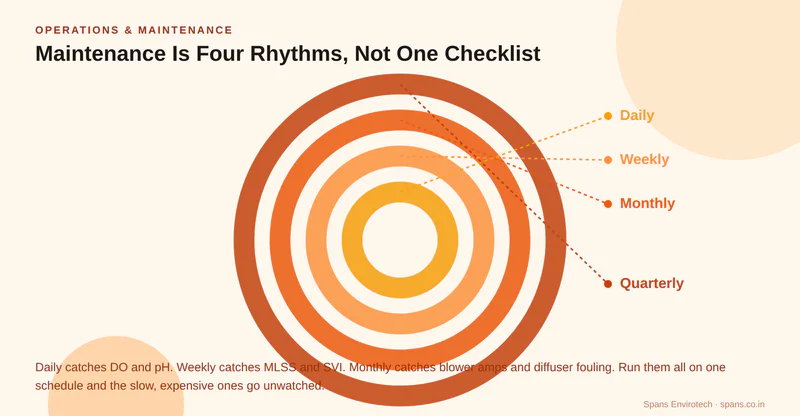
Four speeds, not one list
Some things at a plant change within hours. Dissolved oxygen in the aeration tank, the colour and smell of the mixed liquor, chlorine residual at the outlet: these move fast enough that a daily walk-through and a jar test on settled sludge catch a problem while it is still cheap to fix.
Other things drift over a week. Mixed liquor suspended solids and the sludge volume index tell you whether your biomass is healthy or heading toward bulking, but they do not move enough in a day to be worth checking daily. A weekly reading, tracked as a trend rather than a single number, is what actually catches a slide before it becomes a bulking event.
Then there is a slower layer that most schedules skip entirely: blower amperage trends, air diffuser back-pressure, pump vibration. These move over months, and because nobody is watching them on any fixed schedule, the first signal anyone notices is usually the power bill, by which point the diffusers are already significantly fouled and the blower has been working harder for the same air for weeks. We've walked into plants where the blower amperage had crept up 15 percent over four months and nobody had looked, because nobody's schedule had a monthly line item for it.
And finally there is the annual layer: gearbox oil changes, sensor recalibration, tank desludging, structural inspection of civil works. Miss this layer and nothing looks wrong for a long time, which is exactly the trap.
Why the wrong frequency is worse than no schedule
A plant with no maintenance schedule at least knows it is flying blind. A plant with one undifferentiated schedule, everything checked weekly or everything checked "as needed", is worse off in a specific way: it creates false confidence. Someone is signing a logbook every week, so on paper the plant looks maintained. But a weekly check on something that moves in hours misses the failure entirely, and a weekly check on something that moves over months is just noise dressed up as diligence.
This is the same mistake as checking your bank balance every hour and your retirement account never, just relabelled for a treatment plant. The parameters that actually threaten the plant (biomass health, energy creep, mechanical wear) move slowly enough to hide from casual attention and fast enough to be expensive once they surface. Matching the checking frequency to the actual speed of drift is not a nicety. It is the entire job of preventive maintenance, and it is a genuinely different skill from running the plant day to day.
Nobody's job description says "check the diffusers"
There is a reason the slow layer gets skipped even at plants with a conscientious operator on site. The daily items have an obvious owner: whoever is on shift reads the DO meter and logs it, because that is plainly part of running the plant. The monthly and annual items do not have that natural owner. Checking blower amperage trends is not "running the plant", it sits somewhere between operations and maintenance, and at most sites it belongs to neither, so it belongs to nobody. It only happens if someone has explicitly assigned it, with a name and a date next to it, the same way payroll or safety audits get assigned.
This is an incentives problem before it is a technical one. An operator paid to keep the plant running today has no reason to spend an hour opening a blower casing to inspect a diffuser that is not visibly causing a problem yet. The person who eventually pays for that gap, in a higher power bill or a mid-life blower replacement, is rarely the person who had the chance to catch it. Fixing this does not need new instrumentation. It needs the slow layer written down as somebody's explicit, named responsibility, with a date, the same way the daily layer already is.
What this looks like in practice
Split the schedule into the four layers explicitly, rather than one combined list:
- Daily: visual inspection, DO, pH, chlorine residual, a settled sludge jar test.
- Weekly: MLSS and SVI, sludge age, a look at whether return activated sludge rates still match what the biomass needs.
- Monthly: blower amperage and running hours, diffuser back-pressure if it can be measured, pump vibration, a proper energy check rather than a glance at the meter.
- Quarterly or annual: gearbox and bearing service, diffuser cleaning or replacement, sensor calibration against a known standard, tank and civil structure inspection.
None of this is expensive to run. It is expensive to skip, because the cost of catching diffuser fouling at month four is a cleaning cycle, and the cost of catching it at month fourteen is a blower replacement plus a year of inflated power bills that nobody can fully account for after the fact. If you want the fuller picture on where that energy actually goes, our ETP energy audit guide and reducing ETP OPEX explainer both start from the same premise: most of the waste is slow and invisible until someone bothers to look at the right frequency.
The plants that run cleanly for years are rarely the ones with the newest technology. They are the ones where somebody decided, deliberately, that the blower gets checked monthly whether or not anything seems wrong, and stuck to it. That is a boring thing to get right and a very expensive thing to get wrong.
If your last three months of blower amperage or diffuser readings would genuinely surprise you either way, that's worth a short conversation before it becomes a bigger one. You can reach our team at spans.co.in/contact.
Spans
Spans empowers businesses around the world to grow faster and profitable while using less energy and water.
Visit Site