
STP for Apartments: The Part Builders and RWAs Forget Is Running It
Walk into a two-year-old gated community and ask the security guard where the sewage treatment plant is. He will point you to a corner near the boundary wall, p..

Contents
Walk into a two-year-old gated community and ask the security guard where the sewage treatment plant is. He will point you to a corner near the boundary wall, past the visitor parking, and often you can find it with your nose. That smell is the single most reliable diagnostic in our line of work. A sewage treatment plant for apartments that smells is a plant that has stopped being a plant. It has quietly reverted to what it was before anyone installed anything: a holding tank for sewage, now with expensive machinery bolted on top.
This is the strange thing about STPs in residential real estate. The hardware almost always gets built. The builder needs it to clear the completion certificate, the pollution board consent hangs on it, the brochure promises "100% water recycling." What gets skipped is the only part that matters, which is running the thing after the trucks leave and the sales office shuts.
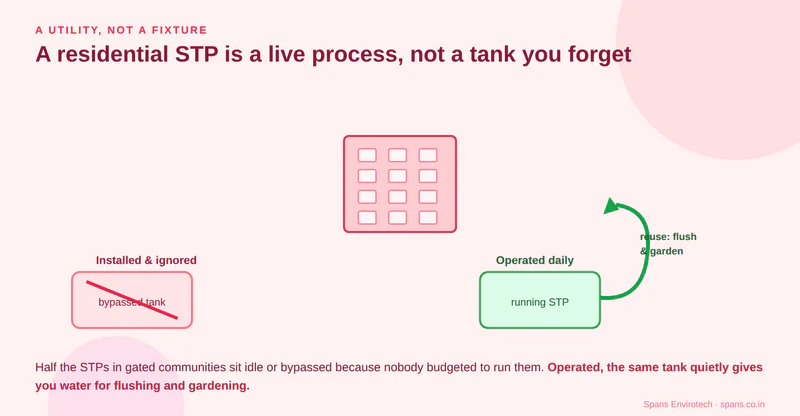
The plant is not the point. The process is.
Here is the confusion at the root of it. A sewage treatment plant for a residential building looks like a fixture. It is grey concrete, blowers, pumps, a control panel. Fixtures are things you install and forget: a lift, a transformer, a water tank. You commission them and they sit there doing their job.
An STP is not that. It is a small biological process that you have to keep alive, every single day, the way you keep a stomach alive by feeding it. The actual treatment is done by microbes, billions of them, growing on media or suspended in the aeration tank. They need air, they need a steady diet of sewage, they need someone to not shock them with a slug of bleach from the housekeeping store. Starve them, drown them, or forget to run the blower over a long weekend, and the population crashes. When it crashes, the plant does not gently degrade. It stops treating, full stop, and the tank turns septic. If you want to see how the biology actually earns its keep, we have written up how an STP works step by step; the short version is that everything downstream depends on that living sludge staying healthy.
So the real question a builder or an RWA should be asking is not "have we installed the STP" but "who is running it on the third Sunday of the monsoon." Those are completely different questions, and almost every problem we get called for lives in the gap between them.
Yes, it is probably mandatory. No, that is not why to run it.
People ask us constantly whether an STP is mandatory for apartments. The honest answer is: it depends on where you are building, and the threshold keeps moving. There is no single national flat-count that switches the requirement on. Most states tie it to the number of dwelling units or the built-up area, and they set the number through local building bye-laws and pollution board directions, not one central rule. Karnataka, for instance, revised its position so that societies below a certain unit count are no longer forced to build one. Other cities pull the threshold the other way. What is genuinely uniform, under the Water Act administered through the pollution boards, is that you cannot let untreated sewage leave your premises into a drain or a lake. That prohibition does not have a flat-count exemption.
The trap is treating the mandate as the reason. A builder who builds an STP only because a rule says so builds the cheapest box that will pass inspection, hands the keys to an RWA with no operating budget, and walks away. The National Green Tribunal has fined enough societies for dead STPs and untreated discharge that the compliance risk is real and personal to the residents, not the departed developer. But compliance is a floor, not a purpose. The societies whose plants run well are the ones that figured out the STP was giving them something they wanted anyway.
The size question, and why it is not about flats
"What size STP do we need" usually gets answered in flats, and that is the first mistake. Sewage volume tracks people and their water use, not doors. The design norms our public health engineering manuals use start from water supply per person per day and assume most of it returns as sewage. A three-BHK housing a family of six generates very differently from an identical flat a broker runs as an Airbnb. Get the occupancy assumption wrong and you either oversize the plant, so the biology starves at low load, or undersize it, so it chokes at peak. If you want a defensible starting number before an engineer sizes it properly, our STP capacity calculator will get you into the right range in KLD.
Technology matters here too, because some processes forgive an inconsistent operator better than others. A residential load swings hard: near zero at 4 a.m., a spike at 8 a.m., another in the evening. Compact attached-growth systems such as MBBR hold their biomass on plastic media, so they ride out load swings and short operator lapses better than a plant depending on perfectly managed suspended sludge. For an asset run by whoever the RWA can afford, robustness beats theoretical efficiency.
Where the money actually goes
The cost conversation is always about capex, the lakhs to build the plant, and this is exactly backwards. Building the sewage treatment plant is a one-time number. Running it is forever: power for the blowers, a trained operator or an AMC, consumables, desludging, media upkeep. Over a plant's life the operating spend dwarfs the build, and the headline for a residential society is simple. The STP that looked expensive to build is cheap to build and expensive to ignore.
And ignoring it is the default failure mode. The plant runs beautifully for the first year while the builder's contractor is still around, then the AMC lapses, the sole operator quits, nobody replaces the diffusers, and within a season the community has a smelly, bypassed tank and a notice from the board. This is why "STP maintenance" and "STP AMC" are the searches that matter more than the ones about installation. The installation is a solved problem. The operation is the unsolved one.
Run it, and it pays you back
A well-run STP is not a cost centre you tolerate for compliance. It is a small water utility you happen to own. Modern townships and commercial buildings are plumbed dual from day one, one line for fresh water and one for treated, so the STP's output can go straight to flushing, gardening and the car wash. In a Bengaluru or Gurugram summer, that reclaimed water is the difference between calling tankers and not. A decentralised STP that actually runs can cover a large share of a society's non-potable demand, which is the whole logic behind India's growing push on treated wastewater reuse that the environment ministry has been nudging cities toward for years. The same tank, treated as an operated asset instead of a completion-certificate fixture, stops being the smelly corner and starts being the reason the borewell lasts another decade.
That is the whole idea. The STP you install clears a certificate. The STP you run gives you water. They are the same concrete box, and the only variable is whether someone is genuinely accountable for it on that third rainy Sunday.
If your society's plant is closer to the smell than the water, it is usually fixable, and the fix is almost never demolishing and rebuilding. It is getting the biology and the operating routine back. That is a conversation we are happy to have, so do get in touch if you want a second opinion on a plant that has stopped earning its keep.
Spans
Spans empowers businesses around the world to grow faster and profitable while using less energy and water.
Visit Site