
The SPCB Compliance Audit Is Won in Your Logbook, Not on Inspection Day
We have watched this happen more times than we can count. A plant with a genuinely good effluent treatment plant, clean outfall, numbers well inside limit, gets..
Contents
We have watched this happen more times than we can count. A plant with a genuinely good effluent treatment plant, clean outfall, numbers well inside limit, gets a show-cause notice after an inspection. Meanwhile a shabbier unit two kilometres away, with an ETP held together by faith and a spare pump, sails through. The first plant's operators are baffled. They were compliant. Their water was clean. What went wrong?
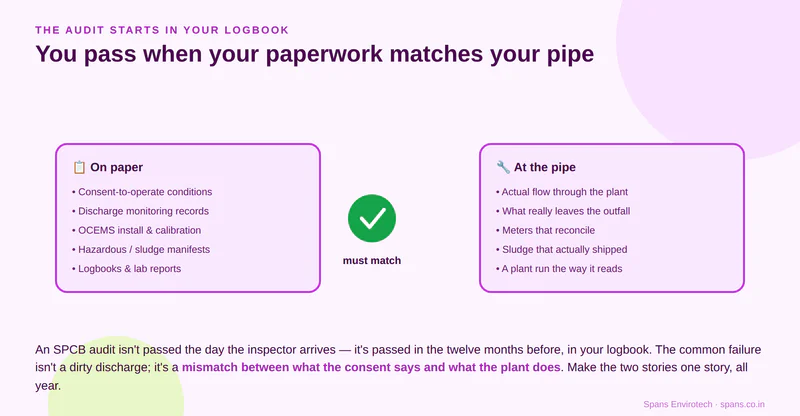
What went wrong is that an SPCB compliance audit is not, at heart, a test of your water. It's a test of whether your plant tells the same story on paper as it does at the pipe. The inspector who walks in isn't primarily there to be surprised by your effluent. They can read a lab report. They're there to check that the plant described in your Consent to Operate, the plant recorded in your logbooks, the plant reporting through your online monitoring, and the plant actually standing in front of them are all the same plant. When those four stories diverge, you fail, even if the water was fine.
So the single most common failure in a pollution control board audit isn't a dirty discharge. It's a mismatch. And the uncomfortable implication is that the audit is not passed on the day the inspector arrives. It's passed or failed in the twelve months before, one logbook entry at a time.
What the inspector is actually reconciling
A consent to operate audit is really a reconciliation exercise rather than a water test, and once you see it that way, the whole thing gets less terrifying. Here is what actually gets reconciled.
It starts with your consent conditions versus reality. Your CTO is a specific legal document. It names a permitted production quantity, a permitted effluent volume, a set of discharge parameters, a treatment scheme, sometimes a mandated technology. The first thing an audit does is hold that document up against the plant. Are you producing more than the consent allows? Discharging more litres than it permits? Running a treatment train different from the one you got consent for? A plant that quietly doubled production without amending its consent has already failed, and no amount of clean water fixes it, because the offence is operating outside the four corners of the permission. This is exactly why the consent process and its conditions deserve to be read line by line, not filed and forgotten.
Then come the monitoring records. Your discharge monitoring reports, your third-party lab analyses, your internal test sheets, and the inspector wants a continuous, dated trail showing you knew your own numbers all year, not just this week. Here's the tell they look for: a logbook that was clearly filled in the night before. Identical handwriting for three months, readings that never vary, pH logged to two decimals every single day at exactly 9 a.m. including the day the plant was shut for maintenance. Fabricated consistency is more damning than an honest bad day, because it proves the records aren't real. And if your consent is written against the applicable effluent discharge standards, your records have to demonstrate you were tracking against those specific numbers, which, as we've argued elsewhere, are often stricter than the general standards everyone assumes apply.
The OCEMS trap and the flow-meter trap
Two places where mismatches hide in plain sight deserve their own mention.
The first is your online continuous emission/effluent monitoring system. For most red-category and many orange-category plants, OCEMS reporting straight to the SPCB and CPCB servers is now a consent condition, not a nicety. The audit checks not just that it's installed but that it's calibrated, that its calibration certificates are current, and (the part plants forget) that its data trail hasn't got suspicious gaps. A sensor that goes offline every time a value spikes tells its own story. The board can already see your OCEMS feed before the inspector ever arrives; if your logbook says one thing and the national monitoring pipeline at CPCB recorded another, you've handed them the mismatch yourself.
The second is flow. Your influent and effluent flow meters have to reconcile: with each other, with your production, with your water consumption, and with your consented volume. If you're drawing far more water than your effluent flow can account for, where did it go? If your effluent flow exceeds your consent, why? A plant category is itself pegged to scale and pollution load under the red-orange-green-white classification, so a flow figure that quietly outgrew your category is a flag that invites a harder look at everything else.
Then there's the waste that leaves in trucks, not pipes. ETP sludge and other hazardous streams generate manifests, and those manifests have to add up: sludge generated should be consistent with the effluent load you treated, and every consignment should have a matching record from an authorised disposal facility. A plant treating lakhs of litres a month that somehow generates almost no sludge is not a miracle of efficiency. It's a question the auditor will ask, and one that's hard to answer well. Where DG sets and air emissions fall under the same consent, the same logic applies: stack monitoring records, DG hours, fuel consumption, all reconciling. And yes, plain housekeeping counts too, because an inspector reads a leaking gland and an oil-stained floor as evidence about the records they can't directly see.
Being audit-ready is cheaper than getting audit-ready
Everything above is checkable any Tuesday, by you, without an inspector present. That is the whole opportunity.
Most plants treat the audit as an event: a week of panic, a scramble to backfill logbooks, a frantic lab run, a deep-clean. That approach is expensive, stressful, and, worst of all, it produces exactly the too-perfect records that auditors are trained to distrust. The alternative is to stop preparing for audits and simply stay permanently audit-ready: log honestly and daily, calibrate on schedule, reconcile flow and sludge monthly, keep your consent open on your desk rather than in a drawer. Run your own quiet internal audit each quarter, the same reconciliation the SPCB does, and fix the mismatches while they're small. It's the same discipline that makes an ETP energy audit pay off: the plant that measures itself continuously is never surprised by what someone else measures.
None of this asks for a fancier effluent treatment plant. The plants that clear audits aren't the ones with the most expensive hardware; they're the ones whose paperwork matches their pipe. The whole regulatory architecture, from the Ministry down through CPCB to your state board, is ultimately just asking one question: does this plant do what it says it does? Make your two stories, the one on paper and the one at the outfall, into a single true story, and keep it that way all year. Then the inspector's visit stops being a verdict and becomes what it should be, a formality.
Running that quiet internal reconciliation each quarter, ideally with a second set of eyes, is the cheap version of all this. Finding your own mismatches is always cheaper than having them found for you.
Spans
Spans empowers businesses around the world to grow faster and profitable while using less energy and water.
Visit Site