
The Cheapest Part on Your Spares List Can Be the One That Shuts the Plant Down Longest
Most spare parts lists at an ETP or STP get built the same way: someone goes through the equipment list, flags the expensive items and the obviously critical on..

Contents
Most spare parts lists at an ETP or STP get built the same way: someone goes through the equipment list, flags the expensive items and the obviously critical ones (the main blower, the duty pump, the MCC), and stocks spares for those. It produces a tidy, defensible inventory, and it misses the part of the question that actually determines how long the plant stays down when something fails, which has very little to do with price or how important the equipment looks on an org chart.
The question a spares list usually answers, and the one it needs to
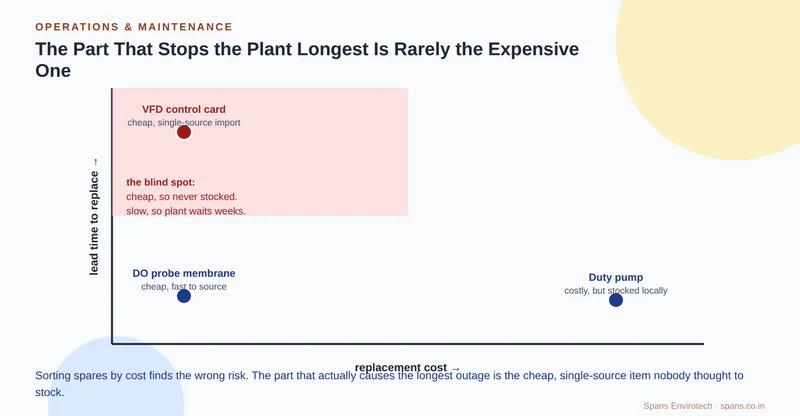
A cost-sorted or criticality-sorted spares list is really answering "what would be expensive or embarrassing to lose." The question that determines actual downtime is different: for each part, how long does it take to get a replacement into the plant once it fails. Those two rankings overlap less than most procurement teams assume. A duty pump is expensive and clearly critical, and it is also usually a standard frame size available from more than one local distributor within days. A VFD control card matched to a specific drive firmware revision, a particular DO probe's membrane cartridge, or a gearbox-specific bearing in an odd metric size can be cheap enough that nobody thought to stock it, and can also take eight to twelve weeks to import if the local market does not carry it, because it is a low-volume, single-source item rather than a commodity part.
This is the same error we described in the piece on standby generator sizing: a calculation that is internally correct, run against the wrong question. Ranking spares by replacement cost is not a wrong calculation. It is a correct answer to a question that is not the one a maintenance manager actually needs answered, which is not "what is this part worth" but "how many days will the plant run degraded or offline waiting for it."
Why the gap stays invisible until it matters
The mismatch between cost-based ranking and lead-time-based ranking does not show up in a spares audit, because an audit typically checks whether the list exists and whether stock matches it, not whether the list was built against the right risk. It shows up the first time a low-cost, long-lead part fails on a piece of equipment nobody flagged as a priority, and the plant discovers that the part sitting in the stores for eight weeks of waiting is not the expensive pump everyone worried about, but a twelve-dollar sensor component that happens to be sourced from a single overseas supplier. The failure itself might be minor. The consequence is not, because a process that depends on that sensor's reading, a dosing loop, an interlock, a compliance monitor, now runs blind or gets bypassed for as long as the part takes to arrive, and bypassing a safety or compliance interlock for two months is a materially different risk than the part's purchase price would suggest.
Plants that run a formal reliability-centred maintenance programme or a structured failure mode and effects analysis usually catch this, because those methods explicitly separate the consequence of a failure from the probability and the recoverability of it, rather than collapsing everything into one criticality score. Most plants running on an informal spares list built from purchase history do not make that separation, and the gap is exactly where the twelve-dollar part with the eight-week lead time hides.
Picture a plant where the online ammonia analyser feeding the aeration blower's dissolved-oxygen control loop uses a proprietary flow cell gasket available from exactly one supplier abroad. The analyser itself was never on anyone's critical spares list, because next to the blowers and the main transformer it looks like a minor instrument, cheap to replace and easy to overlook. The gasket fails, the analyser reads erratically, and the plant drops the loop into manual control while the replacement part makes its way through customs. Manual control is not a crisis by itself, operators run plants manually all the time, but six weeks of manual dosing on a stream with genuinely variable influent load is six weeks of wider process swings than the automatic loop was bought to prevent, and nobody planned for that because nobody had asked how long the gasket takes to arrive until the day it failed.
What actually changes the stocking decision
The fix is not stocking more of everything, which just moves the cost problem from downtime to working capital tied up in a storeroom. It is adding lead time as its own axis in the stocking decision, independent of both price and general equipment importance. For every part on a plant's equipment list, the relevant question becomes: if this fails today, how many sourcing days stand between the failure and a working replacement, and does the plant have a reasonable substitute, a local fabrication option, or a generic equivalent in the meantime. A part that scores high on consequence and high on lead time is the one that belongs in the stores regardless of how little it costs. A part that scores high on consequence but low on lead time, because three vendors in the same city stock it, can often be left to order-on-failure without materially increasing downtime risk, freeing up stores budget for the parts that actually need it.
This reframes what a spares audit should be checking. Not "do we have stock matching our list" but "did we build the list against lead time risk or against price," because a list built the second way will pass every internal audit while still leaving the plant exposed to exactly the failure mode that caused the longest outage last time. The practical first step is less about the stocking policy and more about the data: pulling actual supplier lead times, not assumed ones, for the parts on single-source or import-dependent equipment, since the assumption that "it's just a sensor, it can't be that hard to get" is usually wrong by a factor of weeks rather than days. A review of a plant's O&M practices more broadly, the kind we covered in why most STP maintenance schedules fail before the plant does, tends to surface the same lead-time blind spot once someone actually goes looking for it, because scheduling discipline and stocking discipline are usually weak or strong together.
None of this requires new software or a major process overhaul, mostly a half-day exercise re-sorting an existing spares list by a question nobody asked it before. If your plant's spares list has never been checked against actual supplier lead times rather than assumed ones, that is a conversation worth having with Spans' operations team before the next failure picks the part for you.
Spans
Spans empowers businesses around the world to grow faster and profitable while using less energy and water.
Visit Site