
Soft Starter vs VFD: The Panel Schedule That Taught Us the Difference
A centrifugal blower running at 80 percent of its rated speed draws roughly half its rated power. That one fact, the cube law buried in the affinity laws, is th..
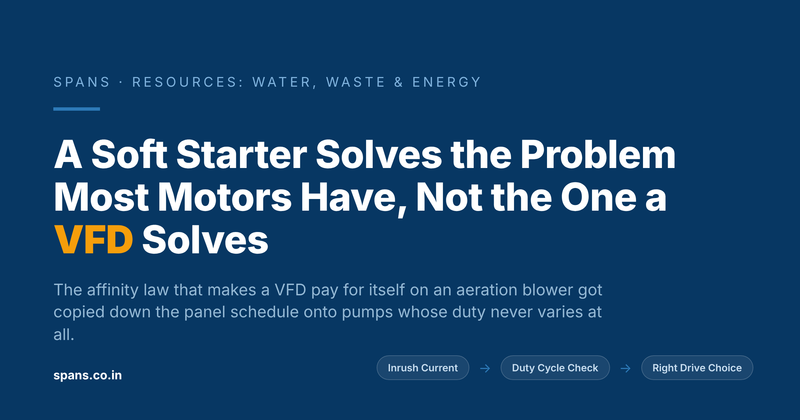
A centrifugal blower running at 80 percent of its rated speed draws roughly half its rated power. That one fact, the cube law buried in the affinity laws, is the entire economic case for putting a variable frequency drive on an aeration blower. It is also, we've noticed, the fact that quietly justifies a VFD on every other motor on the panel schedule, whether or not that motor's duty has anything to do with speed.
We've reviewed enough electrical BOQs for ETPs and STPs to recognise the pattern. Someone specifies a VFD for the blower, correctly, because aeration demand swings with influent BOD and time of day and the energy saved by slowing the blower down at 2 a.m. is real money over a plant's life. Then the same line item gets copied down the schedule: VFD for the RAS pump, VFD for the sludge transfer pump, VFD for the dosing pump, sometimes even for a screw conveyor that runs at one speed for twelve hours a day and stops. By the time the panel is built, half the starters on it are VFDs that never leave 100 percent output, bought to solve a problem none of those motors actually has.
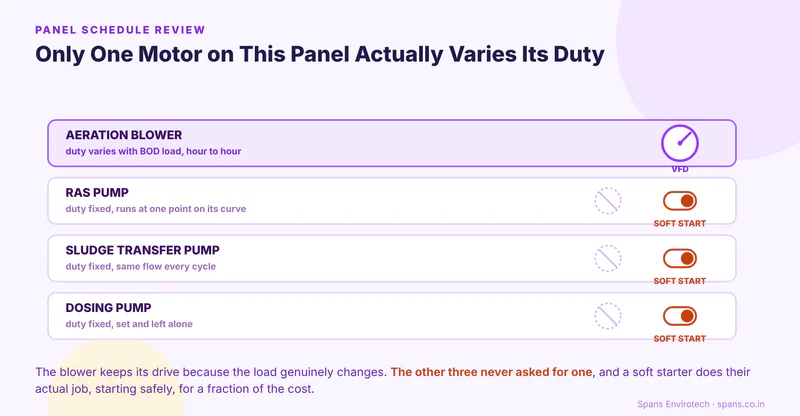
The problem a VFD solves is variable duty: a load whose demand genuinely changes enough, often enough, that running at part speed saves meaningful energy. The problem most plant motors actually have is a different one entirely: a motor that draws six to eight times its running current for a second or two at start, stresses the coupling and the pump shaft every time it does, and needs that inrush managed so the breaker doesn't trip and the mechanical drivetrain doesn't fatigue early. That is a starting problem, not a speed problem, and a reduced-voltage soft starter solves it for a fraction of the capital cost, without the harmonics, without the extra panel cooling load, and without the two to four percentage points of conversion loss a VFD carries on every kilowatt it passes through, quietly, for the motor's entire service life.
The efficiency gap is the part that gets missed, because nobody puts it on the energy audit. A soft starter, once the motor is up to speed, gets out of the circuit entirely, typically bypassed by a contactor, so the motor runs at the same efficiency it would on a direct line. A VFD never gets out of the circuit. It is switching the full load current through power electronics for as long as the motor runs, and that switching has a cost measured in heat, typically putting VFD efficiency somewhere in the mid-90s against a soft-started motor running close to its nameplate figure. On a blower that gets slowed down for ten hours a day, that loss is easily repaid by the energy saved during the other fourteen. On a sludge pump that runs flat out whenever it runs, there is no part-speed saving to repay anything, and the plant has simply bought itself a permanent two or three percent tax on that motor's running cost, on top of the extra capital.
There is a second cost that shows up later, usually on someone else's maintenance budget. VFDs generate harmonic distortion on the supply side and, on long cable runs between the drive and the motor, reflected-wave voltage spikes that have been known to pit motor bearings and stress insulation over years of operation, especially where the cable run from drive to motor is longer than the manufacturer's unmitigated limit. None of this is fatal if the design accounts for it, output reactors and proper cable selection handle it, but it is one more thing to specify, commission and eventually troubleshoot, for a motor that was never going to run at anything but full speed anyway. A soft starter has none of this downstream baggage, because once it steps out of the circuit, the motor is back to being a plain induction motor on a plain supply.
None of this is an argument against VFDs. It's an argument for asking, before the line item goes into the BOQ, whether this particular motor's duty actually varies enough to make speed control worth its cost. Aeration blowers almost always pass that test, because oxygen demand genuinely tracks organic load and the energy at stake is the single largest line item on most plants' power bill. A feed pump moving flow between two tanks at a site with real diurnal variation can pass it too, if someone actually checks the flow profile rather than assuming it. RAS pumps, sludge transfer pumps, dosing pumps and most conveyors, by contrast, are usually sized to run at one point on their curve and stay there, which means the honest answer for them is a soft starter and a saved line item in both capital cost and lifetime energy.
We bring this up because we keep seeing the same instinct play out the other way on site visits: a plant with three or four VFDs quietly parked at 100 percent output since commissioning, next to a panel schedule that priced them as if they were saving energy. The fix costs nothing to specify correctly the first time and quite a lot to unwind afterward, since swapping a VFD for a soft starter after the panel is built means new wiring, a new starter enclosure, and a shutdown window nobody budgeted for. If you're reviewing a panel schedule and want a second opinion on which motors actually earn their drive, our engineering team is happy to look at the duty profile with you before the order is placed, not after.
The affinity law that makes a VFD pay for itself on a blower is real, and it's worth building the whole electrical philosophy of a treatment plant around: speed control for the motors whose load genuinely varies, a soft starter for everything else. The Bureau of Energy Efficiency publishes guidance on this exact trade-off for industrial motors, and the broader mechanics of why a variable-frequency drive behaves the way it does are well documented if you want the electrical theory behind the rule of thumb. What's less documented, because it only shows up on a plant's actual power bill and maintenance log, is how much of an energy audit gets spent explaining why a drive that was supposed to save money has been running at full output since the day it was commissioned. Reviewing the panel schedule against the actual duty cycle before ordering, covered in more detail in our guide to reducing ETP operating costs, is cheaper than reviewing it after. Our guide to design decisions that quietly inflate energy cost covers the same instinct applied to the rest of the plant, and our ETP energy calculator is a reasonable first pass if you want to size the question before you call anyone.
A motor that never changes speed was never going to repay a variable frequency drive. The affinity law only pays out on the motors whose load actually varies, and the discipline worth keeping is checking which ones those are before the panel schedule gets drawn, not after the invoice for the drives arrives.
Spans
Spans empowers businesses around the world to grow faster and profitable while using less energy and water.
Visit Site