
Chlorinating a Bulking Sludge Treats the Filament. It Never Touches What Grew It.
A bulking tank announces itself clearly enough: the sludge blanket climbs the clarifier, effluent turns cloudy, the sludge volume index creeps past the number t..
Contents
A bulking tank announces itself clearly enough: the sludge blanket climbs the clarifier, effluent turns cloudy, the sludge volume index creeps past the number that used to mean trouble, and somewhere on the plant WhatsApp group someone asks who is dosing chlorine today. It is the most reached-for fix in the entire operations playbook, cheap, fast, and genuinely effective often enough that it has become the default response rather than one option among several. Dose the aeration tank or the return sludge line with a controlled amount of chlorine, the filamentous bacteria causing the poor settling take the worst of it, the sludge compacts again within a day or two, and the plant moves on.
What rarely gets asked, because the fix worked and the number went back down, is what actually grew those filaments in the first place. Chlorination kills a population. It does nothing whatsoever to the operating condition in the tank that selected for that population over the ordinary floc-forming bacteria, which means the condition is still sitting there, waiting to grow the next batch of filaments the moment the chlorine residual clears.
One symptom, at least six different causes
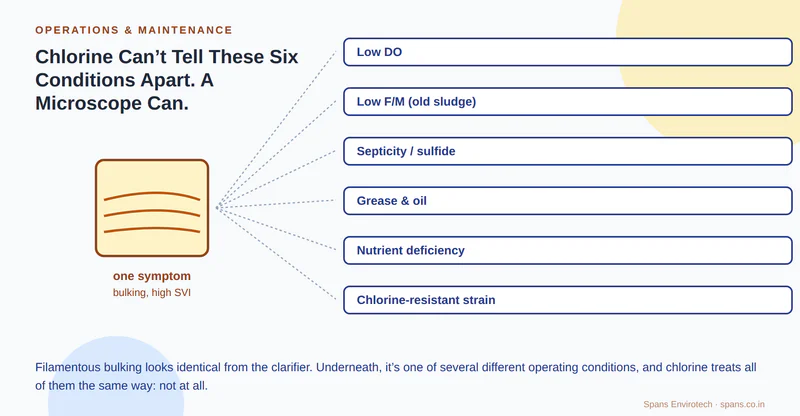
Filamentous bulking looks like a single problem from the control room: high SVI, a sludge blanket that will not settle, effluent that carries more solids than it should. Under a microscope it is not one problem at all. Low dissolved oxygen in the aeration tank favours filament species that tolerate low-oxygen conditions better than ordinary floc-formers. A low food-to-microorganism ratio, meaning the sludge is being starved relative to its population because the sludge age has crept too high, favours an entirely different set of filaments adapted to scavenge scarce substrate. Septic conditions upstream, sulfide reaching the aeration tank from anaerobic zones in the collection system or a poorly aerated equalisation tank, select for yet another group. Grease and oil in the feed, nutrient deficiency in a high-strength industrial effluent short on nitrogen or phosphorus relative to its organic load, each has its own characteristic filament response, and each looks, to an operator watching the clarifier from above, like exactly the same bulking event.
This matters because chlorination addresses the filament, not the condition, and the condition is different in every one of those cases. A plant that chlorinates its way through a low-DO bulking event and then goes back to running the same aeration setpoint has fixed nothing; it has reset a counter that the same condition will trip again. The chemistry worked. The diagnosis never happened.
Picture a plant that bulks every six to eight weeks, reliably enough that the operations team has stopped treating it as an incident and started treating it as routine maintenance: chlorinate, wait a day, move on. Nobody has looked at the sludge under a microscope in over a year, because the chlorination always works well enough that nobody has had a reason to. What that team cannot see, because they have never asked the question in a form that would reveal it, is whether the same filament is recurring because the underlying sludge age has been quietly climbing for a year, or whether it is three or four different filaments taking turns, each responding to the same chlorine dose because none of them happen to be resistant yet. Both produce the identical symptom and the identical fix. Only one of them is a single operating parameter away from actually stopping.
Why the same fix sometimes just stops working
The second complication is that chlorination's effectiveness is not even constant across filament types. Documented chlorine-susceptible and chlorine-resistant strains of the same filament species exist side by side in the literature; the type 021N filament, one of the more common offenders in nutrient-deficient or low-F/M conditions, has been documented maintaining cell integrity at chlorine dosages that would knock back a more sensitive strain without issue. A plant that successfully chlorinated its way out of a bulking event last year has no guarantee that this year's event, triggered by a different underlying condition and populated by a different, possibly resistant filament, will respond to the same dose. The usual operator response to a chlorination that does not work is to increase the dose, which risks exactly the collateral damage chlorination is known for: killing off the nitrifying bacteria the plant depends on for ammonia removal, bacteria that are considerably more sensitive to chlorine than most filaments and considerably slower to recover once knocked back.
What actually breaks the cycle
None of this is an argument against chlorination as a tool. Used as a short-term knockdown while the real cause gets identified and corrected, it is a legitimate, standard part of the response. The step that is too often skipped is the one that costs almost nothing and takes an afternoon: a microscopic examination of the sludge, which does not require exotic equipment, just a lab microscope and a trained eye, to identify which filament is actually present and cross-reference it against the handful of known operating conditions that select for it. That single step turns "the sludge is bulking again" into "the sludge age has drifted too high for the current loading," which is an actionable, fixable statement, where the first one is not.
Once the condition is identified, the fix is almost always a return to correct operating parameters rather than another chemical intervention: adjusting dissolved oxygen setpoints, correcting the sludge age through the wasting rate, addressing septicity upstream, balancing nutrient dosing against the actual organic load. None of these corrections cost anything beyond operator time and a short period of closer monitoring while the sludge population shifts back, typically a sludge age or two, considerably cheaper than another six-weekly chlorination cycle and the chemical cost, nitrifier risk, and operator time that comes with it. These are the same operating fundamentals covered in our guide to the activated sludge process and in what MLSS is actually telling you, and a bulking event is, more often than operators treat it, the sludge microbiology reporting back on exactly one of those fundamentals having drifted.
A bulking tank is not a chemistry problem wearing a biology costume. It is biology reporting, accurately and specifically, that something about the operating condition changed, and chlorine is a way to buy time against that report, not a way to answer it. The plants that stop seeing the same bulking event every few months are the ones that read the report before reaching for the dosing pump, not after.
Spans
Spans empowers businesses around the world to grow faster and profitable while using less energy and water.
Visit Site