
Silica in Water: The Hidden Limit on RO Recovery in Indian Groundwater
Ask an RO designer in Gujarat, Rajasthan, Andhra Pradesh or Karnataka what limits the recovery on a borewell feed, and the answer is rarely hardness. It is sili..
Contents
Ask an RO designer in Gujarat, Rajasthan, Andhra Pradesh or Karnataka what limits the recovery on a borewell feed, and the answer is rarely hardness. It is silica. Indian groundwater routinely carries 20–60 mg/L of dissolved silica, some basins well above 100, and silica is the one scalant that antiscalants only partly control, acid does not touch, and a normal cleaning does not remove. It is the quiet reason many RO plants run at 65% recovery when the operator was promised 80%, and the reason a plant that ignored it needs a new membrane set within a year.
What silica in water is
Silica reaches groundwater from the weathering of silicate rocks — granite, basalt, sandstone — which is why the Deccan Trap and the hard-rock aquifers of peninsular India carry so much of it. It dissolves mostly as monomeric silicic acid, reported on a lab sheet as "reactive silica as SiO₂". A separate, smaller fraction is colloidal silica — polymerised particles that do not register on the reactive test but do foul membranes. Reactive silica behaves like a dissolved salt and concentrates through an RO like any other; colloidal silica behaves like a particle and blinds the membrane like any other.
Why it is different from other scalants
Calcium carbonate scale is predictable, antiscalant-controllable, and acid-soluble. Silica is none of those things.
- Its solubility is low and pH-dependent. Amorphous silica is soluble to about 100–120 mg/L at 25°C and neutral pH. Above that, it polymerises into a glassy, gel-like scale. Solubility rises with temperature and rises sharply above pH 9–10, and falls in cold water — a winter night is when silica scale forms.
- Antiscalants only stretch it. Silica-specific antiscalants can hold the reject supersaturated to perhaps 200–250 mg/L, sometimes more with the newest formulations. That is a real gain, but it is a modest multiple, not the order-of-magnitude margin that antiscalants give against carbonate.
- Iron and aluminium make it worse. Traces of Fe and Al catalyse silica polymerisation and co-precipitate with it, forming a mixed scale that is far harder to remove. A feed with 0.5 mg/L iron and 40 mg/L silica is a more dangerous combination than either alone.
- It does not clean off. Acid does nothing to silica scale. High pH removes some; hydrofluoric acid or ammonium bifluoride cleaners remove more but are hazardous and hard on the membrane. In practice, heavy silica scale is permanent.
How it sets the recovery ceiling
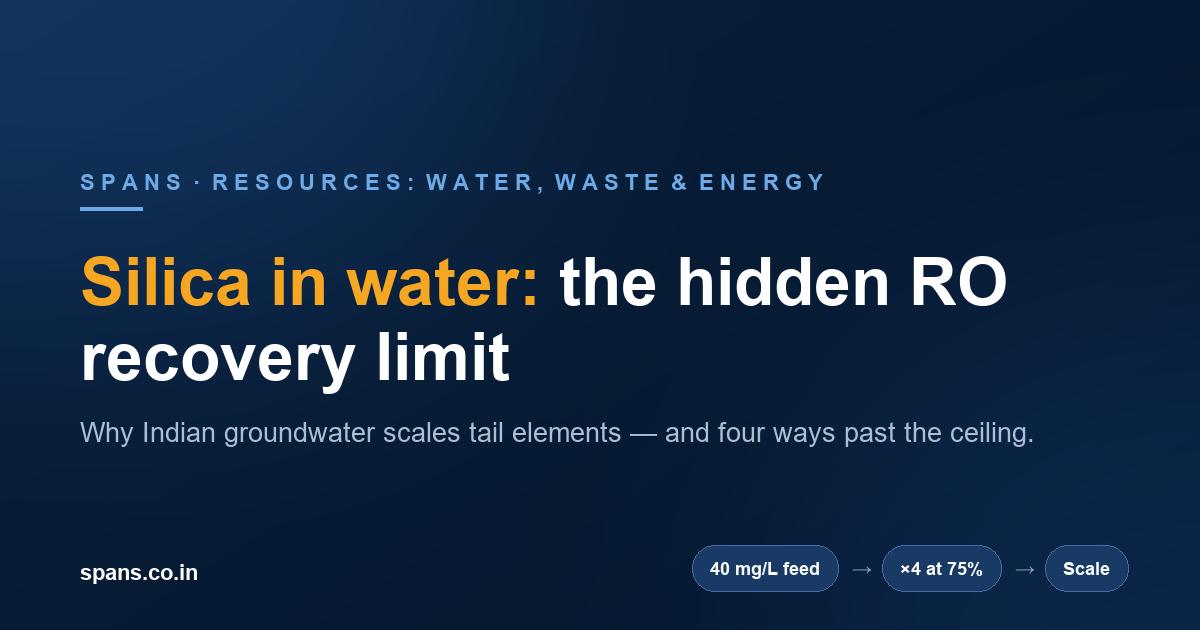
The arithmetic is simple. At recovery R, the reject is concentrated by a factor of roughly 1/(1−R). At 75% recovery, that is 4×; at 80%, 5×; at 85%, 6.7×. A feed with 40 mg/L silica therefore produces a reject at 160, 200 and 267 mg/L respectively. Without a silica antiscalant, the ceiling is about 75%, and only with a warm feed. With a good antiscalant, 80–85% may be feasible. With 80 mg/L silica in the feed, the same calculation caps the plant near 50–65% recovery. This is why recovery is a number the feed hands you, not one the designer chooses — and why, on Indian groundwater, silica is usually the limiting salt that hands it over.
What you can do about it
There are four practical levers, in rising order of cost.
- Design to the silica limit and stop there. Run a scaling projection with the real silica figure, pick a silica-specific antiscalant, set recovery at the safe point, and treat the reject as a design stream to be handled rather than a number to be minimised. This is the right answer for most plants.
- Warm the feed. Silica solubility at 35°C is roughly 30–40% higher than at 20°C. Where waste heat is available, a modest temperature lift buys real recovery. Watch the membrane's temperature limit and the effect on carbonate scaling.
- Remove silica upstream. Lime softening at high pH, or dosing magnesium oxide or magnesium chloride, precipitates silica onto magnesium hydroxide and can remove 60–90% of it — at the cost of a clarifier, sludge and chemical handling. Worth it for large plants where every recovery point is expensive reject to dispose of.
- Go high-pH on a second-pass RO. Above pH 10, silica ionises into silicate and its solubility jumps several-fold. A second RO run at elevated pH on the first stage's reject can push overall recovery to 90%+, which is the trick behind many RO reject treatment and ZLD designs. It needs softened feed (or hardness scales instead) and careful pH control, but it is the only route to very high recovery on high-silica water.
The common mistake
The mistake we see most often is a plant designed from a feed analysis that did not include silica at all — the lab reported TDS, hardness, chloride and pH, the projection assumed silica was zero, and the plant scaled its tail elements within months. If you are specifying an RO on groundwater anywhere in India, insist that the feed analysis includes reactive silica, and preferably total silica, iron and aluminium too. It is a few hundred rupees of testing that decides the recovery, the membrane life and the reject volume for the next decade. If you have a plant that is scaling and no one has mentioned silica, that diagnosis is a short conversation to have with us — [email protected] or +91-98100 00233.
Spans
Spans empowers businesses around the world to grow faster and profitable while using less energy and water.
Visit Site