
A Screw Press Can Hit Its Rated Throughput and Still Miss Its Design Cake Dryness
A sludge screw press at an ETP or STP gets judged, shift after shift, on one number everyone can see on the panel: throughput, the flow of sludge the press is p..
Contents
A sludge screw press at an ETP or STP gets judged, shift after shift, on one number everyone can see on the panel: throughput, the flow of sludge the press is processing per hour. Hit the rated throughput and the machine looks like it is doing its job. That number says nothing about the cake dryness, the percentage solids in the dewatered cake coming out the other end, because throughput and dryness are not independent. They are set by the same handful of control variables, and pushing one up pushes the other down, which means a press can run at its rated throughput every day and still be quietly missing the dryness it was actually bought to deliver.
A correct throughput number and a correct dryness number are different claims
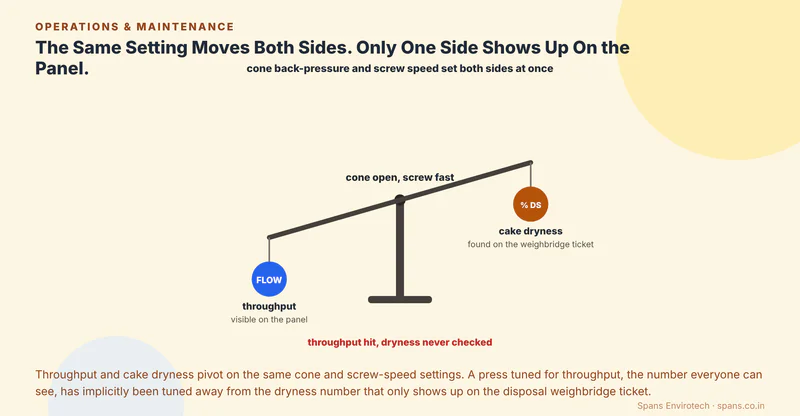
A screw press dewaters sludge by squeezing it through a tapering screw against an adjustable back-pressure cone (or, on some models, by varying screw speed against a constant counter-pressure), and the longer sludge spends under that pressure, the more water it gives up. Residence time is the lever that actually controls dryness, and residence time is set by exactly the same variables that determine throughput: screw speed and cone back-pressure. Open the cone or speed up the screw and throughput climbs because sludge moves through faster, but that same faster transit means less time under pressure, which means a wetter cake. Close the cone down or slow the screw and dryness improves, but throughput falls, because the same sludge now takes longer to pass through. There is no setting that maximises both at once. A press tuned to hit a throughput target, which is the number an operator under production pressure can see and chase in real time, is a press that has implicitly been tuned away from whatever dryness that setting happens to produce, whether or not anyone chose that trade-off on purpose.
Why the throughput number keeps standing in for the dryness number
Throughput reads instantly, right there on the panel or the flow totaliser, confirming the press is keeping up with the plant's sludge production in the moment. Cake dryness does not read instantly. Confirming it requires a lab moisture test on a cake sample, or, more often in practice, waiting for the sludge disposal contractor's weighbridge ticket to show how many tonnes of wet cake left the site that week, a figure that arrives days after the fact and gets compared against a budget line rather than against the press's actual setting at the time. An operator chasing throughput because that is the number visible and demanded in the moment has no equivalent real-time signal telling them dryness has slipped, so the press can run for weeks at a cone setting that technically clears its throughput target while quietly producing a cake wet enough to be costing real money in disposal weight, and nobody finds out until someone finally cross-checks the weighbridge tonnage against what the sludge mass balance says it should have been.
This is the same shape of mistake we described in the piece on polymer dosing for sludge dewatering: there a fixed polymer dose rate looked stable and correct on paper while the actual solids-to-polymer ratio drifted as feed solids changed, because a fixed setting and a correct outcome are different claims whenever the relationship between them depends on conditions that keep moving. It is close kin, too, to the piece on DO setpoint versus oxygen transfer efficiency: a dissolved oxygen probe can hold its setpoint exactly and still be masking a real efficiency cost nobody is tracking, the same pattern of a visible control variable standing in for an outcome that only shows up on a bill weeks later.
Picture two identical plants running the same make and model of screw press on comparable sludge. Plant A's operators have a standing instruction to open the cone whenever the press starts backing up during a high-flow shift, since that keeps throughput up and avoids an overflow alarm, and nobody has ever paired that instruction with a cake dryness check. Plant B's maintenance team pulls a cake sample for a moisture test once a week and logs it against the cone setting and screw speed at the time, building up a real picture of where the trade-off actually sits for their sludge. Both presses hit their rated throughput reliably. Plant A's disposal contractor bill runs consistently higher per tonne of dry solids removed, because a meaningful share of every truckload is water the press could have squeezed out if the cone had been set differently, and nobody at Plant A has the data to see it, only the throughput number that always looked fine.
What actually confirms the press is giving you the cake you're paying to haul away
The fix is not abandoning throughput as a number worth watching, since keeping up with the plant's sludge production in real time genuinely matters. It is adding the check throughput alone cannot provide: a routine cake dryness measurement, even a simple moisture-balance test a few times a week, logged against the cone and screw speed settings in force at the time, so the plant has an actual map of where its own trade-off sits rather than an assumption. Where disposal is weighed and paid by tonnage, that dryness figure converts directly into a cost nobody should be flying blind on, worth setting against the plant's broader wastewater treatment cost picture rather than treated as a fixed, unavoidable number. For a press running consistently wetter than its design dryness, the fix is rarely a bigger machine, usually a deliberate re-tuning of cone pressure or screw speed against a dryness target instead of a throughput target, and sometimes a look at polymer conditioning upstream, since poorly flocculated sludge blinds the screen and defeats dryness regardless of how the press itself is set.
A screw press that hits its rated throughput every shift has told you it can keep up with the plant. It has not told you what that cake actually costs to haul away, and the two numbers only look the same until someone actually checks. If your plant's dewatering operation has never logged cake dryness against the press settings producing it, that gap is worth closing with Spans' operations and maintenance team before the next disposal invoice quietly prices in water the press could have removed.
Spans
Spans empowers businesses around the world to grow faster and profitable while using less energy and water.
Visit Site