
The STP That Does Everything In One Tank: How a Sequencing Batch Reactor Works
Ask most operators what technology their sewage plant runs on and they will tell you, quite proudly, that it is a sequencing batch reactor. Ask them how it diff..
Contents
Ask most operators what technology their sewage plant runs on and they will tell you, quite proudly, that it is a sequencing batch reactor. Ask them how it differs from ordinary activated sludge and you often get a shrug. "It's the modern version." That answer is wrong in an interesting way, because the SBR is not a newer, cleverer bug. It is the same bug doing the same job. What changed is not the biology. It is the geometry of time.
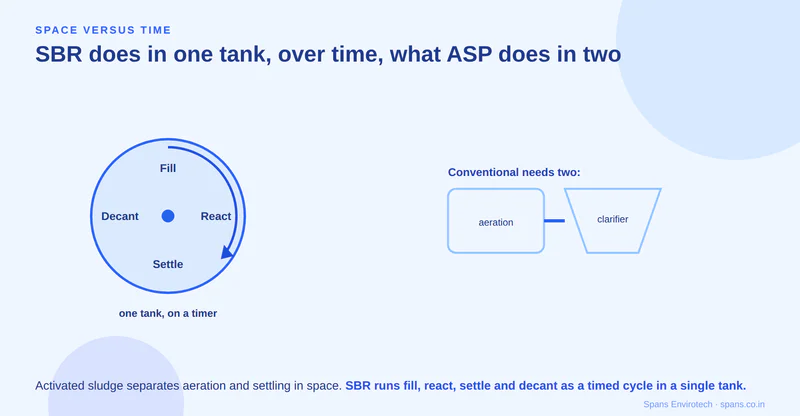
SBR is the full form of sequencing batch reactor, and the word that matters in that phrase is sequencing. A conventional activated sludge process treats sewage by moving it through space: raw water enters an aeration tank, spends some hours being eaten by microbes, then flows onward into a separate secondary clarifier where the sludge settles out and clean water spills over a weir. Two tanks, two jobs, water travelling from one to the other continuously. An SBR does the identical two jobs, aeration and clarification, but it does them in one tank, one after the other, on a timer. The water does not move from a react zone to a settle zone. The tank simply stops being an aeration tank and becomes a clarifier for a while, then becomes an aeration tank again.
That is the whole idea. Conventional plants separate the steps in space. SBRs separate them in time. Almost everything an SBR is good at, and everything it is bad at, falls out of that single swap.
The cycle is the plant
Because there is only one tank, the treatment happens as a repeating cycle of phases, and it is worth naming them properly because this is what "SBR process" actually means. The US EPA's wastewater technology fact sheet on SBRs lays out the standard four, matching the classic description of a sequencing batch reactor, and they are almost self-explanatory.
Fill. Screened, degritted sewage flows into the basin, which already holds settled biomass from the last cycle. You can fill statically, fill while mixing, or fill while aerating, and that choice is a real design lever: an anoxic mixed fill, for instance, lets the bugs use nitrate instead of oxygen and gives you denitrification almost for free.
React. The blowers come on. This is the part that looks like a normal aeration tank. Air drives the microbes to oxidise the organic load, converting BOD into more microbes and carbon dioxide, and ammonia into nitrate. The mixed liquor suspended solids you are carrying determine how fast this goes, exactly as in any activated sludge system.
Settle. Now the difference bites. The blowers and mixers switch off and the tank goes still. With nothing stirring it, the sludge flocs sink and a clear layer of treated water forms on top. You have turned your aeration tank into a clarifier without pumping anything anywhere. The stillness is the clarifier.
Decant. A decanter, usually a floating or moving weir, skims that clear top layer off and sends it to disinfection and discharge. Then the cycle starts again, often with a short idle phase in between to trim timing. Waste sludge is drawn off periodically so the population does not grow without limit.
Run that loop a few times a day and you have treated your sewage using aeration, settling and equalisation all inside the same four walls. It is a genuinely elegant piece of thinking, and it does the same fundamental work that the biology in any full sewage works does, just rearranged in time.
What the swap buys, and what it costs
Collapsing two tanks into one has obvious appeal on an Indian site where land is the expensive thing. You delete the secondary clarifier, the return-sludge pumps and the pipework between them. On a tight municipal plot, or a podium in a city where a sewage treatment plant has to hide under a car park, that saved footprint is not a nicety. It is often the reason the plant can be built at all. This is a large part of why SBR has become one of the default choices for municipal STPs in India, including many of the plants funded along the Ganga basin under Namami Gange.
There is a subtler prize too. A batch is a controlled experiment. Because you own the tank for a defined window, you can decide precisely how long it stays anoxic, how long it aerates, when it settles. That control makes nutrient removal, nitrogen and phosphorus, far easier to tune than in a plant where water is forever flowing through. You are not chasing a moving target; you are running a recipe.
But the bill comes due, and it comes due in two places. The first is the clock. An SBR has no independent clarifier quietly doing its job around the clock. It has a PLC deciding, minute by minute, when to aerate and when to go still. If that controller, a level sensor or the timing logic drifts, the plant does not degrade gracefully. It settles when it should aerate, or decants sludge into the river. The plant lives and dies by its timer.
The second is the decanter. Everything you treated leaves through that one weir during a short window. A decanter that dips too low, or moves too fast, pulls settled solids out with the clear water and your discharge quality collapses in a single phase. In a conventional plant a bad clarifier gives you hours of warning; in an SBR a bad decant gives you minutes.
And there is a structural weakness worth being honest about: an SBR hates wildly swinging flow. During settle and decant, the basin cannot accept water. If a surge arrives mid-cycle, it has nowhere to go. That is why serious SBR plants are built as two or more basins staggered out of phase, or with an equalisation tank in front, so there is always a basin open to receive. A single-basin SBR sold as handling storm flow is a plant waiting to overflow.
So where does it actually fit
Against MBBR, the contrast is clean. MBBR grows its biomass on plastic media in a continuously flowing tank, so it swallows variable and shock loads without blinking and needs almost no operator choreography, which is why it dominates building-scale packaged STPs. But it cannot match an SBR's fine control over nitrogen, and it still needs downstream clarification. SBR trades that easy tolerance of chaos for precision and a smaller civil footprint. Against conventional ASP, the trade is footprint and control against simplicity: an old-fashioned aeration-tank-plus-clarifier plant is more forgiving of a sleepy night operator precisely because nothing depends on split-second timing. If you are weighing these against each other for a real project, our note on MBBR versus activated sludge draws the lines more fully, and it is a conversation worth having with an engineer before the concrete is poured rather than after, which is what our team spends a good part of its week doing.
None of this makes SBR a better or worse technology than the alternatives. That framing is the mistake operators make when they call it "the modern one". The microbes in an SBR are the same microbes that have run activated sludge plants for a century, doing the same slow work of eating what we flush. The plant did not get smarter. It got a schedule. And once you see that a sequencing batch reactor is simply activated sludge with a clock where the second tank used to be, you understand both why it saves so much space and why it demands so much attention: you have handed the job of the clarifier to time itself, and time is a component you cannot inspect, only trust.
Spans
Spans empowers businesses around the world to grow faster and profitable while using less energy and water.
Visit Site