RO in Textile Dyeing Effluent Reuse and ZLD: What Makes the Membranes Survive
Tirupur learned it first, then Ludhiana, Surat, Pali and Panipat: when the regulator says zero liquid discharge, the RO plant becomes the heart of a textile dye..
Contents
Tirupur learned it first, then Ludhiana, Surat, Pali and Panipat: when the regulator says zero liquid discharge, the RO plant becomes the heart of a textile dyeing unit's water system, and it is also the piece most likely to fail. Dye-house effluent is the most hostile feed most RO membranes will ever meet — salty, coloured, hot, alkaline, loaded with surfactants and organics — and the difference between a reuse plant that runs and one that burns through membranes every year is almost entirely in what happens before the RO and what is done with what comes out of it.
What dye-house effluent looks like to a membrane
A cotton dyeing and finishing unit produces effluent with TDS anywhere from 3,000 to 12,000 mg/L, driven by the sodium chloride or sodium sulphate used in reactive dyeing, plus COD of 800–2,500 mg/L, colour in the thousands of Pt-Co units, pH of 9–11, temperature of 40–60°C, and a cocktail of surfactants, sizing agents, sequestrants and dye hydrolysates. From an RO's standpoint every one of those is a problem. The TDS sets a high osmotic pressure; the organics and surfactants foul; the colour bodies adsorb onto polyamide and are notoriously hard to clean off; the temperature pushes membranes past their limits; and the pH, if not corrected, does the same. A membrane sent this water without serious pre-treatment lasts months.
The pre-treatment train that works
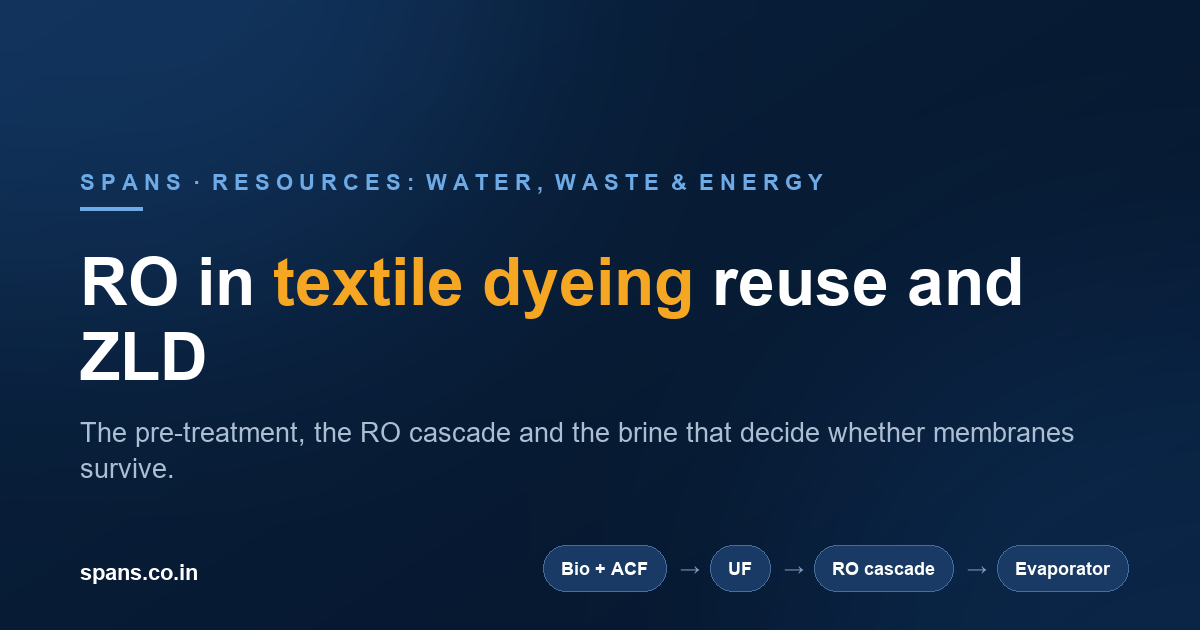
The sequence that has emerged as the standard in Indian textile ZLD is long, and every stage is there for a reason:
- Equalisation and cooling. Dye batches are discontinuous; the RO needs steady feed under 35–40°C. A cooling tower or heat exchanger on the equalised effluent is not optional.
- Chemical treatment. Coagulation with ferrous sulphate, alum or PAC, plus polyelectrolyte, in a flash mixer and clarifier or DAF, to knock out colour, suspended solids and a first slice of COD. This is where 60–80% of the colour goes.
- Biological treatment. An MBBR or activated sludge stage to bring COD down to 150–300 mg/L and destroy the biodegradable organics that would otherwise biofoul the membranes. Salt-tolerant biology is needed above 5,000 mg/L TDS.
- Tertiary polishing. Multimedia filtration, then activated carbon to adsorb residual colour and organics — the ACF is the stage that protects the RO from colour fouling more than any other.
- Ultrafiltration. The final barrier, delivering SDI under 3 and removing the colloidal fraction the clarifier and filters missed. On textile effluent, UF fouling is itself aggressive; expect a daily CEB.
- Softening. Either lime-soda in the chemical stage or a resin softener before the RO, so that the high-recovery RO downstream is not limited by hardness.
Only after all of that does the effluent become RO feed — typically at COD under 100 mg/L, colour under 50–100 Pt-Co, SDI under 3, and pH adjusted to 6.5–7.5.
The RO: multi-stage or bust
A textile ZLD needs to recover 85–95% of the water as permeate, because everything that is not permeate goes to an evaporator that costs 25–40 kWh per cubic metre of reject. A single RO stage on 8,000 mg/L feed reaches 60–70% recovery before osmotic pressure and scaling stop it, so the standard design is a cascade: a brackish-water RO on the treated effluent, followed by a high-pressure (seawater-grade) RO on its reject, sometimes a third stage or a high-pH pass for silica. Each stage runs within its own safe recovery; together they reach 90%+. Fouling-resistant, wide-spacer elements throughout; conservative flux of 12–16 L/m²·h; antiscalant chosen for sulphate and silica, not just carbonate; and a CIP regime that the operators actually follow. Cleaning frequency of every four to eight weeks is normal and acceptable; every two weeks means the pre-treatment is failing.
The brine is the business
The thing that makes textile ZLD economically bearable is that the RO reject is a salt solution the dye house wants back. A well-run plant recovers the sodium sulphate or sodium chloride from the evaporator as crystalline salt for reuse in dyeing — Tirupur's CETPs and larger individual units do exactly this. The RO's job is therefore to deliver a reject stream as concentrated as possible (to shrink the evaporator) and as clean as possible (so the recovered salt is usable). That second requirement is why the pre-treatment removes colour and organics so aggressively: organics that reach the evaporator end up in the salt, and coloured or sticky salt goes to landfill instead of back to the dye bath. Multiple-effect evaporators and ATFDs are the downstream half of this story.
What decides success
Three things, in our experience across textile clusters. First, whether the biological stage is genuinely working — a plant whose MBBR is overloaded sends organics straight through to the membranes, and no filter or carbon bed fully compensates. Second, whether the operating team has normalised RO data and reads it, so cleaning happens at 10% flux loss rather than 30%. Third, whether the plant was sized for the real effluent — peak shift flow, peak TDS from the heaviest dyeing batch, peak temperature in May — rather than the average in the DPR. A ZLD designed on averages spends its life in upset. The feasibility study should answer all three before the first membrane is ordered.
If your dyeing unit is facing a ZLD mandate, or has an RO that is not surviving its effluent, that is a conversation worth having with us early — [email protected] or +91-98100 00233.
Spans
Spans empowers businesses around the world to grow faster and profitable while using less energy and water.
Visit Site