
RO Membrane Fouling vs Scaling: How to Tell Which One You Have
An RO plant that is losing permeate is either fouling or scaling, and the two look identical from the control room: pressure goes up, flow goes down, the operat..
Contents
An RO plant that is losing permeate is either fouling or scaling, and the two look identical from the control room: pressure goes up, flow goes down, the operator reaches for the cleaning chemicals. But fouling and scaling have opposite causes, opposite locations in the array, and opposite cures — and cleaning for the wrong one wastes a day, a drum of chemical, and a little more of the membrane's life. The good news is that the plant is telling you which one it is, if you normalise the data and look at where the pressure drop is sitting.
Two different diseases
Fouling is stuff arriving with the feed and sticking to the membrane: suspended solids, colloids, organics, oil, and biofilm. It is a pre-treatment failure. It lands where the feed first meets the membrane — the lead elements of the first stage — because that is where the solids are and where the flux is highest.
Scaling is stuff being created inside the RO: sparingly soluble salts — calcium carbonate, calcium sulphate, barium sulphate, silica, calcium fluoride — that were dissolved in the feed but exceed their solubility as the water is concentrated. It is a recovery or antiscalant failure. It lands where the water is saltiest — the tail elements of the last stage.
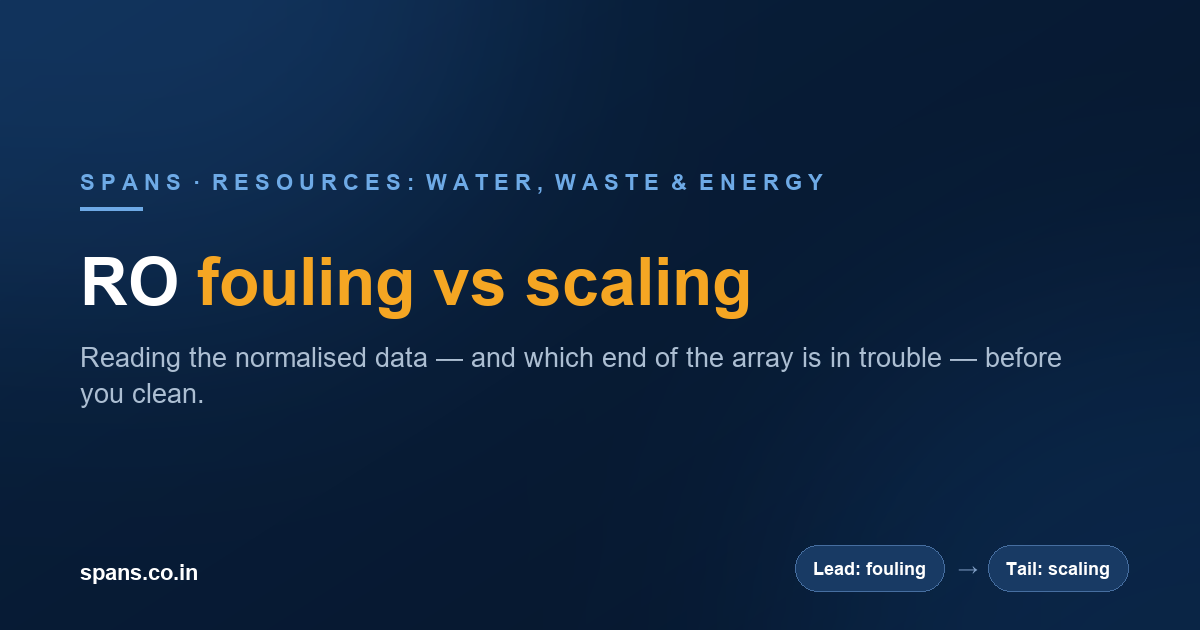
That geography is the single most useful diagnostic you have. Lead-end problem: fouling. Tail-end problem: scaling.
Why the raw data lies
Permeate flow, pressure and salt passage all move with feed temperature, feed TDS and applied pressure — none of which are constant. A 5°C drop in feed temperature on a winter morning cuts permeate flow by roughly 15% with nothing wrong at all. If you trend raw flow you will chase ghosts. Normalisation corrects each reading back to a reference condition (usually start-up), so what remains is the membrane's genuine change. Every membrane manufacturer publishes a normalisation spreadsheet; the industry rule is that a clean is due when normalised permeate flow drops 10%, normalised salt passage rises 5–10%, or normalised differential pressure rises 15% from the baseline. These three normalised numbers, trended daily, are the whole diagnosis.
Reading the three signals
- Normalised permeate flow falls, ΔP rises in stage 1, salt passage steady or slightly up. Particulate or colloidal fouling. Check SDI and turbidity of the feed; look at the cartridge filter ΔP; suspect the clarifier or the UF upstream.
- Normalised flow falls, ΔP rises across all stages, slimy or smelly on element inspection. Biofouling. Check for chlorine breakthrough that never happened (no biocide), a warm feed, high organics or nutrients, and long idle periods without flushing.
- Normalised flow falls, salt passage rises, ΔP rises in the last stage. Scaling. Check recovery against design, the antiscalant dosing pump, the feed hardness, alkalinity and silica, and the reject LSI or saturation indices.
- Salt passage rises sharply, flow rises, ΔP unchanged. This is not fouling at all — it is damage. Oxidation from chlorine, a mechanical failure of an O-ring or a glue line, or a telescoped element. No cleaning will fix it.
- Flow falls, salt passage falls, ΔP steady. Membrane compaction or organic adsorption on the surface. Usually an oil or surfactant problem on industrial feeds.
Confirm before you clean
Three cheap checks turn a hunch into a diagnosis. First, probe the array: measure permeate conductivity from individual pressure vessels, or from individual elements with a sample tube if the design allows. The element with the worst salt passage is the sick one, and its position tells you the disease. Second, look at the reject: if scaling is suspected, analyse the concentrate and calculate saturation for carbonate, sulphate and silica at the actual recovery. Third, if the answer is still unclear, pull a tail element and a lead element and weigh them. A scaled element is noticeably heavier than its shipping weight; a biofouled one is slimy on the feed spacer; a colloidally fouled one has a fine brown film on the lead scroll. For a persistent or expensive problem, a proper membrane autopsy — sectioning the element and analysing the foulant — costs a fraction of one wrong cleaning cycle on a large plant.
The cure is different — and so is the prevention
Once you know what you are dealing with, the chemistry follows:
- Fouling comes off with high-pH cleaning (pH 11–12, often with a surfactant or chelant), which swells and lifts organics and biofilm. Prevention is pre-treatment: better clarification, a working multimedia filter, UF where the feed is variable, correct cartridge filter replacement, and a biocide programme for biofouling.
- Scaling comes off with low-pH cleaning (pH 2–3 citric or HCl for carbonates and iron; specialised cleaners for sulphates and silica, which are far harder). Prevention is chemistry: recovery set from a proper scaling projection, antiscalant dosed reliably and matched to the limiting salt, softening or acid dosing where carbonate is the limit.
When both are present — which is common on borewell feeds with iron and hardness — clean alkaline first, then acid, so the organic layer does not shield the scale. The full procedure is covered in RO membrane cleaning and CIP.
The plants that keep their membranes for five years are not the ones with the best cleaning chemicals; they are the ones that normalise their data every day, know which end of the array is in trouble, and clean early for the right reason. If your RO is losing flow and you are not sure whether to reach for acid or alkali, that is a conversation worth having with us before the next clean — [email protected] or +91-98100 00233.
Spans
Spans empowers businesses around the world to grow faster and profitable while using less energy and water.
Visit Site