
A Concrete Tank Can Pass Every Strength Check and Still Fail on Day One
Most people assume a concrete tank is designed the same way a beam or a column is: work out the loads, check the section can carry them without collapsing, add ..

Contents
Most people assume a concrete tank is designed the same way a beam or a column is: work out the loads, check the section can carry them without collapsing, add a safety margin, done. A liquid-retaining tank is designed to a different, stricter standard, and the gap between the two is where most early tank failures actually come from.
A beam that develops a hairline crack under load is usually fine. Nothing is meant to stay inside it. A tank holding effluent is a different problem entirely: the moment a crack opens wide enough, liquid weeps through it, and that changes everything downstream of the crack, literally. This is why liquid-retaining structures in India are designed to IS 3370, a code that sets a materially tighter permissible crack width than an ordinary reinforced concrete member would ever need to meet. The governing question for a tank wall is not "will this collapse" but "will this stay tight enough to hold liquid", and those two questions have different answers for the same slab of concrete.
Why a crack that looks cosmetic is not
Once a crack opens on the wetted face, moisture and dissolved salts reach the reinforcing steel through it far faster than through sound concrete. The steel corrodes, corrosion product occupies more volume than the steel it replaced, and the expanding rust widens the crack from the inside, which lets in more moisture. This is a feedback loop, not a one-time defect, and it is why a tank that looked fine at handover can be seeping within a few years if the crack control was ever marginal. The failure that eventually shows up as a wet patch on the outside of a tank wall usually started as a hairline crack that nobody flagged, because it looked exactly like the kind of crack a beam is allowed to have.
Crack width in a tank wall is controlled less by how much total reinforcement is in the section and more by how that steel is distributed: bar spacing and diameter determine how many fine, harmless cracks form instead of one wide one. A slab or wall cast against an older, already-hardened section is restrained as it tries to shrink while curing, and that restraint, not any applied load, is what opens the first cracks in a young tank, often within days of the pour. This is why large tanks are cast in panels with proper movement joints rather than as one continuous mass: an unbroken pour that cannot move anywhere as it shrinks will find its own crack pattern, and it rarely finds one that is convenient.
Correctly detailed construction joints and pipe penetrations matter as much as the reinforcement calculation itself, and inspection here has to be as deliberate as the design was. Most leaks we have traced back to source were not steel-quantity shortfalls. They were a construction joint that was not water-stopped properly, or a pipe penetration cast without a puddle flange, both of which a strength check would never catch because neither one threatens collapse, and both of which a crack-width gauge run along every joint during the first filling would have caught immediately.
The second attack happens above the waterline, not below it
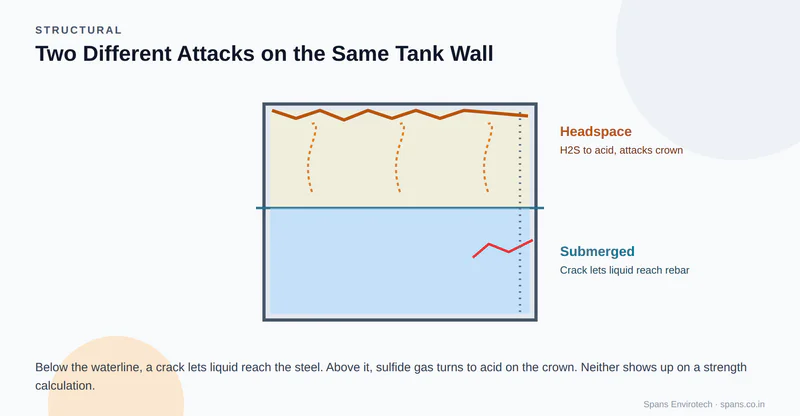
There is a corrosion mechanism specific to covered sewage structures that a purely structural view of the tank misses entirely, because it has nothing to do with cracking or hydrostatic pressure. Sewage releases dissolved hydrogen sulfide gas, which rises into the headspace above the liquid, and bacteria living on the moist concrete crown oxidise it into sulfuric acid. This attacks the concrete directly, chemically, with no crack required to start it. It is not unusual for the crown of a covered wet well or an underground tank to be in worse condition than the submerged walls below the waterline, simply because everyone's attention, ours included, defaults to what is below the liquid line rather than what is breathing above it.
Unlike the below-waterline crack problem, this attack does not care whether the concrete is intact or cracked. It works on sound concrete just as effectively, dissolving the cement paste at the surface and exposing aggregate over months, and it is often fastest exactly where ventilation is poorest, which tends to be wherever the design assumed the headspace didn't need much attention. A tank can pass every crack-width check on its walls and still lose section thickness at the crown within a few years of commissioning, for a reason that has nothing to do with structural design in the conventional sense.
This means a tank genuinely built for a wastewater duty needs two separate protection strategies working at once: crack-width control and correct detailing for everything in contact with liquid, and a chemically resistant lining or coating for anything exposed to the sulfide-laden headspace atmosphere, particularly the crown and the upper third of the walls in an enclosed structure. Specifying one without the other is a common and expensive gap, because each strategy is answering a completely different failure mode.
Designing for the job, not the checklist
None of this is exotic engineering. It is the ordinary practice of asking what will actually threaten a tank's real job, which is holding liquid reliably for decades, rather than stopping at the checklist item that is easiest to calculate. A structural drawing that passes every strength check and skips the crack-width verification, the joint detailing, and the headspace lining is not a lesser version of a correct design. It is a design for a different, easier problem than the one the tank actually has to solve.
If you are reviewing drawings for a new ETP or STP civil package, or trying to work out why an existing tank is weeping years before it should, the two questions worth asking before any other are: what is the calculated crack width on the wetted faces, and what protects the crown from the atmosphere above the liquid. CPHEEO's own manuals for sewerage and treatment plant design are worth reading alongside IS 3370 for exactly this reason: the code sets the crack-width limit, the manual is where the detailing guidance and headspace considerations actually get spelled out. Everything else on the drawing is easier to get right once those two questions are answered honestly.
Spans
Spans empowers businesses around the world to grow faster and profitable while using less energy and water.
Visit Site