
Correcting Your Power Factor Is Simple. Doing It Next to a VFD Isn't.
Every electrical consultant who has ever looked at a treatment plant's monthly bill has given the same advice: your power factor is low, install capacitors, the..

Contents
Every electrical consultant who has ever looked at a treatment plant's monthly bill has given the same advice: your power factor is low, install capacitors, the penalty goes away. It is correct advice, cheap to implement, and on most plants it works exactly as promised within a month of commissioning. On a growing number of plants it also quietly cooks the capacitor bank within a year, and the engineer who specified it is long gone by the time anyone traces the failure back to its actual cause.
The arithmetic that makes capacitors look like free money is genuinely simple. A plant full of induction motors, blowers, pumps, and mixers, draws real power that does work and reactive power that just magnetises windings. The ratio between the two is the power factor, and most DISCOMs start charging a penalty once it drops below roughly 0.95, with the surcharge climbing fast as it falls further. A bank of capacitors sitting at the main panel supplies that reactive power locally instead of pulling it from the grid, the power factor climbs back above the penalty threshold, and the monthly bill drops by a number that usually pays for the capacitors within a year or two. None of this is wrong. It is just incomplete for a specific, increasingly common kind of plant.
The load has changed since this advice was written
That advice assumes the reactive load is the clean, old-fashioned kind: induction motors running straight off the line, drawing current that lags the voltage by a fixed angle. Correcting for that is a textbook problem and capacitors solve it exactly as the textbook says. But a modern ETP or STP does not run its blowers and pumps straight off the line any more. It runs them through variable frequency drives, because VFDs are how a plant actually gets the energy savings that make the blower itself efficient. We have written before about why that switch to twin-lobe or tri-lobe blowers on VFDs is usually the right call. It is. But it changes the electrical problem the capacitor bank is being asked to solve.
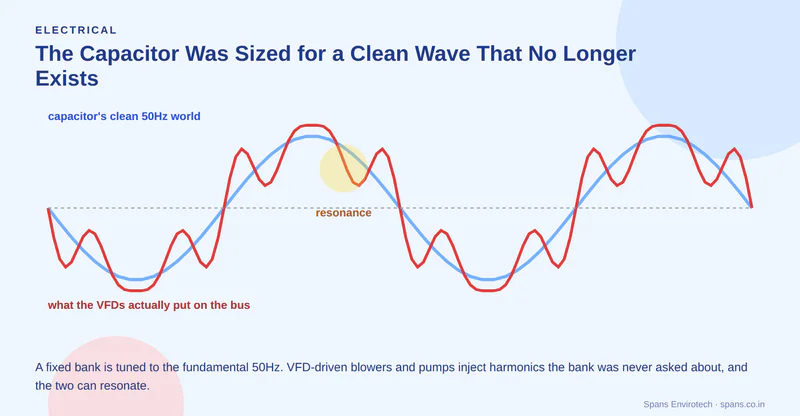
A VFD does not draw a clean sine wave. It chops the incoming AC into pulses to synthesise the frequency the motor needs, and that switching injects harmonic currents back onto the plant's electrical network, at the 5th, 7th, 11th harmonic and beyond. A fixed capacitor bank, which was sized purely against the fundamental 50 Hz reactive power, has no opinion about those harmonics until it accidentally resonates with them. The capacitor's impedance falls as frequency rises while the system's inductive impedance rises with it, and somewhere in between those two curves cross. If that crossing point lands near a harmonic the VFDs are actually producing, the bank and the plant's own supply inductance start amplifying that harmonic between them instead of absorbing it.
What resonance actually looks like on site
Nobody gets a diagnostic message that says "harmonic resonance detected." What they get is a capacitor bank that runs warmer than its datasheet suggests it should, fuses on the bank that blow for no obvious reason, and voltage waveforms at the panel that an oscilloscope would show as visibly fuzzed rather than a clean sine, though almost nobody puts an oscilloscope on an MCC panel until something has already failed twice. The failure mode that actually gets attention is usually blunter: the capacitor bank itself fails, sometimes violently enough to trip the main incomer, on a day with nothing unusual happening except the normal mix of VFD-driven blowers running at the normal mix of speeds.
The frustrating part is that the bill looks fine right up until the failure. Power factor correction is working exactly as specified, the penalty has genuinely disappeared from the monthly invoice, and the plant has no reason to suspect the thing that is quietly stressing itself to failure is the very equipment installed to save money. We have seen this diagnosed, eventually, as "the capacitor bank must have been a bad batch," and a replacement installed on the same busbar with the same resonance condition, which fails again on roughly the same timeline.
The fix is not a bigger capacitor, it is a different question
The actual answer is not complicated once someone asks the right question before specifying the bank rather than after it fails: what harmonic spectrum do our own VFDs actually put on this bus, and does the capacitor's resonant frequency sit anywhere near it? If it does, the standard, well-proven answer is a detuned capacitor bank, where a small series reactor shifts the bank's resonant point below the lowest harmonic the plant's VFDs produce, so the two can never find each other. This costs more than a plain capacitor bank, by a margin that is a rounding error against a single bank failure and the unplanned shutdown that comes with it, and it is a known, catalogued product line from every reputable capacitor manufacturer, not a bespoke engineering exercise.
What it does require is treating power factor correction as part of the same electrical design conversation as the VFD fleet, rather than a separate catalogue purchase made by whoever is closing out the electrical BOQ. An energy audit that looks at the load profile without also looking at the harmonic profile will recommend a correctly sized, incorrectly specified bank, because sizing and specification are answering different questions. The load survey that catches this costs an afternoon with a power quality analyser on the main incomer, cheaper by a wide margin than the capacitor bank it is meant to inform, and considerably cheaper than the bank that gets installed without it.
None of this is an argument against power factor correction. The penalty is real, the fix works, and a detuned bank costs little enough more than a plain one that there is no honest case for skipping the harmonic check to save that difference. It is an argument against treating "install capacitors" as the end of the analysis on any plant where VFDs are already doing the real work of saving energy. The two fixes were designed to solve different problems, and a plant running both needs someone to check that they are not, between them, quietly creating a third one. If you are speccing a panel upgrade or an energy retrofit and want that check done before the bank goes in rather than after it fails, that conversation is worth having early: spans.co.in/contact.
Spans
Spans empowers businesses around the world to grow faster and profitable while using less energy and water.
Visit Site