
A Fixed Polymer Dose Rate Can Look Perfectly Stable and Still Be Wrong Most of the Time
A dewatering polymer dose at most ETPs and STPs gets set once, usually from a jar test or an early commissioning trial, and then run as a fixed rate: so many li..
Contents
A dewatering polymer dose at most ETPs and STPs gets set once, usually from a jar test or an early commissioning trial, and then run as a fixed rate: so many litres per hour, or a fixed ratio against sludge flow. On the SCADA trend chart that dose rate looks admirably stable, a flat line that never needs operator attention. The flat line is exactly the problem, because the number that actually determines whether flocculation works, and therefore whether the cake comes out dry and the centrate comes out clear, is not the dose rate on its own. It is the dose relative to the solids concentration in the sludge feeding it at that moment, and that ratio is almost never as stable as the dose rate suggests.
A stable dose and a stable ratio are different claims
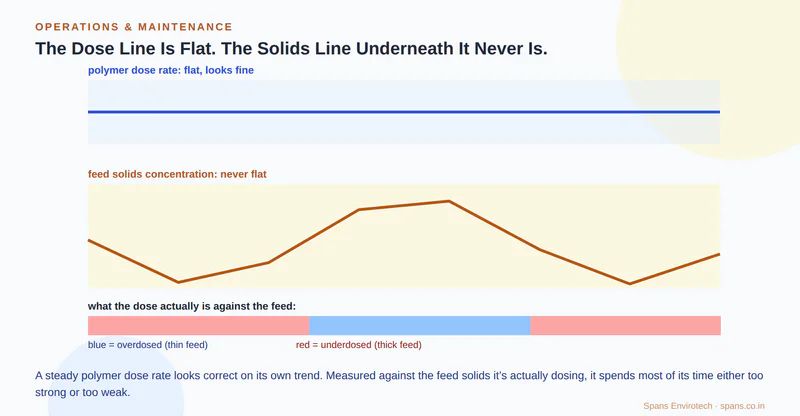
A polymer pump running at a fixed rate is making one claim: this many litres per hour, reliably, hour after hour. It is not making any claim about whether that rate is correct for the sludge currently arriving at the dewatering unit, because the pump has no way to know what the current solids concentration is unless something tells it. Sludge feeding a centrifuge or belt press varies in solids concentration for entirely ordinary operational reasons: a thickener running slightly differently shift to shift, a different mix of primary and secondary sludge reaching the dewatering unit depending on what upstream processes are doing, normal day-to-day variation in the plant's influent and biological load. None of that variation shows up on the polymer dose trend, because the dose trend only plots the one number the operator set, not the ratio that number forms against a constantly shifting denominator.
Why both directions of error look like someone else's problem
When feed solids rise and the fixed dose falls behind what the now-more-concentrated sludge needs, the sludge is effectively underdosed relative to what the moment requires, and the result is incomplete flocculation: a wetter cake than the dose rate's history would predict, and often a cloudier centrate carrying fines back to the head of the plant. When feed solids fall and the same fixed dose becomes more than the thinner sludge needs, the excess polymer does not just go to waste financially, though it does that too. Overdosed sludge commonly turns sticky, can foul equipment and downstream conveyance, and has been documented in published case studies to drive extra antifoam demand as a secondary consequence of the dosing error rather than anything the antifoam programme was actually responding to.
Both failure modes tend to get diagnosed as something other than dosing. A wetter-than-usual cake gets blamed on the sludge "being difficult that week." Sticky, hard-to-convey dewatered solids get treated as a mechanical or housekeeping issue. The antifoam consumption creeping up gets addressed by buying more antifoam rather than by asking why demand increased. All three symptoms can trace back to the same root cause, a fixed dose rate running against a feed solids concentration that moved without anyone adjusting the pump to match it, and the polymer trend chart, the one place an operator might look first, shows nothing wrong at all.
This is a close cousin of the problem we described in the piece on SCADA alarm management: a number that is individually correct and stable on its own terms can still be the wrong answer to the question that actually matters, because the question that matters is a ratio or a rate against a second, independently moving quantity that the first number's own trend chart never shows. There, the hidden second quantity was operator capacity against a growing alarm count. Here, it is feed solids concentration against a fixed polymer rate. In both cases the chart that looks fine is answering a narrower question than the one the plant is actually being tested on.
Picture a plant running a decanter centrifuge with polymer dosed at a fixed ratio set during commissioning, a dose an outside commissioning engineer confirmed worked well against the sludge sampled that week. Months later the plant's thickener starts running slightly thicker sludge on average, a change nobody formally decided, just a gradual drift in how the upstream process happens to be operating that quarter. The fixed dose, unchanged since commissioning, is now consistently a little light relative to what the thicker feed needs. Cake moisture creeps up, centrate clarity degrades slightly, and the operations team responds the way most plants do: they bump the dose rate up a notch, which fixes the symptom for the current feed but is now a new fixed number sitting at the wrong ratio whenever feed solids happen to swing back down again. The plant has not solved the mismatch. It has just re-centred it, and will likely repeat the same manual correction, in one direction or the other, every time feed characteristics drift far enough to produce a visible symptom.
What dosing against the real ratio looks like
The fix documented across the dewatering industry is not a better fixed rate, which only moves the mismatch around rather than removing it. It is dosing against measured feed solids rather than against a flat rate: an inline solids sensor on the sludge entering the dewatering unit, feeding a control loop that adjusts the polymer pump in something closer to real time as concentration moves, rather than relying on an operator to notice a symptom and make a manual, reactive adjustment after the fact. Grab-sample-based manual correction, still common practice at many plants, inherits the same lag problem it is trying to solve, because by the time a grab sample result comes back, the sludge it was taken from has usually already been dewatered under the wrong dose.
Plants that have made this switch report it pays for itself in both directions at once: less polymer wasted on routinely overdosed periods, and fewer poor-cake episodes during underdosed ones, which is a different and more direct saving than simply trying to find one better fixed number, because no single fixed number can be correct against a feed that does not hold still. CPHEEO's guidance on sludge treatment and disposal covers dewatering process selection at the design stage, but the dosing control strategy, fixed-rate versus solids-responsive, is a day-to-day operational decision that sits entirely outside what any design manual specifies and is worth revisiting independently of whatever equipment is already installed.
If your plant's polymer dose has been running at the same rate since commissioning regardless of what the feed sludge is actually doing, that is worth reviewing with Spans' process and operations team before the next quietly expensive batch of overdosed cake goes out the door.
Spans
Spans empowers businesses around the world to grow faster and profitable while using less energy and water.
Visit Site