
A Fouled pH Sensor Reads Wrong. On Automatic Dosing, the Plant Makes That Reading Come True.
Every ETP with chemical dosing runs a pH probe somewhere near the top of its instrument maintenance schedule, more frequently calibrated than almost anything el..
Contents
Every ETP with chemical dosing runs a pH probe somewhere near the top of its instrument maintenance schedule, more frequently calibrated than almost anything else on the plant, because everyone already knows pH probes drift. What gets underweighted is what actually happens once that drift occurs on a plant where dosing is automatic rather than manually triggered. A pH probe that just logs a wrong number on a monitoring screen is a nuisance, something an operator eventually notices and recalibrates. A pH probe feeding a closed-loop dosing controller does not just mislead the log. It can recruit the dosing pump to make its own wrong reading come true.
What fouling actually produces
A pH electrode fails gradually, not with an error code. Organic matter, oil and grease, and inorganic precipitates coat the glass membrane and the reference junction over weeks, and the output drifts smoothly in one direction rather than jumping to an obviously implausible value. A probe reading progressively more acidic than the water actually is looks, on a trend chart, exactly like a process that has genuinely started drifting acidic. Nothing about the shape of that trend tells anyone it originated at the electrode rather than in the tank. This is precisely why fouling is so often mistaken for a process upset: the instrument is producing a plausible, gradually worsening lie, and a plausible lie is the hardest kind to catch.
Where monitoring just gets you a wrong number, and dosing gets you a wrong action
On a plant where an operator reads the pH manually and adjusts dosing by hand, a fouled probe produces a wrong number that sits on a screen until someone questions it. The water itself is untouched. On a plant where the pH meter feeds an automatic dosing control loop, the same wrong number becomes an instruction. A probe reading falsely acidic tells the controller the water needs more caustic, and the controller, doing exactly what it was built to do, doses more caustic. Because the fouled probe is still fouled after that dose, its reading barely moves, so the controller reads a persistent deficit and keeps dosing. The water itself, which started at a genuinely correct pH, is now actually receiving caustic it never needed, and because the dose is real even though the original deficit was not, the water's actual pH eventually does start to climb.
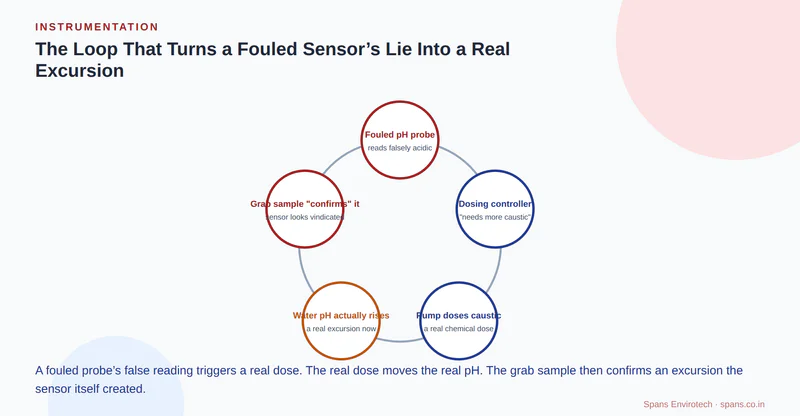
This is the part that makes the failure so hard to catch afterward: the control loop did not merely report a false excursion, it manufactured a real one. By the time anyone pulls a grab sample to verify what the probe is reading, the grab sample confirms an actual, measurable pH shift, because the automatic dosing genuinely moved the water. The instrument that started this chain of events now looks vindicated rather than suspect, since the independent check appears to agree with it. Nobody traces the excursion back to a fouled electrode, because every piece of evidence gathered after the fact, the trend chart, the grab sample, the downstream pH, tells a consistent story about a real process problem. The only point in the whole sequence where the story was false was the original reading, and that reading is the one piece of evidence nobody thinks to re-examine once the water itself confirms it.
Picture a metal finishing plant where the neutralisation tank's pH probe sits in a stream carrying fine metal hydroxide precipitate, exactly the kind of inorganic fouling that coats a reference junction fastest. The probe begins reading a touch more acidic than reality, slowly enough that nobody flags it during the plant's normal shift checks. The dosing controller, reading that persistent deficit, holds the caustic dose a notch higher than the process actually needs, day after day, and the real pH downstream of the neutralisation tank drifts upward over a couple of weeks, slowly enough to look like seasonal variation in the incoming effluent rather than a sudden fault. The eventual investigation, once someone notices the downstream STP or discharge point is running consistently alkaline, starts from the downstream symptom and works backward through dosing records, pump logs, and incoming effluent characteristics, almost never arriving at the electrode first, because nothing about an alkaline discharge obviously points at a fouled sensor rather than a changed process.
We have written before about how a level sensor's own installation and fouling can defeat it in ways the spec sheet never warns about; a pH probe on automatic dosing is the same category of problem with a sharper consequence, because a level sensor's bad reading mostly misleads a pump schedule, while a pH probe's bad reading can actively alter the chemistry of the water through the very control loop meant to protect it. The more precisely engineered the dosing control, the more faithfully and quickly it turns a fouled sensor's lie into a real, measurable fact.
What actually breaks this cycle
None of this argues against automatic dosing control, which is the correct, standard way to manage pH on any plant handling variable industrial effluent; manual dosing has its own, usually worse, failure modes. It argues for treating electrode maintenance as part of the control loop's reliability, not a separate instrumentation chore on its own schedule. The cleaning and verification interval for a pH probe feeding automatic dosing should be set against the specific fouling rate of that stream, oily or high-solids effluents foul faster than clean process water, rather than a generic calendar reminder copied from a manual that assumed a cleaner application. A probe due for calibration next week on the generic schedule can already be driving the dosing pump on a fouled, biased reading today.
The more durable fix is not trusting a single point measurement to drive dosing unchecked at all: a periodic grab-sample cross-check built into the maintenance routine, or a redundant probe that the control logic compares against before accepting a large dosing correction, catches exactly the failure mode described here before the dosing pump has a chance to turn a false reading into a true one. The same discipline that goes into continuous compliance monitoring applies here with even more force, because a pH probe feeding automatic dosing is not just reporting on the plant's condition. It is, in a very literal sense, steering it. If you are reviewing a dosing control strategy and want a second opinion on where the verification checks should sit, that is worth raising before the next upset gets misdiagnosed as a chemistry problem: spans.co.in/contact.
Spans
Spans empowers businesses around the world to grow faster and profitable while using less energy and water.
Visit Site