
OCEMS and CEMS: When Your Effluent Data Files Its Own Show-Cause Notice
A few years ago, an inspector arriving at the gate was the moment of truth. You knew roughly when the visit was coming, the ETP ran at its Sunday-best for a for..
Contents
A few years ago, an inspector arriving at the gate was the moment of truth. You knew roughly when the visit was coming, the ETP ran at its Sunday-best for a fortnight beforehand, samples were drawn, and a report followed weeks later. Compliance was an event. You prepared for it, you passed or you didn't, and then life went back to normal.
That world is gone, and most factories we work with haven't fully registered it. The pollution board now sees your effluent and emission numbers 24 hours a day, before it ever sends anyone to your site. A pipe of live data runs from your outfall to a government server and updates continuously. Which means the most important thing about your treatment plant is no longer just whether the water is clean. It is whether your data says so, without gaps, without drift, and without the awkward silences that a regulator reads as guilt.
What the acronyms actually mean
Let's get the definitions out of the way, because the alphabet soup trips people up. CEMS is the full form Continuous Emission Monitoring System: the stack-mounted instruments that measure air pollutants like particulate matter, SO2 and NOx in real time. OCEMS is the broader umbrella the Central Pollution Control Board uses, Online Continuous Emission and Effluent Monitoring System, and the "effluent" half is the one that concerns anyone running an ETP. On the water side it means online effluent monitoring: analysers sitting at your final discharge point continuously reading pH, chemical oxygen demand, total suspended solids, and an effluent flow meter recording exactly how much you release.
The word doing the heavy lifting is "online." It doesn't mean the instrument merely exists. It means the instrument is wired, through a data acquisition and handling system, to transmit those readings to your State Pollution Control Board and to CPCB servers on a live basis. This whole architecture is a joint push by the Ministry of Environment and CPCB, and if you want the primary source, the online monitoring pages on cpcb.nic.in lay out the requirements and the CPCB OCEMS guidelines directly.
The obligation lands hardest on the 17 categories of highly polluting industries, the classic red-category operations: distilleries, pulp and paper, textiles, pharma, tanneries, thermal power, sugar, chemicals, and the common effluent treatment plants that serve industrial clusters. If your unit sits in that list, or discharges above the volumes CPCB specifies, real-time effluent monitoring stopped being optional some time ago. It is now written into the consent to operate itself, a condition you agree to keep running before you are allowed to run at all.
The regulator now watches the stream, not the snapshot
Here is what changes when monitoring goes continuous, and it is more profound than it first sounds.
Under a periodic regime, a bad afternoon could hide inside a good month. A grab sample is one instant; if your COD spiked while the analyser wasn't looking, nobody knew. Continuous monitoring removes the hiding places. Every reading is timestamped and stored. When a parameter crosses the prescribed discharge standard, an automatic SMS alert is generated and sent, to you, to the SPCB, and to CPCB, in the same minute. There is no report-writing delay for anyone to lean on. The exceedance announces itself.
So the board's mental model of your plant is no longer a photograph taken on inspection day. It is a film that never stops rolling. And films reveal things photographs cannot: not just how high your COD went, but how often, for how long, and at what time of night. A plant that quietly bypasses its effluent treatment plant after the day shift leaves used to be invisible. Now the flow meter keeps reading and the pattern is legible to anyone scrolling the dashboard.
The failure mode nobody warns you about
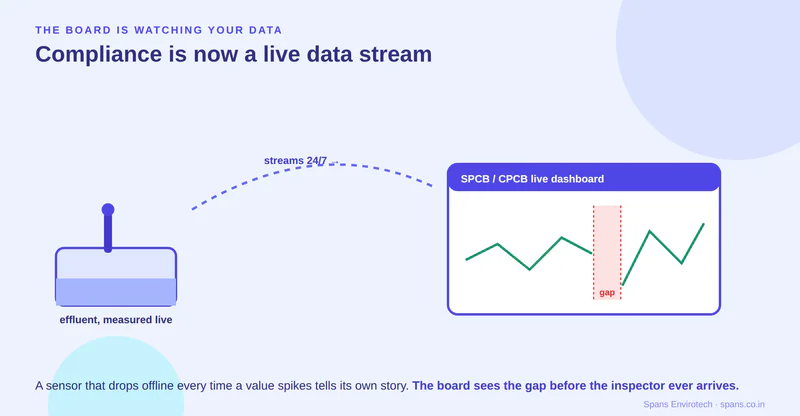
Now the counterintuitive part, the reason we're writing this at all. The thing that gets most factories a show-cause notice is not dirty water. It is missing data.
Think about what the CPCB server actually receives. Every few minutes it expects a clean packet: correct schema, correct parameter tags, a valid timestamp, an in-range value. When any of that breaks, the server doesn't guess in your favour. It rejects the packet and logs a blank. And blanks are where the trouble starts, because a regulator cannot tell the difference between "my analyser was down" and "I switched it off because the number was ugly." A data gap during a spike looks exactly like a cover-up, whether or not it was one.
The ways this goes wrong are mundane and maddening. A DAHS server clock drifts by twenty seconds after an overnight update reboot, and suddenly every packet is flagged as a future or past timestamp and silently discarded. A flaky mobile link at a remote outfall drops packets on a monsoon evening. An analyser's reagent runs dry on a public holiday and nobody notices for three days. None of these is a pollution offence. All of them can read as one.
Calibration is the other quiet killer. An effluent flow meter or a COD analyser drifts over months if it isn't checked against a reference. Then an auditor turns up with a handheld meter, reads a different value from your live feed, and now you are not defending your water quality. You are defending your honesty, because a mismatch between your reported number and the auditor's number is the shape of alleged data manipulation, which under the Water Act is a far more serious accusation than an exceedance. CEMS calibration, done on a schedule and documented, is what keeps that conversation from ever starting. If your OCEMS is behaving oddly and you're not sure whether it's the process or the instrument, that is exactly the kind of thing worth talking through with people who run these plants before it becomes a notice.
Design the plant so the honest number is easy to send
Once you see it this way, a lot of engineering decisions reorganise themselves around one goal: make the true value cheap and continuous to produce, so you never have a reason to want a gap.
That is partly instrumentation discipline, redundant power for the DAHS, time synchronisation you actually verify, spare reagents, a technician who owns the analysers. But it is mostly upstream. An ETP that runs stably produces a boring, flat data trace, and boring is exactly what you want the regulator to see. The plants that panic about their live feed are usually the ones whose treatment is marginal, riding just under the limit, so every load swing threatens an exceedance and every exceedance is now public in real time. The fix for a scary dashboard is rarely a cleverer data trick. It is more treatment margin, which an honest energy and process audit will usually find hiding in a plant that was designed for a report card, not for a livestream.
Continuous monitoring wasn't invented in India; the idea of a continuous emissions monitoring system piping data to a regulator has decades of precedent abroad. What is genuinely new is the directness. The board no longer asks you for your data. It already has it, timestamped, before it decides whether to visit.
So the real shift OCEMS and CEMS brought to Indian industry isn't stricter limits. The limits were always there. What changed is that compliance stopped being a thing you demonstrate on request and became a thing you broadcast, continuously, to an audience that never looks away. The old skill was passing an inspection. The new skill is running a plant clean enough, and instrumented well enough, that you would happily hand anyone the live feed. When your data can file its own show-cause notice, the only safe strategy is a plant that has nothing it needs to hide.
Spans
Spans empowers businesses around the world to grow faster and profitable while using less energy and water.
Visit Site