
Membrane Bioreactor (MBR): When It Earns Its Premium, and When It Doesn't
The most land-hungry object in a conventional sewage plant is the one that treats nothing. The secondary clarifier holds no active biology, breaks down no pollu..

Contents
The most land-hungry object in a conventional sewage plant is the one that treats nothing. The secondary clarifier holds no active biology, breaks down no pollution, and spends its whole life doing one slow job: letting sludge sink so that clearer water can slide off the top. On a mid-sized plant it can swallow a quarter of your plot. And a membrane bioreactor, stripped of the brochure language, is really just one decision. Stop settling the sludge, and filter it out instead.
That is the whole of MBR. Everything the technology is famous for, good and bad, follows from that single swap.
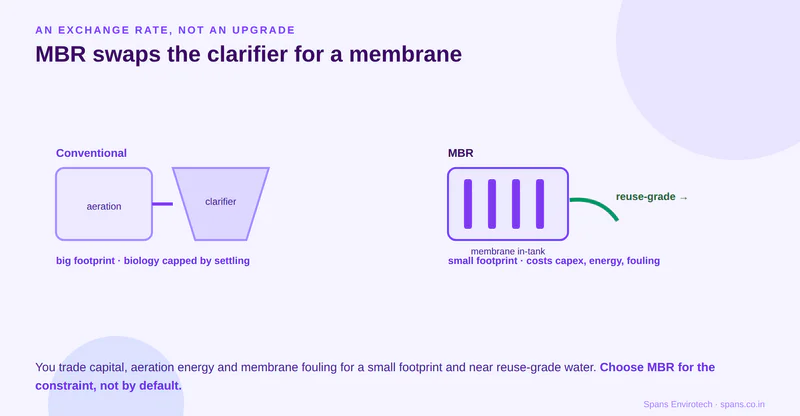
What the membrane actually replaces
MBR stands for membrane bioreactor, and the full form tells you almost nothing useful, so let us be concrete about the process. You still have the same aeration tank full of hungry bacteria that any activated sludge plant has. The bugs still eat the organic load, you still blow air into them, the biology is unchanged. The difference is at the back end. Instead of piping the mixed liquor to a clarifier and waiting on gravity, you drop micro- or ultrafiltration membranes (pore sizes roughly 0.01 to 0.4 micron) straight into the tank and draw clean water through them. Solids, bacteria, most pathogens: none of it fits through the pore. What comes out is near-tertiary water, TSS under 5 mg/l, low turbidity, ready for reuse or as clean feed to an RO.
Once you see that the membrane is simply doing the clarifier's job, the two advantages MBR is sold on stop being magic and start being obvious.
The clarifier was never just occupying space. It was quietly capping how concentrated your biology could be, because sludge only settles if it is not too thick. A conventional plant therefore lives around 2,000 to 4,000 mg/l MLSS. Push much past that and the settling breaks down. A membrane does not care whether sludge settles; it filters regardless. So an MBR runs at 8,000 to 12,000 mg/l and beyond, which means the same amount of treatment fits into a fraction of the tank volume. That is your small footprint, and it is not a marketing claim, it is arithmetic.
And because the barrier is physical rather than gravitational, the effluent is disinfected-grade by construction, not by luck. That is your reuse quality.
Where the bill lands
None of this is free, and here is where the honesty has to come in. MBR does not remove cost. It moves it, into three places.
Capex first. Membranes are expensive, and they are consumables with a finite life, so you will replace them. An MBR plant carries a higher upfront number and a rebuild cost quietly baked into year seven or eight.
Energy second. Thicker liquor is harder to oxygenate, so higher MLSS means you blow more air just to keep the biology fed. On top of that you run continuous cross-flow scour air along the membrane surface to hold fouling back. Aeration is already the largest single line on most treatment-plant power bills, and MBR pushes it up further.
Fouling third, and this is the one that catches people out. The membrane's entire value is that nothing gets through it, which is precisely why material piles up on it. Cake, biofilm, scaling: the pores blind over, flux drops, and you fight it with air scour, chemical cleans and the occasional soak. Managing fouling is a genuine slice of MBR operating cost, and a plant left to an operator who lets it slide will slowly choke.
So the trade states cleanly. MBR buys you space and water quality, and it pays for them in money and energy. It is not a "better" sewage plant. It is a different exchange rate.
MBR vs MBBR vs plain activated sludge
Most of the confusion in this market sits here, because the names rhyme and the sales decks blur them. A quick sort.
Conventional activated sludge is the baseline: cheap air, big tanks, a clarifier, ordinary effluent that usually needs a tertiary polish before anyone can reuse it.
MBBR, the moving bed biofilm reactor, is a different upgrade altogether. It grows biofilm on floating plastic carriers, so you pack more treatment into a tank without adding volume. But notice what MBBR does not remove: it still needs a clarifier or tube settler at the back, because you still separate solids by gravity. MBBR intensifies the biology; it does not, on its own, hand you membrane-grade water. If you want the long version, we have written a full MBBR vs MBR guide that walks through both.
MBR is the one that deletes the clarifier. That is the real line in the sand. MBBR keeps gravity separation and adds biofilm; MBR replaces gravity separation with a membrane. They are less rivals than answers to different questions, and plenty of good plants run them in series, MBBR biology feeding an MBR barrier.
So when does the premium actually pay
Here is the decision we walk clients through, and it has nothing to do with which technology is newest.
Name your binding constraint. If it is plot area, and you genuinely cannot fit a clarifier and a tertiary train, MBR earns its keep, because it delivers both inside one tank. A basement STP under a city high-rise is the textbook case.
If it is effluent quality, and you must feed an RO for reuse or hit a spec tight enough for flushing, cooling and landscaping, MBR earns its keep again, because it produces that water directly and protects the downstream RO membranes from fouling. With India's reuse rules now pushing bulk water users to recycle a rising share of their wastewater and report it monthly to the pollution boards, more plants are landing in exactly this bracket. The US EPA's water reuse framework and the CPCB's reuse guidance both point the same direction.
But if you have land, and your effluent only has to meet discharge norms, MBR is a premium you are paying for nothing. A well-run conventional or MBBR plant will clear the same standards at lower capex and a far gentler energy bill. Buying MBR here is like buying a sports car to sit in traffic.
That is the entire argument. MBR is neither the default nor the villain. It is a machine that converts money and energy into space and reuse quality, at a fixed and unforgiving exchange rate if you do not actually need what it is selling.
The mistake we see most often is not choosing MBR. It is choosing it before anyone has named the constraint it is meant to solve. Decide that first: is your problem land, or reuse, or neither? The honest answer picks the plant for you. And if you are staring at a plot plan and a reuse target and cannot yet tell which way it points, that is a good afternoon's conversation, and one we are always glad to have with you.
Spans
Spans empowers businesses around the world to grow faster and profitable while using less energy and water.
Visit Site