
MBBR vs Activated Sludge: You're Choosing Which Problem You'd Rather Have
Whenever someone asks us to settle "MBBR vs activated sludge," they want a winner. A clean verdict, a better technology, a box to tick. And we've learned to slo..
Contents
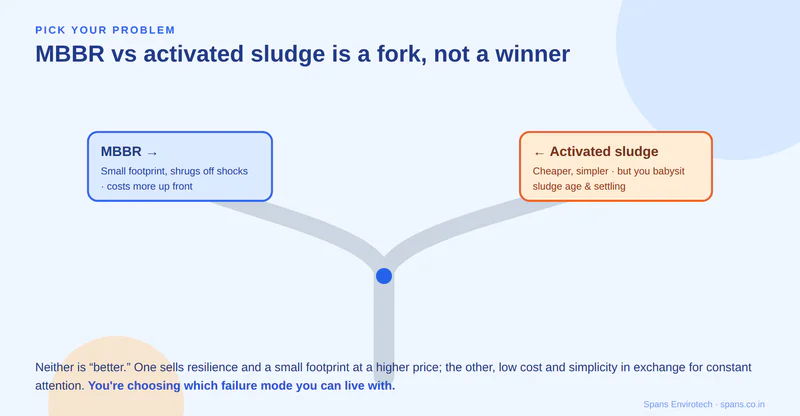
Whenever someone asks us to settle "MBBR vs activated sludge," they want a winner. A clean verdict, a better technology, a box to tick. And we've learned to slow down at exactly that moment, because the honest answer isn't a winner. Both processes treat water. Both have kept factories compliant for decades. What actually differs is the kind of trouble each one hands you — and you don't get to choose no trouble. You only get to choose which trouble.
So the real question, the one worth an afternoon of your attention, isn't "which is better." It's "which failure mode can I live with?" Let me make the trade honest in both directions, because most comparisons you'll read are quietly selling one side.
What activated sludge actually sells you
The activated sludge process is the old workhorse, and it's old for good reasons. It's cheap to build. There's no media to buy, no carriers, no fine screens on every outlet — just tanks, aeration, and a clarifier. The engineering is a century deep; every consultant, every operator, every pump vendor in India understands it in their bones. If your load is steady and your budget is tight, that simplicity is worth real money.
But here's what you're signing up for. In activated sludge the biology stays in the tank only because you catch it in the clarifier and pump it back. That means you are, forever, managing a living population that wants to escape. You babysit the sludge age. You watch your MLSS like a hawk. You waste sludge on a schedule, and if you get the wasting wrong the whole culture drifts. Worst of all, the entire system leans on one fragile step — settling. The day the sludge stops settling well, whether from a filamentous bloom, a temperature swing, or a slug of oil, your biology floats over the weir and out of the plant. Precisely on your worst day, the process punishes you.
And it hates surprises. Activated sludge is happiest with a load that looks the same every shift. Swing the flow or the strength — a batch dump, a weekend shutdown, a seasonal product change — and the culture struggles to keep up. The failure mode is a biology failure mode: it's slow, it's finicky, and recovering a crashed culture can take weeks. That's the trouble you're buying. Low cost and deep familiarity, paid for with constant vigilance and fragility under load swings.
What MBBR actually sells you
Now the other side, and it deserves the same honesty. MBBR grows its biology as a biofilm on floating carriers that never leave the tank, so it stops depending on settling to hold the population. That single change buys you two things activated sludge can't easily offer: resilience and a small footprint. The biofilm shrugs off load swings because it isn't relying on a clarifier that might fail; a slug of load just gets eaten faster by biology that stays put. And because capacity is set by carrier surface rather than tank volume, MBBR fits treatment into a fraction of the space — which is why it wins nearly every crowded retrofit.
But it is not free, in two senses. It costs more up front — the carriers are real money, and the tank needs proper aeration and good screens. And it doesn't abolish the babysitting; it relocates it. Your worry is no longer sludge age and settling. Your new worry is media retention: the screens on every outlet that keep carriers in the tank. Blind a screen and heads rise; break one and your expensive media flows into the next unit, or out of the plant entirely. You worry about whether the bed is genuinely circulating or sitting dead in the corners. You worry about the fine screens upstream, because rags and grit that activated sludge would tolerate will clog an MBBR's outlet mesh.
So the MBBR failure mode is a mechanical one — screens, aeration, circulation. That's the honest trade. It's arguably a nicer class of problem to have, because mechanical failures are visible and fixable in hours, where a crashed biological culture takes weeks. But it's a real problem, with a real capital bill attached, and anyone who tells you MBBR is maintenance-free has never fished carriers out of a downstream sump at 2 a.m.
How to actually decide
Strip away the salesmanship and the choice comes down to a few honest questions about your own site.
How much does your load swing? Steady flow and strength all year favours activated sludge — you get its low cost without paying much for its fragility. Big daily or seasonal swings favour MBBR, whose resilience is exactly the thing you'd be buying. How much land do you have? A tight, built-up site tilts hard toward MBBR's footprint; a greenfield plot with room to spare removes one of MBBR's biggest advantages. What's your capital position versus your operating tolerance? A lean build budget and skilled operators who don't mind watching a culture points to activated sludge. Higher capital but a preference for a plant that mostly looks after itself points to MBBR. And what's already in the ground — because upgrading an overloaded activated sludge tank by adding carriers is often the cheapest good answer of all, keeping the concrete and buying the resilience.
Whichever way you lean, meeting the discharge norms is the floor, not the deciding factor — both processes clear it when designed and run properly. The decision lives above that floor, in which ongoing headache fits your operation. If your real choice is between these two, our longer MBBR vs activated sludge comparison lays out the numbers side by side, and if you're weighing a membrane route as well, the MBBR vs MBR guide extends the same honest framing to that third option. When you want to test it against your actual flow and strength, the sizing calculator is a fair place to start.
Here's the reframe to leave with. "Which is better" is the wrong question because it assumes one of them has no downside, and neither does. You're not choosing a winner. You're choosing whether you'd rather spend your years babysitting a biology that wants to leave, or maintaining the screens that keep your carriers home. Pick the trouble you'd rather have — and if you're not sure which that is for your plant, that's exactly what a conversation with us is for.
Spans
Spans empowers businesses around the world to grow faster and profitable while using less energy and water.
Visit Site