
MBBR Media: The Part Everyone Treats as a Commodity (and Shouldn't)
There's a moment in a lot of MBBR projects where someone buys the media the way you'd buy sand. A sack, a price per cubic metre, a quick glance at the number pr..
Contents
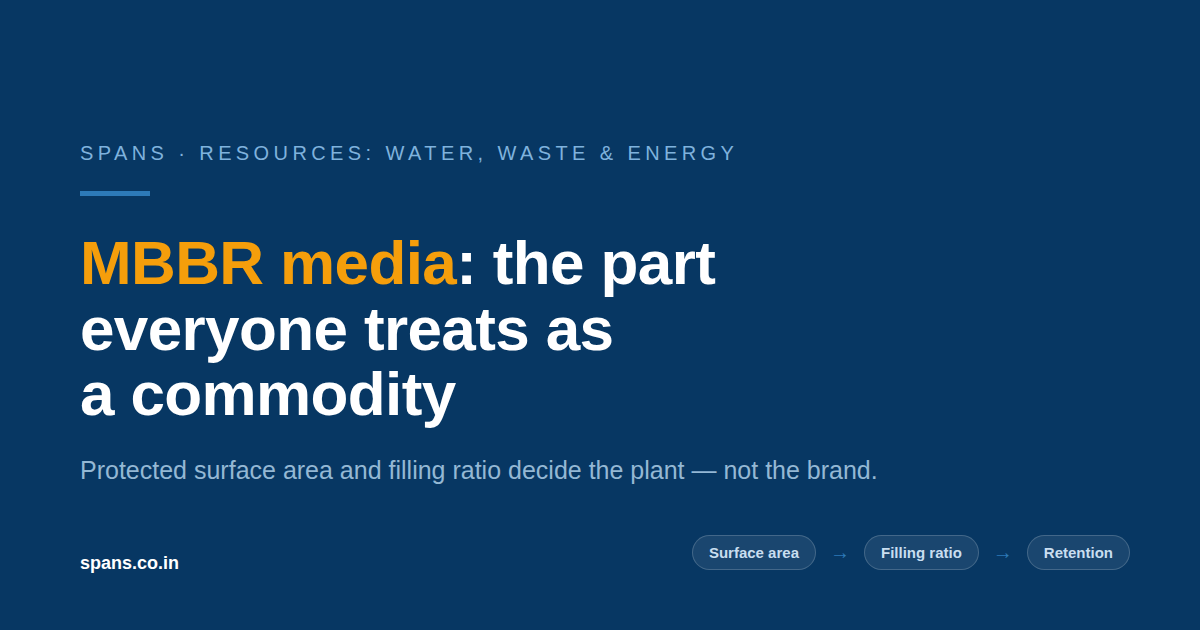
There's a moment in a lot of MBBR projects where someone buys the media the way you'd buy sand. A sack, a price per cubic metre, a quick glance at the number printed on the datasheet, done. It feels like a commodity. It looks like a commodity — small plastic bits, more or less identical, sold by the lot. And that instinct, that entirely reasonable instinct, is how a good design quietly becomes a disappointing plant.
Because the media isn't the sand of the process. It's closer to the soil. And nobody who's grown anything thinks all soil is the same.
Let me explain what I mean, because the mistake is subtle and it hides behind a real number.
The number that lies to you
Every carrier is sold on its specific surface area — square metres of surface per cubic metre of media. Bigger number, more room for biofilm, more treatment. So buyers do the obvious thing: they compare the numbers and pick the biggest one per rupee. A carrier boasting 800 m²/m³ must be better than one offering 500, right?
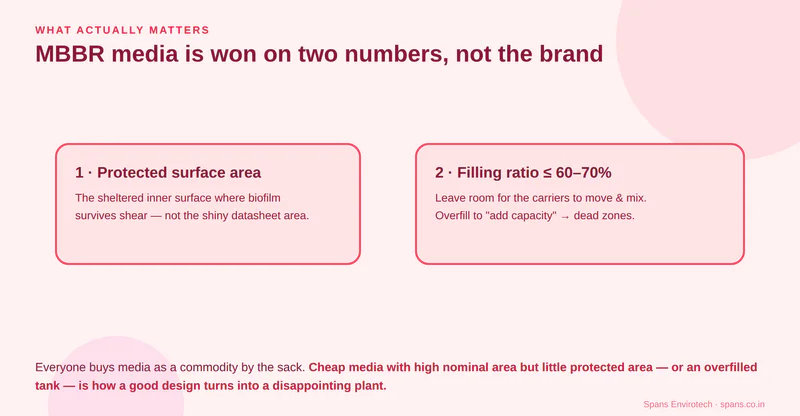
Here's the thing. That headline number is the nominal or total surface area, and a large part of it is on the outside of the carrier. And the outside is the worst place in the tank to be a bacterium.
Think about what's actually happening inside a working MBBR reactor. The carriers are tumbling, colliding, scraping past each other in a violent, aerated churn. That churn is not gentle. Biofilm on an exposed outer surface gets sheared off almost as fast as it grows — scoured away by collision and turbulence. So the outer area contributes far less than its square-metre count suggests. The biology that survives, matures, and does the steady work of eating your COD and ammonia lives in the protected interior — the sheltered channels, the recessed cross-sections, the little rooms inside the wheel where a biofilm can thicken without being scrubbed off every few seconds.
This is why serious carrier design is all about geometry, and why the research literature on biofilm carriers keeps distinguishing total surface area from effective or protected surface area — the fraction that actually holds a stable biofilm under shear. The academic version of the moving bed biofilm reactor makes the same point in drier language: it's the internal, protected surface that governs performance. A cheap carrier can post an enormous nominal number and deliver a fraction of it in practice, because most of that area is out in the storm.
So the first thing that separates media that works from media that photographs well: how much of that advertised surface is actually protected. Two carriers with the same headline 600 m²/m³ can differ by a factor of two in the area that matters. You cannot see this in the price, and you often can't see it in the spec sheet either. You have to know to ask.
Then people overfill the tank
Suppose you've bought genuinely good media. There's a second, even more common way to throw the advantage away, and it comes from a perfectly natural impulse: if biology lives on carriers, and I want more biology, I should stuff in more carriers.
So the tank gets filled to 75%, 80%, higher. And performance gets worse, which baffles everyone, because surely more media means more treatment.
It doesn't, and the reason is movement. The carriers only work if they circulate — every carrier needs to travel through the aerated, oxygen-rich, food-rich zones and back again. That circulation needs empty water to move through. Fill ratio is the fraction of the empty tank volume you pack with carriers, and past a point, the carriers get in each other's way. The bed stops tumbling and starts churning as a sluggish mass. Dead zones appear. The biofilm in the middle of the crowd goes hungry and anaerobic; you start smelling it before you can measure it. This is why the sane filling ratio for MBBR sits at or below 60–70% — you're leaving room for the whole population to keep moving. Push past it chasing more surface, and you lose more to poor circulation than you ever gained by adding carriers.
The two mistakes compound beautifully. Buy media that's mostly unprotected surface, then overfill the tank to compensate for the disappointing results, and you've built a plant that's worse than if you'd used less of something better. We've walked into tanks exactly like this — packed to the brim, media that looked impressive in the sack, effluent that wouldn't meet the discharge norms on a good day. The fix was almost insulting in its simplicity: remove media and replace it with a better carrier. Less product, better result. Try explaining that invoice.
What this means when you buy
None of this is an argument for expensive media as a badge. It's an argument for buying on the two things that actually determine whether the design lands: protected specific surface area, and a filling ratio that keeps the bed alive. Get those right and ordinary-looking carriers give you a plant that hums for years. Get them wrong and the fanciest media in the world can't save you.
So the questions to ask aren't about brand or colour or the size of the headline number. They're: how much of this surface is protected under real shear? What fill ratio is this design assuming, and is it honest? Does the carrier geometry actually shelter a biofilm, or does it just maximise the number on the page? We wrote a longer MBBR media buyer's guide that walks through exactly these checks, and the design parameters that tie surface, fill ratio and load together — because the media never makes sense in isolation, only against the load it has to carry. If you want to see how surface area maps to your numbers before you commit to anything, the sizing calculator is a decent starting point.
The deeper point is just this. The media looks like the most commoditised part of the whole system, and it's secretly the part where the project is won or lost. Treat it like sand and you'll pay for it in effluent quality for a decade. Treat it like soil — the thing your entire biology has to live in — and you'll understand why two plants with identical drawings can perform nothing alike. When you're ready to buy, buy on protected area and honest fill ratio, not on the sack. If you'd like a second pair of eyes on a spec before it becomes a plant, that's a conversation worth having early, and we're always happy to talk it through as your media supplier.
Spans
Spans empowers businesses around the world to grow faster and profitable while using less energy and water.
Visit Site