
The Level Sensor Spec Sheet Won't Tell You What Actually Defeats It
A level sensor's spec sheet will tell you its accuracy to the millimetre. It will not tell you that a centimetre of foam on an aeration tank will make an ultras..

Contents
A level sensor's spec sheet will tell you its accuracy to the millimetre. It will not tell you that a centimetre of foam on an aeration tank will make an ultrasonic unit report a level that is simply wrong, confidently and continuously, with no fault flag raised anywhere.
This is the thing nobody tells you when you are picking instrumentation for a wet well or a tank: the question is never "which sensor is best". It is "what, specifically, is trying to defeat each sensor at this exact spot", and the answer changes tank to tank, even within the same plant.
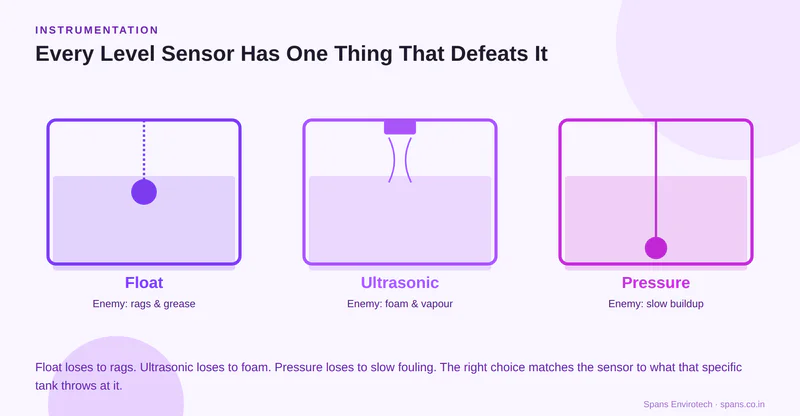
Three technologies, three different enemies
Float switches are the oldest and simplest option: a buoyant float rides up and down a guide rod, triggering a switch at set points. They are cheap, they need no power to fail safe, and a redundant high/low pair is still how most wet wells start and stop their pumps. Their enemy is anything fibrous. Rags, grease, and wipes (the same debris a bar screen exists to catch upstream) snag the float or coat the guide rod, and a stuck float either runs a pump dry or floods a wet well while looking perfectly normal on the panel.
Ultrasonic sensors, mounted above the liquid with no contact at all, solve the fouling problem entirely: nothing sits in the water to snag or coat. They give continuous measurement instead of a simple point, which is what you want for level control rather than just pump start/stop. Their enemy is anything that scatters or absorbs the return signal: foam, heavy splashing near an inlet, and steam in an enclosed tank. An aeration tank with any surfactant load, which describes a lot of industrial effluent, is close to the worst-case environment for this technology, even though it looks like the obvious choice on a datasheet.
Submersible pressure sensors sit in the liquid and measure the head pressure pushing on a diaphragm. Foam, turbulence and vapour do not touch this measurement at all, which is precisely where ultrasonic struggles. Their enemy is exactly what defeats a float: since the diaphragm sits in the liquid, grease and biofilm build up on it over months, and an uncleaned sensor drifts quietly rather than failing obviously. If you (or our team, since this is our contact page) are speccing instrumentation for a genuinely difficult tank, this is usually the conversation worth having before ordering anything.
There is a fourth option worth naming for the genuinely hostile cases: radar level sensors work on the same non-contact principle as ultrasonic but at a much shorter wavelength, which makes them far less bothered by foam and vapour. They cost more, which is exactly why they are worth reserving for the one or two tanks on a site where both ultrasonic and pressure struggle, rather than specifying everywhere out of caution. A sensor budget spent evenly across every tank usually means the worst tank is still under-specified and the easiest tank is over-specified.
The failure nobody notices until the pump runs dry
The float-versus-ultrasonic-versus-pressure decision would be an academic one if the failure modes were obvious. They rarely are. A pressure sensor with a slowly fouling diaphragm does not throw an alarm. It reports a level that drifts a little further from the truth every week, and a pump controlled off that reading starts running dry, or a wet well starts backing up toward a manhole, well before anyone reads the trend and asks why. We have seen a plant lose a submersible pump to dry-running for exactly this reason: the sensor was never wrong enough, on any single day, to look wrong.
Match the enemy, not the spec sheet
Once you frame it this way, selection stops being a features comparison and becomes a question about the specific tank.
- A raw sewage wet well, full of rags and grit, punishes a float switch. A submersible pressure sensor in a protective stilling pipe, or a non-contact option mounted well clear of the inlet splash zone, survives longer.
- A clarified or filtered water tank, with no foam and no fibrous solids, is close to the best case for ultrasonic: cheap, nothing in the water, easy to service.
- An aeration tank with visible surface foam is close to the worst case for ultrasonic and the best case for submersible pressure, provided someone actually cleans the diaphragm on a schedule rather than assuming it is maintenance-free because it has no moving parts.
- A tank where continuous compliance monitoring matters, feeding data to an OCEMS system that a regulator can audit, needs a technology whose failure mode is a flagged fault, not a silently plausible wrong number. That pushes the choice toward whichever option is least likely to drift undetected in that specific tank, which is not the same answer in every tank on site.
None of this requires exotic instrumentation. A plant with three different tank conditions can reasonably run three different sensor technologies, and that is not indecision, it is the correct answer once you have actually asked what would defeat each option where it is installed.
Why this matters more than the accuracy number
Every sensor vendor leads with accuracy, because it is the easiest number to put on a datasheet and the easiest one to compare across brands. But a sensor that is accurate to two millimetres and defeated by foam is less useful, in that specific tank, than one accurate to two centimetres that simply keeps working. The plants that get instrumentation right are not the ones that bought the most precise sensor. They are the ones that asked, tank by tank, what was actually going to try to break the reading, and bought for that.
That question costs nothing to ask and gets skipped constantly, usually because the person specifying the sensor is working from a catalogue rather than standing next to the tank. A five-minute walk around the site, noting where foam sits, where rags collect, and where a splash zone reaches, tells you more about which sensor will actually survive than any comparison chart, because the chart is describing the sensor and the walk is describing the tank.
The instrumentation industry sells technology. The job in front of you is choosing which technology loses to which enemy the least, in the one tank you are actually standing next to.
Spans
Spans empowers businesses around the world to grow faster and profitable while using less energy and water.
Visit Site