
Industrial Water Treatment Cost: The Number That Matters Least Is the One Everyone Negotiates
Every procurement team we meet does the same thing. They line up three or four vendor quotes, they find the cheapest capital number, and they negotiate it down ..
Contents
Every procurement team we meet does the same thing. They line up three or four vendor quotes, they find the cheapest capital number, and they negotiate it down another eight percent. Then they sign, feel like they won, and spend the next fifteen years quietly paying for it.
Here is the uncomfortable truth about industrial water treatment cost: the number on the front page of the quote, the CAPEX, the thing everyone negotiates, is the number that matters least. It is real money, yes. But it is a one-time payment for an asset you will run for a decade and a half. The bill that actually decides whether this plant was a good decision is the operating bill, paid every single month, and almost nobody puts it in the tender.
The iceberg you're actually buying
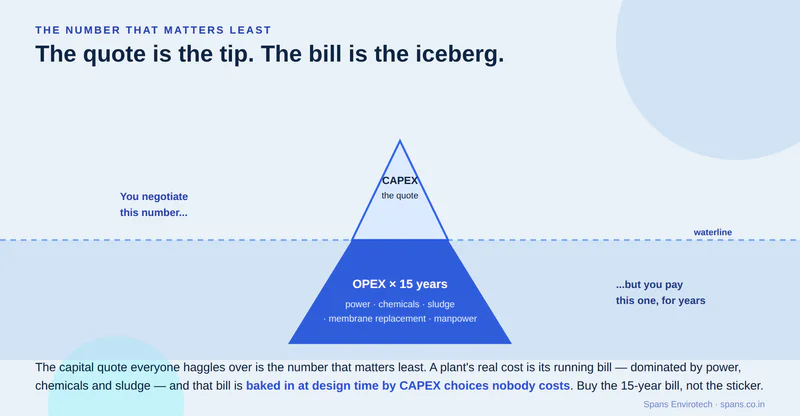
Think of the plant as an iceberg. The capital quote is the tip above the waterline: visible, easy to compare, the thing you point at and haggle over. Below the waterline sits the mass you don't see at signing: power, chemicals, sludge disposal, membrane replacement, manpower. Over fifteen years that submerged mass dwarfs the tip. On most industrial effluent plants we've costed, the lifetime OPEX runs two to four times the original CAPEX. You are not buying a machine. You are buying a monthly bill with a machine attached.
And here is the part that catches people. OPEX is not a separate thing you get to optimise later, once the plant is running and you've "settled in." It is baked in at design time, by CAPEX decisions nobody bothered to cost. This is the whole CAPEX versus OPEX argument in one line: the two numbers are not independent. Skimp on the tip of the iceberg and you grow the part underwater. The cheapest plant to build is very often the most expensive one to own.
Here is where that trade actually lives.
Where the running cost actually goes
Walk any effluent treatment plant OPEX bill with us and it breaks into five buckets, roughly in order of who hurts you.
Power, and power mostly means aeration. In a conventional biological plant, the blowers feeding air to the aeration tank draw more electricity than everything else combined, commonly half to two-thirds of the plant's entire power bill. That is not a fixed cost of nature. It is a design choice. A plant built with a cheap fixed-speed blower and a crude on/off control will over-aerate for years, dumping oxygen the bugs never asked for, because dissolved-oxygen control cost extra at the tender stage and got value-engineered out. Fit dissolved-oxygen-based variable-speed control and fine-bubble diffusers instead of coarse ones, and the same treatment happens on a fraction of the air. We've written separately about aeration systems because this single subsystem quietly writes the biggest cheque in your OPEX. The Bureau of Energy Efficiency has been pushing industry toward exactly this kind of motor and drive efficiency for years. The physics is settled; only the specification is negotiable.
Chemicals. Coagulants, flocculants, acid and alkali for pH correction, antiscalants, nutrient dosing. The daily chemical bill is set almost entirely by two things you decide at design: the quality of your pre-treatment and whether your dosing is manual or automated. A plant with weak equalisation and no inline instrumentation gets dosed by an operator watching a jar test, which means dosed generously, which means for years. Good pre-treatment is the cheapest chemistry you will ever buy.
Sludge disposal. Every kilogram of solids you generate is a kilogram you dewater, cart off-site, and pay a landfill or incinerator to take, often as a notified hazardous waste. A plant designed to minimise chemical sludge and dewater it hard produces a fraction of the tonnage of one that doesn't. This line item rarely appears in the sales pitch and never stops appearing in the ledger.
Membrane replacement. If your plant has an RO or ultrafiltration stage, the membranes are consumables with a life measured in a few years. Whether they last two years or five is decided upstream, by whether the pre-treatment protects them or lets them foul and scale. Replace a full RO train early because you saved money on softening, and you've paid for the softening several times over.
Manpower. Skilled operators, round the clock, for fifteen years. A well-instrumented, well-automated plant runs on fewer hands and fewer 2 a.m. panic calls. A cheap, manual plant is labour-hungry forever.
Look at what those five buckets have in common. Four of them are sized by decisions made before the plant is ever switched on, decisions that live in the CAPEX quote as line items you could cut to win the negotiation.
The trade you're actually making
So when a vendor sharpens their pencil to beat a competitor's price, ask where the pencil went. Did they drop to a fixed-speed blower? Coarse-bubble diffusers? Thinner pre-treatment ahead of the membranes? Manual dosing instead of automated? Each of those shaves the tip of the iceberg and grows the mass beneath it. You will pay the difference back with interest, monthly, in power and chemicals and dead membranes, for as long as the plant runs. The US EPA has published life-cycle costing frameworks for exactly this reason: the honest way to compare treatment options is total cost of ownership, not first cost. And yet first cost is almost always what gets compared.
This is why the smart way to buy a plant inverts the whole process. Instead of asking "what does it cost to build," you ask "what does it cost to run for fifteen years." Make every vendor hand you a projected annual OPEX (power in kWh, chemicals in rupees per kilolitre, sludge tonnage, membrane replacement cycle, headcount) and add fifteen years of it to their capital number before you compare anything. Suddenly the cheapest quote is usually not the cheapest plant. The two answers can be near inverses of each other. If you want to see this for yourself before you ever talk to a vendor, our ETP energy calculator lets you watch the aeration bill move as you change the blower control, which is the single most honest number in the whole exercise.
And once the plant is built, the same logic keeps paying. Most of the ways to reduce ETP OPEX after commissioning, whether tuning aeration to real dissolved-oxygen demand, automating dosing, or recovering water to cut fresh-water and discharge costs, are just retrofits of the decisions a cheaper tender left out. Even the economics of a ZLD plant, where energy dominates everything, are really this same argument turned up to full volume.
India is going to keep tightening the screws on industrial water. NITI Aayog has been blunt that water-stressed industry has to treat and reuse, not just discharge, which means these plants are becoming permanent fixtures, not compliance afterthoughts. A permanent fixture is bought on its lifetime bill or it is bought badly.
So stop negotiating the sticker price. Start negotiating the fifteen-year bill. Ask every quote to show you what it costs to run, not just what it costs to build. If the vendor can't or won't answer that, you've learned the most important thing about the plant before you've spent a rupee. When you're ready to cost yours the honest way, talk to us. Bring the flow and the effluent analysis. The cheap quote can wait.
Spans
Spans empowers businesses around the world to grow faster and profitable while using less energy and water.
Visit Site