
Industrial Water Reuse: Stop Asking 'Can We?' and Start Asking 'Which Water, For What?'
Almost every conversation about industrial water reuse we walk into starts with the same question: "Can we reuse our water?" And it's the wrong question. Not be..
Contents
Almost every conversation about industrial water reuse we walk into starts with the same question: "Can we reuse our water?" And it's the wrong question. Not because the answer is no — the answer is almost always yes — but because the question quietly smuggles in an assumption that goes on to wreck the project. It assumes there is one thing called "our water," and that reusing it means turning all of it back into something clean enough to trust.
That assumption is what makes reuse look expensive. And it's why so many well-meaning plants end up costing out a heroic all-or-nothing scheme, staring at the number, and deciding the whole idea was never practical to begin with.
Let me explain what actually goes wrong.
The single-grade trap
Here's the pattern we see again and again. A factory decides to reuse treated effluent. Someone sizes a scheme. To be safe — because nobody wants to be the engineer who fed dodgy water into something important — the whole recycled stream gets treated to the highest quality any point in the plant might need. Usually that means pushing everything through reverse osmosis and delivering RO permeate to every tap that gets reused.
RO permeate is beautiful water. It is also expensive water. You pay for the membranes, you pay for the power to push water through them, you pay for the antiscalant and the cartridge filters, and — the part everyone forgets — you generate a reject stream, 20 to 30 percent of your feed, that is now saltier and harder to get rid of than the effluent you started with. So you've spent a lot of money and you still have a disposal problem, just a smaller and nastier one.
Then the plant looks at where all this pristine, costly water is going. And a lot of it is going to cooling tower make-up. Or floor washing. Or ash quenching. Or gardening. Uses that would have been perfectly happy with water an order of magnitude cheaper to produce.
That's the trap. You treated everything to the standard of your most demanding user, then handed that gold-plated water to your least demanding ones. Of course it didn't pay back.
Water has grades. So do your uses.
The reframe is simple, and once you see it you can't unsee it. Water inside a factory is not one thing. It's a spectrum of qualities. And the uses inside a factory are not one thing either — they're a spectrum of requirements. The whole art of industrial water reuse is lining those two spectrums up.
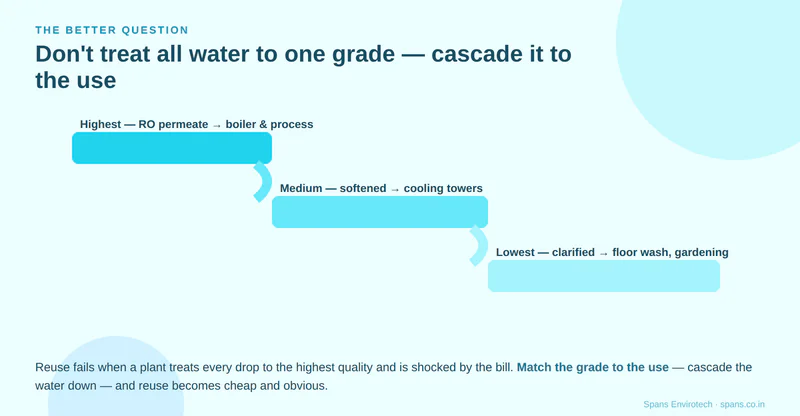
Boiler feed sits at the top. It genuinely needs very low dissolved solids, low hardness, low silica — feed it anything else and you'll be chasing scale and carryover for the rest of the boiler's life. Process water that contacts your product may need to be that clean too, or cleaner, depending on what you make. Fair enough. Those uses earn their RO.
But now come down the ladder. Cooling towers can tolerate a surprisingly wide band of quality; what they care about is scaling and biological fouling tendency, not ultra-purity, and they're often run at cycles of concentration that make polished water almost wasteful. Floor and equipment wash-down needs water that's clean and non-odorous, not demineralised. Ash handling, dust suppression, quench, landscaping, first-stage rinses — these will drink your secondary or tertiary treated effluent quite happily. This is what water recycling in industry actually looks like in the field: not one pipe of perfect water, but a cascade.
So the real question is never "can we reuse our water?" It's: which water, for what? Map every reuse point to the minimum quality it actually needs — not the quality that feels safe, the quality it needs — and then produce each grade with the cheapest treatment that reliably hits it. Suddenly reuse stops being one enormous RO project and becomes a set of small, obvious, well-paid moves.
What grade-matching looks like in practice
Start by walking the plant with two lists. On one, every stream you discharge, with its rough quality. On the other, every place you draw fresh water, with the quality that use genuinely requires. Most plants have never put these side by side, and the first time they do, the mismatches jump out.
You'll usually find that the bulk of your fresh water demand — often the majority — is for uses that don't need anything like fresh-quality water. Cooling make-up and washing alone can dominate. That demand can frequently be met straight from tertiary-treated effluent with disinfection, no membranes involved. You reserve RO for the genuinely demanding uses, which are a smaller slice, so your RO plant is smaller, your reject is smaller, and your economics flip. We've written more about where treated effluent can and can't be reused across Indian industry, because the answer genuinely depends on what you make and where you sit.
If you want to sanity-check the arithmetic before anyone builds anything, our water reuse calculator lets you play with how much of your demand each grade can cover, so the cascade earns its keep on a spreadsheet before it earns it on site.
None of this means RO is the villain. When you do need high-grade water, a well-designed RO system for industrial wastewater reuse is exactly the right tool — the point is to aim it only at the uses that need it. And if regulation is pushing you all the way to zero liquid discharge, grade-matching matters even more, not less: every litre you can satisfy with cheaper water is a litre you don't have to force through the most expensive stages of the plant.
There's good external ground to stand on here too. The US EPA's work on water reuse is organised around fit-for-purpose quality — matching the grade to the application rather than over-treating — and India's own policy direction under NITI Aayog is pushing industry hard toward treating recycled water as a resource with grades, not a single compliance hurdle. Even the plain-language definition of reclaimed water is built around graded, purpose-specific use.
The question worth asking
So here's where we land. "Can we reuse our water?" invites a yes-or-no answer to a project you've already accidentally over-specified. "Which water, for what?" invites a map — and the map is where the money is.
The plants that make reuse pay aren't the ones with the fanciest membranes. They're the ones who stopped treating water as a single substance and started treating it as a graded resource, sending each grade exactly as far up the quality ladder as it needs to go, and not one rupee further.
If you want a second pair of eyes on your own two lists — what you discharge, and what you actually need — that's a conversation we're always happy to have. Bring the map. That's where it starts.
Spans
Spans empowers businesses around the world to grow faster and profitable while using less energy and water.
Visit Site