
Why a Water Audit Beats a New RO Plant (Almost Every Time)
A factory calls, and the sentence is almost always the same. "Our water bill has gone through the roof, the pollution board wants us to reuse, send us a quote f..
Contents
A factory calls, and the sentence is almost always the same. "Our water bill has gone through the roof, the pollution board wants us to reuse, send us a quote for an RO plant." Or a ZLD plant, or a bigger effluent treatment plant. The capex is already decided. We are being asked for a number, not an opinion.
The honest opinion, most of the time, is this: you do not yet know where your water goes, and until you do, any plant you buy is a guess wearing a decimal point. Not a wrong guess necessarily. Just an expensive way to find out something a cheap exercise would have told you first.
That cheap exercise is a water audit. It is boring, it barely shows up on a balance sheet, and it routinely finds the cheapest litres in the whole factory before anyone signs a purchase order. This piece is about why that ordering matters, and why the least glamorous line item on the list is usually the one that pays for the rest.
You cannot cut what you never measured
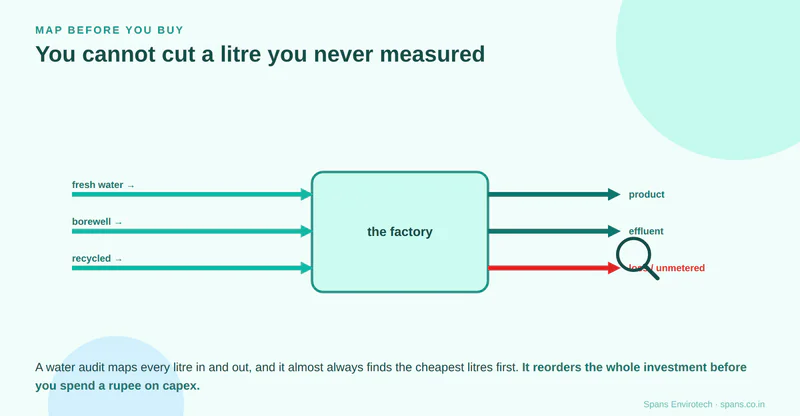
Here is the whole idea in one sentence. You cannot recover, reuse or reduce a litre you have never counted.
Most plants know exactly one number with confidence: the total on the municipal invoice, or the borewell running hours, or both. Everything downstream of the inlet is folklore. "Cooling takes most of it." "The dye house is the thirsty one." Maybe. We have opened enough valves to know that a plant's intuition about its own water is wrong about as often as it is right, and it is almost never right about magnitude.
A water audit is simply the discipline of turning folklore into a map. At its heart is a water balance: every drop that enters the boundary, set against every drop that leaves. Inputs are the easy half, municipal supply plus borewell plus whatever you already recycle. Outputs are the honest half: process consumption, cooling tower evaporation and blowdown, boiler make-up, washing and rinsing, domestic use, and effluent to the drain. When you draw that as a water balance diagram, arrows sized to real flows, two things happen. The big consumers announce themselves, and the gap announces itself louder. The gap, the water you paid for that does not show up in any output, is your unaccounted loss. It is also, usually, your cheapest win.
The audit finds the free litres first
The reason a water audit reorders the whole investment is that not all litres cost the same to save. Some are practically free.
A leaking cooling circuit that has been topping itself up for two years. A once-through rinse that runs to drain when it could cascade. A cooling tower with worn drift eliminators throwing water into the sky. An unmetered line feeding a section nobody quite owns. None of these need a membrane or a crystalliser. They need a wrench, a float valve, a re-piped overflow, sometimes just a meter and someone who cares about the reading. This is the recoverable loss, and the discipline of the audit is to chase it before you chase the hard stuff. Evaporation and blowdown are real losses too, but you cannot un-boil water. Prioritise what a spanner can fix over what only physics can.
We have walked plants where the "we need ZLD" conversation quietly became "we needed three float valves and a shared meter" after a fortnight of measurement. Not always. Sometimes the audit confirms that yes, you genuinely need to treat and recover at scale, and now you can size that plant against real numbers instead of a nameplate and a prayer. Either way the wastewater treatment cost you eventually commit to is a decision, not a flinch.
How a water audit actually runs
People imagine a water audit is a clever piece of software. It is mostly clipboards, meters and a fortnight of paying attention. The water audit methodology that most Indian practitioners follow, adapted from the IWA and AWWA water balance framework, breaks into four unremarkable stages.
First, survey and data collection. Walk the site, mark every inlet and outlet on a layout, pull twelve months of bills and borewell logs. Second, measurement. Temporary or clamp-on flow meters on the lines that matter, spot readings across a full production cycle, because a factory's water on a Monday and on a Sunday are different animals. Third, the balance and analysis. Reconcile inputs against outputs, quantify the loss, benchmark your specific consumption (litres per unit of product) against what similar plants achieve, which is really your water footprint in working clothes. Fourth, the water audit report: not a certificate for a file, but a ranked list of interventions, each with an indicative saving, a cost, and a payback. Fix the free things this quarter, plan the capex things for next year.
A good water auditor is worth the fee precisely because they distrust the obvious. They will meter the line everyone swears is small, and find it is not. The value is in the measuring, not the branding on the cover page.
Why now, and not next year
For years a water audit was a nice-to-have, because water in India was effectively free once the borewell was drilled. That era is closing.
Groundwater is no longer a bottomless, costless input. The Central Ground Water Authority now prices abstraction through charges that climb steeply as you move from Safe blocks into Semi-critical, Critical and Over-exploited ones, and its NOC conditions increasingly mandate telemetry meters that report your draw straight to the regulator's portal. States are moving too; several now levy per-cubic-metre charges on industrial groundwater use. When the meter is real and the tariff is real, every unaccounted litre is a line of pure, recurring loss. NITI Aayog has been blunt for years that large parts of the country face acute water stress, and factories are where that abstract warning turns into a bill.
So the pressure to reuse is genuine, and reuse is the right long-term direction. We help plants get there with RO, recycling and reuse schemes all the time, and there is good technical guidance in our industrial water reuse guide and even in bodies like the US EPA's water reuse material. But reuse designed on top of an unaudited plant recovers your waste and your wastefulness in the same pipe. You end up building membranes to purify water you should never have spilled. Map first, then reuse. The audit is what tells you how big the recovery job really is, and quietly shrinks it before you cost it.
There is a second dividend people miss. The same measuring habit that cuts water intake usually cuts the load and the energy on your treatment plant, because the litres you never contaminate are litres you never have to pump and aerate. If you have read our note on how to reduce ETP opex, this is the upstream version of the same argument.
So before the quote for the RO plant, ask for the map. A water audit costs a fraction of any capex it informs, it can usually be scoped in a couple of weeks, and it has an awkward habit of finding money that was leaking the whole time. If you want a rough sense of what recovery could return on your own numbers, our water reuse calculator is a fair place to start, and if you would rather just have someone walk the site with a meter and an open mind, that is a short conversation to have with us. Not because the audit is the exciting part. Because it is the part that decides whether everything after it is worth buying.
Spans
Spans empowers businesses around the world to grow faster and profitable while using less energy and water.
Visit Site