
The Hybrid Annuity Model (HAM) in Water Projects, Explained
India has built a great many sewage and water treatment plants that do not work. Not because the engineering was wrong, but because of how they were paid for. A..
Contents
India has built a great many sewage and water treatment plants that do not work. Not because the engineering was wrong, but because of how they were paid for. A contractor built the plant, collected payment for building it, and left; the municipality that inherited it had neither the money nor the incentive to run it well; and within a few years the plant was a concrete monument quietly bypassing sewage to the nearest drain. The Hybrid Annuity Model exists to fix that specific failure, and understanding it means understanding the two older models it sits between.
The two models it replaced
The EPC model is the traditional one. The government pays a contractor to engineer, procure and construct the plant, in instalments tied to construction milestones. The contractor's job ends at commissioning. The flaw is structural: the contractor is paid to build, not to make the plant work over time, and the government body left operating it is chronically short of funds and expertise. The result is the pattern above — plants built and then neglected.
The BOT (Build-Operate-Transfer) model swings the other way. A private developer finances, builds and operates the plant for a long concession, recovering the cost through the revenue it generates, and only later transfers it back. This aligns incentives beautifully — the developer must run the plant well to earn — but it dumps almost all the financing and demand risk on the developer. For sewage treatment, where there is no straightforward revenue stream from the water, few developers will take that risk, and those who do price it steeply. Bids are thin.
HAM is the deliberate hybrid of the two, designed to keep the accountability of BOT without the crushing risk that scares bidders away.
How HAM actually works
Under the Hybrid Annuity Model as used for water and sewage projects in India, the cost is split and, crucially, so is the timing of payment:
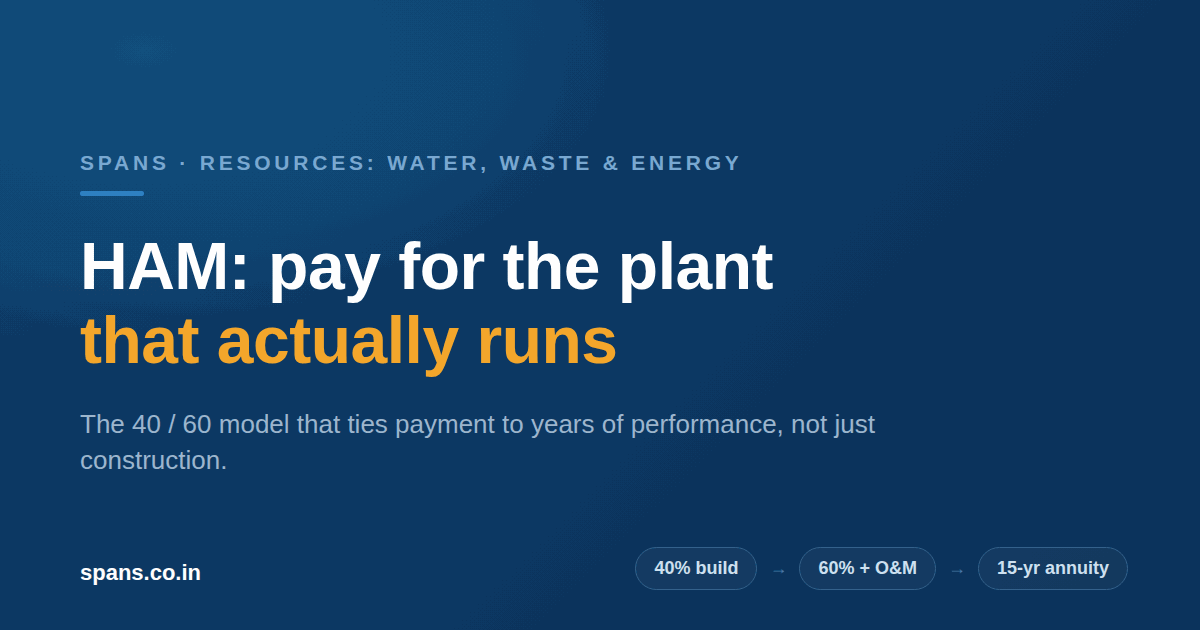
- The government pays roughly 40% of the capital cost during construction, released against milestones — enough to de-risk the build and keep developers interested.
- The developer funds the remaining 60% of capital, plus the entire operation and maintenance cost, out of its own pocket up front.
- The government then repays that 60% to the developer as annuities spread over the operating period — typically around 15 years — along with interest, and pays separately for O&M.
The mechanism hiding in that structure is the important bit: because 60% of the developer's money and all of its O&M return are paid out over the operating years, and those payments are tied to the plant actually performing, the developer only gets fully paid if the plant keeps running to standard for fifteen years. Payment is chained to performance. The incentive to walk away at commissioning — the thing that killed the EPC-built plants — is gone.
'One City, One Operator'
The model has been adopted at scale by the National Mission for Clean Ganga (NMCG) for sewage infrastructure along the Ganga basin, with the first HAM sewage treatment plants taken up in cities such as Haridwar and Varanasi and many more following. NMCG paired it with a sensible operational idea: 'One City–One Operator', where a single concessionaire is responsible for all the sewage assets of a city rather than a patchwork of contractors for different pieces. One party owns the outcome for the whole city, and is paid over years to keep it working. It is a direct answer to the fragmented, unaccountable arrangements that let so many plants fail.
Why it matters beyond the finance department
It is tempting to file HAM under "procurement" and move on, but the shift it represents is the same one we argue for constantly on the engineering side: a treatment plant is not a thing you build, it is a thing you run. Whether it is a city's sewage system or a housing society's STP, the concrete and steel are the easy, one-time part; the value lives entirely in years of disciplined operation. HAM is the financial world arriving at the same conclusion the operators reached long ago — that the only contract worth signing is one that pays for the plant working, not merely existing.
For anyone tracking India's water infrastructure, HAM is why the pipeline of municipal sewage treatment is finally being built with operation designed in from the start. It does not guarantee good engineering — a badly designed plant will struggle no matter how it is financed — but it removes the perverse incentive that doomed a generation of public plants to be built and abandoned.
If you are involved in a municipal or industrial water project and want a clear-eyed view of the engineering and operating realities behind the commercial model, that is a conversation we are glad to have — [email protected] or +91-98100 00233.
Spans
Spans empowers businesses around the world to grow faster and profitable while using less energy and water.
Visit Site