
How a Sewage Treatment Plant Works: It's Just a River on a Deadline
A river cleans sewage for free. Dump a reasonable amount of organic waste into a healthy flowing river and, a few kilometres downstream, it's gone. Bacteria ate..
Contents
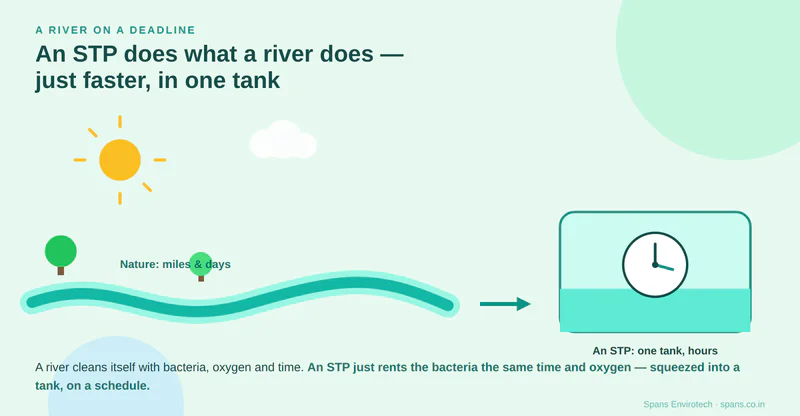
A river cleans sewage for free. Dump a reasonable amount of organic waste into a healthy flowing river and, a few kilometres downstream, it's gone. Bacteria ate it, oxygen from the surface and the tumbling water kept those bacteria breathing, and the river carried the whole reaction along its length while it happened. No pumps, no power bill, no operator. Nature has run this process for a very long time.
The catch is time and space. A river takes kilometres and hours to do the job. You have a plot behind your factory and a discharge deadline. So a sewage treatment plant is not some alien piece of chemistry — it is a river, folded up small and put on a deadline. Every single thing in an STP exists to do what a river does, faster and in less room. Once you hold that one idea, the jargon falls away and each stage becomes obvious.
What the river actually does, and what we're renting
Strip it down and river self-purification is two ingredients: bacteria that eat organic pollution, and oxygen that keeps those bacteria alive while they eat. That's it. The organic load in sewage — measured as BOD, the oxygen the bugs will demand to digest it — is food. Give the food, the bugs, and enough oxygen enough time together, and the pollution is consumed.
So when we design an STP we are really renting two things the river gets for free: time and oxygen. Time, because the reaction isn't instant — the bugs need a few hours of contact with the water. Oxygen, because a tank full of hungry bacteria will strip the water of air in minutes and then suffocate. A river gets its time from its length and its oxygen from its surface and its rapids. We have neither, so we buy both — time as tank volume, oxygen as an air blower. Almost the entire cost and cleverness of an STP is in supplying those two things efficiently in a space a river would find laughably small.
Now walk the stages. Each one is just the river, sped up.
Screening and grit: the things the bugs can't eat
Before any biology, we pull out what bacteria will never digest — rags, plastic, sanitary waste, grit, sand. A river deposits this on its banks and bed over kilometres. We do it in seconds with a bar screen and a grit chamber, because if that stuff reaches the pumps and aeration tank it clogs and abrades everything. This is pure housekeeping. It protects the living part of the plant from the dead weight that would otherwise choke it.
Primary settling: let gravity do the free work first
Give dirty water a moment of stillness and the heavy solids sink. A slow-moving stretch of river does this in its pools. We do it in a primary clarifier — a quiet tank where a good chunk of the settleable load drops out as sludge before we spend any energy on it. Why aerate and feed bacteria to remove material that plain gravity will remove for nothing? Primary settling is the plant being thrifty: strip out the easy half cheaply, so the expensive biological stage only has to handle the hard half.
Aeration: this is the river, and this is where the deadline is met
Here is the heart of it. The aeration tank is the river's living stretch, compressed. It is full of the same bacteria a river carries, packed to a density no river ever reaches, and we blow air through it continuously because at that density they'd asphyxiate otherwise. The bugs eat the dissolved and fine organic load — the BOD — and multiply.
The whole trick is the deadline the style of this stage sets. How long does the water sit here holding hands with the bacteria? That's the hydraulic retention time, and it is literally how much river-length you've rented. Too short and the bugs don't finish eating; the water leaves still dirty. Too long and you've built a needlessly huge tank. Getting HRT right is getting the deadline right.
This is also where technology choice comes in, and it's the same question every time: how do I pack more hungry bacteria into less tank? Classic activated sludge keeps them floating in the water. MBBR gives them plastic media to grow on, so far more biomass lives in the same volume — more river in less space. Different answers, identical goal: more bugs, more contact, less footprint. The EPA has decades of documentation on these variants, but they're all dialects of the one idea.
Secondary settling: separate the workers from the water
After the bugs have eaten, you have clean-ish water full of bacteria. You need the water without the bacteria. So a second quiet tank — the secondary clarifier — lets the biomass settle out. And here's the elegant part: we scoop that settled sludge and pump most of it back to the aeration tank. Those bacteria are a trained, hungry workforce; you don't discard them, you recirculate them so the incoming sewage meets a full crew. The river grows its bugs fresh each time. We keep ours on payroll.
Disinfection: the last thing the river's distance did for you
A river's sheer length and sunlight kill off much of the remaining pathogens before the water is used again downstream. We don't have that distance, so we add a deliberate disinfection step — chlorine, or UV — to knock out the bacteria that cause disease before the treated water is discharged or reused. It's the final compression of something the river did with kilometres and time.
That's the whole plant. Screening removes what can't be eaten, primary settling drops the easy load, aeration rents time and oxygen for the bugs to eat the rest, secondary settling recovers the water, disinfection makes it safe. Every stage maps onto something a river does on its own. The engineering is entirely about doing it in a smaller space and against a clock.
Which is why the interesting questions about an STP are never "what does this tank do" — the river answers that. They're "how much time and oxygen does this particular sewage need, and how do I supply it in the footprint I've got." That's a sizing problem, and it rewards being honest about your real flow and load. If you want to sanity-check the scale of plant your building or township actually needs, our STP capacity calculator is a quick first pass — and the broader story of how sewage treatment works as a public-health system, backed by discharge norms the CPCB sets, is worth reading alongside it.
When you're ready to turn the river-on-a-deadline into an actual plant on your plot, come talk to us. The physics is old. The good design is in the details.
Spans
Spans empowers businesses around the world to grow faster and profitable while using less energy and water.
Visit Site