
The Sewer Was Always the Slow Answer to Faecal Sludge Management
Ask a small town's engineers how they plan to clean up their sewage, and most will describe a sewer network. A trunk line down every road, a house connection fo..
Contents
Ask a small town's engineers how they plan to clean up their sewage, and most will describe a sewer network. A trunk line down every road, a house connection for every plot, pumping stations, and a big central plant at the end of it. It is a fine plan. It is also a plan that needs land the town does not have, money the state has not sanctioned, and years, often a decade or more, of digging up roads that are already dug up for something else. So the plan sits in a report, and meanwhile the town's toilets keep working exactly as they always have: into septic tanks and pits under the floor.
That gap between the plan and the reality is where the whole problem lives. And once you look at it honestly, a slightly heretical thought follows: for most of urban India, the sewer was never the right first answer at all.
What is faecal sludge, and why it is not the same as sewage
Start with the words, because the acronyms do real work here. FSM is short for faecal sludge management. Faecal sludge is what accumulates in an on-site sanitation system, a septic tank, a pit latrine, a twin-pit, when it is used but not connected to a sewer. It is not the flowing wastewater that a sewer carries to a treatment plant. It is the thick, partially digested, highly concentrated material that settles and sits, sometimes for years, until a truck comes to empty it. When people add "and septage" and write FSSM, faecal sludge and septage management, septage is simply the specific version of this that comes out of a septic tank.
The reason this matters is scale. Only about two in five urban Indian households are connected to a piped sewer. The rest, roughly half on septic tanks and the remainder on pits and other on-site systems, are non-sewered. Of the country's 4,700-odd towns and cities, only around 400 have a sewerage network at all. So when we talk about cleaning up urban sanitation, we are mostly not talking about sewage in pipes. We are talking about crores of tanks, quietly filling, that somebody empties eventually. The question is only whether what comes out is treated or tipped into the nearest drain.
For most of these towns, the honest answer today is: tipped. A tanker desludges a septic tank, drives to the edge of town, and empties into a nullah, a field, or a canal. Everything the household did right, containing the waste, breaks at the last step. This is the failure faecal sludge management exists to fix, and it is a failure of the value chain, not of engineering. Containment, emptying, transport, treatment, reuse: get any link wrong and the whole thing leaks.
The reframe: treat what is already in the tank
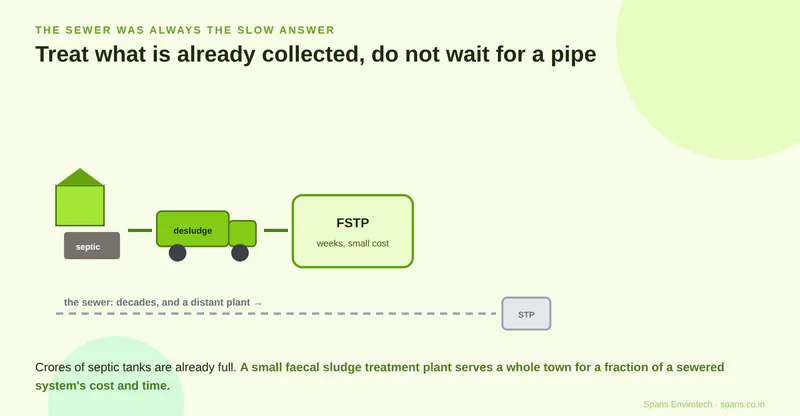
Here is the shift in thinking. A sewer's job is to move waste from every home to one place so it can be treated. But in a town full of septic tanks, the waste is already collected. It is sitting in lakhs of small tanks, pre-concentrated, waiting. You do not need to lay pipe to every house to get at it. You need a truck and a place to take it.
That place is a faecal sludge treatment plant, an FSTP. And an FSTP is a fundamentally cheaper, faster object than a sewered system. A conventional sewage treatment plant is only the visible tip of a sewered scheme; the real cost and delay is the buried network feeding it, which routinely dwarfs the plant itself. An FSTP skips all of that. It sits on a modest plot, receives septage by tanker, and treats a whole town's worth of accumulated sludge on a footprint and a budget that a small municipality can actually carry. Septic tank desludging becomes a scheduled service instead of a midnight dump. This is what decentralised, non-sewered sanitation means in practice: not a lesser version of a sewer, but a different and often better-fitted answer to the same public-health problem. If your town or facility is weighing this against a sewered scheme, it is worth talking it through before the capital plan is locked, because the two paths diverge fast on both cost and timeline.
How an FSTP actually treats septage
The faecal sludge treatment process is less mysterious than the name suggests, and it borrows heavily from things wastewater engineers already do. When a tanker arrives, the septage first goes through screening and grit removal to pull out the rags, plastics and sand that always come with it. Then the real work: separating the solids from the water, because faecal sludge is mostly water carrying a heavy solid load, and the two fractions want completely different treatment.
Dewatering is the heart of it. The sludge is spread onto drying beds, unplanted sand beds or planted beds with reeds, or pushed through a mechanical screw press, so the water drains and evaporates off and you are left with a much drier solid cake. That cake still needs stabilisation: time, drying and biological digestion to break down the organic matter and knock down the pathogen load, whether through extended drying, composting, or anaerobic digestion. What comes out the far end is a stable, soil-like material. Done well, it stops being a hazard and becomes a resource, compost or biochar that has genuine value, which is the same waste-to-value logic we apply across industrial treatment.
The liquid fraction, the water pressed out of the sludge, is the other half of the job and the part people forget. It is high in ammonia and organics and cannot just be let go. Smaller FSTPs polish it through anaerobic baffled reactors and planted gravel filters, aerobic and anaerobic stages doing complementary work in the way we have written about in aerobic versus anaerobic treatment. This is the same biology that makes any STP work, step by step, just sized for a concentrated, intermittent feed rather than a steady sewered flow.
Co-treatment, and the case for not waiting
There is an even faster route where a town already has a sewage treatment plant with spare capacity: co-treatment. Instead of building a standalone FSTP, tankers discharge septage in controlled doses into an existing STP that has room to absorb the load, where it is dewatered and folded into the sewage the plant already handles. Where the spare capacity genuinely exists, this is the cheapest and quickest fix of all, because it uses infrastructure that is already built and running. It is not a universal answer, an overloaded STP has no room to give, but as a bridge it is hard to beat.
None of this is fringe. India has set up more than a thousand FSTPs, and the policy scaffolding is real: the National Policy on Faecal Sludge and Septage Management from 2017, the sanitation targets under Swachh Bharat, and the urban-infrastructure push of AMRUT. The technical guidance comes from bodies like CPHEEO and the framing work by the NITI Aayog and its partners. This is now the mainstream direction of Indian urban sanitation, not a workaround, and the global evidence base behind faecal sludge management has matured alongside it.
So when a town chooses between waiting for a sewer and building an FSTP, it is not choosing between the proper solution and a stopgap. The sewer was always the expensive, slow answer to a problem that, in a non-sewered town, was never really about pipes. The waste is already collected, one septic tank at a time. Faecal sludge management just does the obvious thing with it: goes and gets it, treats it, and turns it into something worth having. The town that understands this stops waiting for a network it may never finish, and starts cleaning up the sanitation it already has.
Spans
Spans empowers businesses around the world to grow faster and profitable while using less energy and water.
Visit Site