
ETP vs STP Difference: Which Wastewater Treatment System Is Right for Your Facility?
When someone asks us to explain the difference between ETP and STP so they can pick the right one, we've learned to gently take the question apart before answer..
Contents
When someone asks us to explain the difference between ETP and STP so they can pick the right one, we've learned to gently take the question apart before answering it. It's usually asked as if the two were rival products on a shelf, as if a good engineer could just tell you which is the better buy. That framing is the reason so many people end up with the wrong plant, or two plants where they needed one, or one where they needed two. ETP and STP are not competitors. They are answers to two completely different questions, and the only thing that decides which answer you need is what is actually in your water.
You do not choose between an ETP and an STP. Your wastewater chooses for you, and the engineering worth paying for isn't the picking. It's telling your streams apart and refusing to mix them.
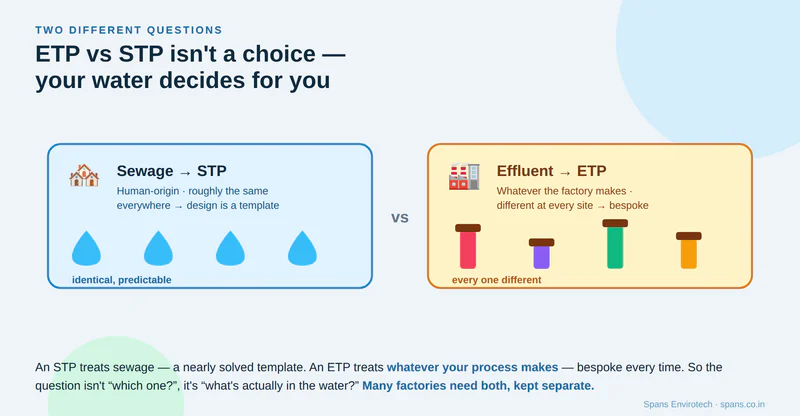
Sewage is a solved problem. Effluent never is.
Start with what an STP actually treats: sewage. The water from toilets, washbasins, kitchens, canteens, bathrooms. And here is the quietly remarkable fact about it. Sewage is nearly the same everywhere on earth. Human beings, whether in a Pune IT park or a Ludhiana textile mill or a housing society in Kochi, produce domestic wastewater with roughly the same organic load, the same nitrogen, the same predictable, biodegradable character. Sewage is human-origin, and humans, biochemically, are boringly consistent.
That consistency is everything. It means the biology that eats sewage is well understood, the loads are predictable within a narrow band, and the design has been refined for a century into something close to a template. When we build an STP, we are not inventing. We are sizing a known process to a known kind of water. That's why the STP process runs in the same recognisable steps at almost every site: screening, biological treatment, settling, disinfection. It's also why you can genuinely estimate a domestic plant from a headcount before an engineer has walked the site. Our STP capacity calculator does exactly that, because with sewage, litres per person per day is a reliable number. Sewage design is nearly a solved template. That is not a criticism. A solved problem is a gift.
Now an ETP. An effluent treatment plant treats industrial effluent, and industrial effluent is whatever that particular factory happens to make. There is no template, because there is no typical effluent. A pharmaceutical unit's process water is a chemistry problem of solvents and high COD. An electroplating shop sends you heavy metals and acids. A dairy hands you fats and a staggering organic load. A textile dyehouse gives you colour, salt, and a pH that swings by the hour. Industrial wastewater isn't one thing that happens to be harder than sewage. It's a thousand different things, and the only way to know what's in yours is to characterise it. Chemically unpredictable, different at every site, and often different between two factories making the same product on different machines.
Which means an ETP is bespoke every single time. We don't reach for a template; we start from a lab report and build the treatment train around what that specific water contains. This precipitation stage for those metals, that oxidation step for this COD, a polishing stage the neighbour's plant doesn't need. Sometimes the effluent is valuable or toxic enough that the train has to run all the way to zero liquid discharge, recovering water and salt instead of releasing anything at all. The point isn't that ETPs are fancier. It's that they are custom, because the water is custom.
So the real question was never "which one"
Once you see the difference this way, the original question dissolves. "Which is right for my facility, ETP or STP?" assumes your facility produces one kind of wastewater. Most don't. A factory has people, and people produce sewage: the canteen, the toilets, the washrooms. The same factory has a process line, and that produces effluent. Those are two different waters with two different origins, two different chemistries, and two different right answers.
So a great many industrial sites need both. An STP for the domestic stream, an ETP for the process stream. Not because someone oversold them, but because you genuinely have two problems wearing one address. The mistake we're called in to fix, again and again, is the opposite of buying too much. It's a site that ran both streams into one plant to save money, and now has neither a working STP nor a working ETP. A slug of process chemistry hits a biological plant designed for sewage and kills the culture. Or dilute domestic flow swamps an ETP tuned for concentrated effluent and wrecks its economics. Mixing the streams doesn't combine two solutions. It manufactures a third, worse problem.
This is why the real engineering happens upstream of any tank, in the drains. Keep the sewage line and the effluent line separate from the moment they leave their sources, and each goes to the plant built for it. Combine them and you've thrown away the one piece of information that told you what to build, which is where the water came from. The discipline is plumbing before it's process. Some of the same hardware even shows up in both worlds; a robust biological stage like MBBR treats domestic sewage and the biodegradable fraction of many effluents alike. But the same equipment doing similar work is not a reason to run one plant. It's just proof that the streams differ by what's dissolved in them, which is exactly the thing you must not blend.
There's a cost dimension too, and it follows the same logic. An STP's price tracks flow, because the process is known, so bigger just means more of the same. An ETP's cost tracks chemistry, because a nastier effluent needs more and cleverer stages regardless of volume. Two sites with identical flows can carry very different ETP bills, and that isn't a quote padding itself. It's the water talking.
None of this changes the compliance floor. Both plants exist to meet the discharge norms your pollution control board sets, the same way regulators like the US EPA frame theirs, and both clear that bar when designed for the water they actually receive. The norms are the destination. Reading the water is how you get there.
So stop asking which system is right for your facility. Ask what is in your wastewater, and be honest that the answer is usually "two different things." If you're genuinely unsure how many streams you have, that's worth reading together before anyone sizes a tank. But the principle holds either way: sewage goes to an STP, process effluent goes to an ETP, and many factories run both, kept firmly apart. That isn't hedging. It's the correct answer to two separate questions.
Spans
Spans empowers businesses around the world to grow faster and profitable while using less energy and water.
Visit Site