
Sludge Management: The Half of the Plant Nobody Designs For
Walk any effluent plant with the people who built it and notice which way they point. Towards the clarifier running clear, the aeration tank breathing away, the..
Contents
Walk any effluent plant with the people who built it and notice which way they point. Towards the clarifier running clear, the aeration tank breathing away, the polished stream at the outfall meeting the standard. That is the part everyone is proud of. Nobody walks you to the sludge.
Yet the sludge is the whole point. Treatment does not destroy pollutants; it relocates them. An effluent treatment plant is, underneath all the tanks, a machine for taking contamination that is spread thinly through thousands of litres of water and concentrating it into a small, wet, heavy mass. The clear water at the outfall is not where the pollutants went. The sludge is. Which means the plant is not finished when the water passes the discharge test. It is finished when the sludge has somewhere legal and affordable to go.
We keep meeting plants that were designed as if that second half did not exist. The water side is drawn beautifully. The sludge side is a corner of the yard, a hired truck, and a vague assumption that someone will cart it away.
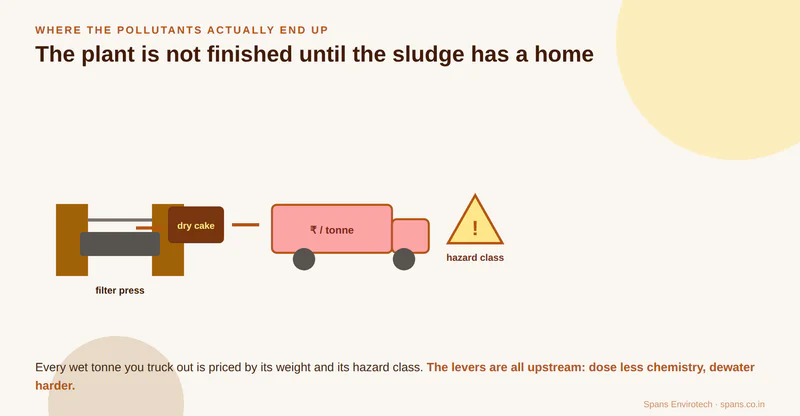
The pollutants change address, they don't leave
Sludge generation is not one stream but three, and it helps to keep them separate in your head. Primary sludge settles out in the first clarifier: grit, solids, whatever dropped under gravity. Chemical sludge is everything you deliberately precipitated, the alum, lime or ferric flocs you dosed to pull colour, phosphates and metals out of solution. Biological sludge is the waste from the activated sludge process, the microbial mass that ate the organic load and now has to be wasted so the bugs stay hungry.
Here is the uncomfortable arithmetic. Almost every kilogram of chemistry you dose to make the water pass reports, in the end, to the sludge. A high-COD, metal-bearing stream that you hit hard with coagulant to force the numbers down does not make the metals vanish. It parks them in the cake. Dose more to be safe, generate more sludge to dispose of, and each of those tonnes carries the very contaminants you were paid to remove. The success at the outfall and the liability in the yard are the same event seen from two ends.
So sludge management is not a downstream chore. It is the downstream consequence of every upstream decision, and it is priced accordingly.
Wet weight is the enemy you can actually beat
Sludge leaves your gate priced two ways: by what it weighs, and by what hazard class it carries. Both are set upstream, by you, long before the truck arrives.
Take the weight first, because it is the easy win everyone underuses. Fresh sludge is roughly 97 to 99 percent water. You are, in effect, paying to truck water to a landfill. The entire craft of sludge dewatering is turning a sloppy slurry into a stackable cake, and the dewatering methods form a clear ladder. Sludge drying beds sit at the bottom: cheap, no moving parts, but they need land, time and a kind sky, which the monsoon does not provide. Above them come the mechanical options: the plate-and-frame filter press, the belt press, the screw press, and the centrifuge, often a decanter. These cost capital and power, but they work in the rain and on a schedule.
What they buy you is dryness, and dryness is tonnage. Depending on the sludge and the machine, cake solids typically land somewhere between 10 and 45 percent, with a well-run decanter centrifuge reaching close to 50. That spread is not a technical footnote. Moving a cake from 20 percent solids to 35 percent roughly halves the number of wet tonnes you haul, because you have squeezed out the water that was riding along for free. Every wet tonne is a tonne you pay a transporter to move and a tonne the disposal facility weighs at its gate. Dewatering harder is the cheapest opex cut in the whole plant, and it is usually the first thing the original design skimped on.
The hazard class is also a design decision
Now the second price. Sludge from an industrial ETP is, in most cases, hazardous waste, and India's hazardous-waste rules treat it as such. That is not a formality. It means the sludge has to be characterised in a lab for heavy metals and leachability, stored properly, moved only by an authorised transporter with a manifest for every trip, and disposed of only at an authorised Treatment, Storage and Disposal Facility, whether that is a secure landfill or an incinerator. You keep records, you file annual returns, and if the material turns up somewhere it should not, the consequence is a closure notice, not a fine you shrug off. The Ministry of Environment and the pollution boards have been steadily tightening this framework, and TSDF capacity has not kept pace, which is exactly why the gate rate keeps climbing.
Add it up and ETP sludge disposal has quietly become one of the more painful lines in a plant's running cost, often tens of thousands of rupees per wet tonne once you fold in transport, testing and the TSDF charge. It belongs in the cost of treatment from the first drawing, not as a surprise the operations team discovers in year two.
But hazard class is not fixed by fate either. If you segregate a genuinely clean, non-hazardous stream instead of pouring everything into one common ETP, you avoid dragging the whole sludge volume into the expensive category. Choosing a coagulant that does its job at a lower dose, or precipitating metals selectively so they do not smear across every tonne, changes what the lab report says and therefore what the disposal costs. This is worth sitting down over early with someone who has actually costed the disposal route, because the levers are all in the process, and none of them are in the truck.
Dry sludge can be fuel, not just waste
There is a better ending than a landfill. Dried, organic-rich ETP sludge carries real calorific value, and cement kilns will accept it for co-processing as an alternative fuel under the co-processing route the ministry permits. Done right, a stream that used to be pure cost becomes something a cement plant takes off your hands for far less, sometimes recovering the energy locked in the material rather than burying it.
The catch is in the word dried. Wet sludge has no calorific value worth burning; you would be paying to evaporate water in a kiln, which nobody wants. Dry sludge disposal only opens up once you have driven the moisture out, which loops straight back to dewatering and, where it pays, thermal drying. The recovery route and the weight-reduction route are the same investment wearing two hats, and both land in the same place: a lower, and often near-zero, cost to get the material out of your yard. That is precisely the kind of move that separates a plant that merely runs from one that is quietly cheaper to operate, and it is why sludge deserves a seat in the capex-versus-opex conversation rather than a footnote after it.
The sales pitch stops at the outfall. The design drawing usually stops there too. The regulator's file does not, and neither does your accountant's. A treatment plant is not a water machine with a sludge problem attached; it is a device whose actual product is a concentrated, hazardous solid, and the clean water is just what is left once you have made it. Design for where the pollution ends up, not only for where the water goes, and the half of the plant nobody wanted to look at turns out to be the half that decides what the whole thing costs.
Spans
Spans empowers businesses around the world to grow faster and profitable while using less energy and water.
Visit Site