
ETP Plant Design Checklist: 15 Things to Verify Before You Build
Here's something we've come to believe after cleaning up other people's plants for years: every expensive ETP mistake was made on paper, months before anyone po..

Contents
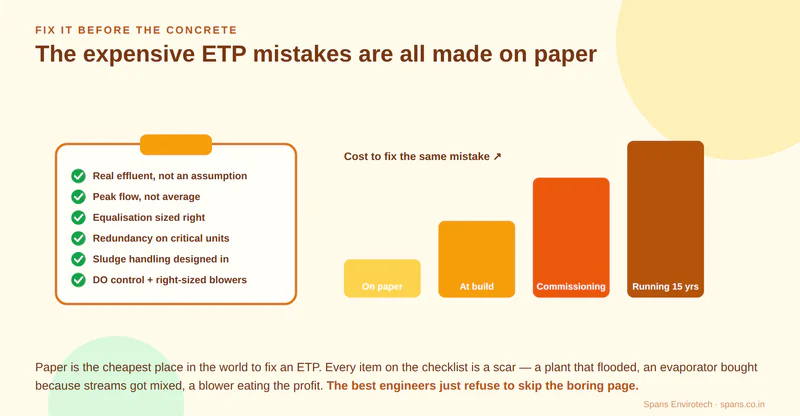
Here's something we've come to believe after cleaning up other people's plants for years: every expensive ETP mistake was made on paper, months before anyone poured a gram of concrete. The evaporator that runs half-empty, the tank that floods every monsoon, the blower that quietly eats the profit. None of those were built wrong. They were drawn wrong. And paper, it turns out, is the cheapest place in the world to fix a mistake. A pencil line costs nothing. The same line, cast in RCC and wired to a motor, costs a decade of regret.
So this isn't really a checklist about construction. It's a checklist about the boring page most people skip on the way to the exciting one. Every item below is a scar, a plant we've seen fail in a specific, avoidable way. Good ETP design isn't cleverer than bad ETP design. It just refuses to skip the page.
Know the water before you draw a single tank
The first mistake is the mother of all the others: designing for a number someone made up.
1. Characterise the real effluent, not a design assumption. Somebody writes "COD 2,000 mg/l" in a tender because that's what the last plant had. Then the plant runs at 6,000, and every downstream unit is undersized from birth. Get real samples, across real shifts. The lab report is the foundation; everything else is built on it.
2. Separate the peak from the average. Average flow is a comforting lie. Effluent doesn't arrive politely at a constant rate. It comes in slugs, at shift change, at CIP, at the 3 pm wash-down. Size for the peak, or the plant chokes exactly when the factory is busiest.
3. Design in equalisation, generously. The single most common thing we retrofit is a bigger equalisation tank, because the original was sized as an afterthought. Equalisation is what turns a violent, swinging load into a calm, treatable one. Skimp here and you pay for it in every unit that follows.
4. Segregate streams, and don't mix problems. We've watched a factory buy an evaporator it never needed, purely because a clean stream and a toxic stream got married in a common drain. Keep dilute apart from concentrated, biodegradable apart from inhibitory. Mixing is a decision you can't undo downstream.
5. Match the process to the actual load. A high-BOD organic effluent wants biology; a metals-laden one wants chemistry first. Choosing the wrong core process, or a fashionable one, is expensive forever. For medium-strength biodegradable loads with limited footprint, an attached-growth system like MBBR often does more per square metre than a conventional tank. But that's a conclusion, not a default.
Design for the bad day, not the brochure day
Every plant looks brilliant on the vendor's brochure, running at nameplate, on a Tuesday, with a fresh operator. Plants don't live on Tuesdays. They live on the bad day.
6. Confirm the discharge norm before you design, not after. This sounds obvious and is violated constantly. Are you meeting inland-surface-discharge limits, or designing for reuse, or feeding a CETP? Each is a different target, and each demands a different plant. Pin the number down with your state board and cross-check the CPCB standards first. Retrofitting a tighter norm onto a finished plant is how good money follows bad.
7. Build redundancy into the units that can't fail. One raw pump, one blower, one dosing line, and the day it trips, you're discharging untreated effluent and explaining yourself to the regulator. Critical duty units need a standby. Not everything; just the things whose failure stops the plant or breaks the consent.
8. Design sludge handling in, not bolted on later. Sludge is not an afterthought. It's half the plant's real labour. We routinely find plants with beautiful treatment trains and nowhere sensible for the sludge to go, so it piles up, dries in the sun, and becomes someone's daily misery. Filter press, thickener, disposal route: draw them on day one.
9. Specify aeration and DO control, and right-size the blower. This is the line that decides your power bill for the plant's whole life. A fixed-speed, oversized blower with no dissolved-oxygen control is a machine built to waste electricity, and aeration is 50–70% of the running cost. Put a DO probe and a way to turn the air down into the drawing. It is far cheaper as a line item than as a retrofit.
10. Write a power budget before you commit the layout. Add up the connected load honestly and ask what it costs to run, not just to build. So much poor ETP design bakes in energy costs that haunt the plant forever. Our ETP energy calculator will let you price the running cost while it's still just numbers, the one moment it's free to change.
The lines nobody costs
Here's the pattern in the plants that age badly: the treatment got all the attention, and the unglamorous supporting lines got none. Those are the lines that decide whether anyone can actually run the thing.
11. Leave footprint for expansion. Factories grow. The plant that was perfect at 100 KLD becomes a straitjacket at 150, and there's no land left because every square metre was spent. Leave space. It's the cheapest insurance you'll ever buy.
12. Design for O&M access and safety. If an operator can't reach a valve, clean a diffuser, or lift a pump without a crane and a prayer, maintenance won't happen, and unmaintained plants fail. Walkways, handrails, clearances, confined-space access. Boring on paper, life-and-death in the field.
13. Instrument it, and plan for monitoring. Flow, pH, DO, and, for many red-category units, an online continuous emissions/effluent monitoring link the board can see in real time. Design the OCEMS in from the start; it's a nightmare to add to a live plant. What you don't measure, you can't defend.
14. Design reuse in, don't dream it later. If there's any chance the treated water gets reused, whether for cooling, gardening, flushing or process, the polishing train and the plumbing belong in the original drawing. Bolting reuse onto a finished plant is where the running-cost savings quietly evaporate. Both the US EPA and India's Bureau of Energy Efficiency frame water and energy as the same problem for exactly this reason.
15. Write the chemical dosing, storage, commissioning and handover plan. Where do the chemicals live, how are they dosed, who tuned the plant, and what did they hand the operator? A plant commissioned in a hurry and handed over on a WhatsApp message is a plant that will drift out of compliance within a year.
The boring page
The best ETP engineers we know aren't smarter than the rest. They're not sitting on some secret unit process. They just refuse to skip the boring page: the one with the real effluent numbers, the peak flow, the sludge route, the power budget. They treat the design stage as the only stage where mistakes are still cheap, because it is.
Fifteen checks. Every one of them is a plant we've seen limp because somebody was in a hurry to pour concrete, and the repairs we get called in to make on site are almost always things the drawing could have settled for nothing. Paper is still the cheapest place to fix it.
Spans
Spans empowers businesses around the world to grow faster and profitable while using less energy and water.
Visit Site