
An Equalization Tank's Size Doesn't Equalize Anything. Its Mixing Does.
Every ETP design brief that includes an equalization tank answers the same sizing question the same way: pick a retention time, usually somewhere between six an..
Contents
Every ETP design brief that includes an equalization tank answers the same sizing question the same way: pick a retention time, usually somewhere between six and twelve hours of average flow, and size the tank's volume accordingly. It is treated as the whole design decision, the number that goes on the drawing and the number everyone checks off as "equalization handled." It is, at best, half the question. A tank sized to the correct hydraulic retention time can sit there with the right volume and still pass a shock load through to the biological process almost unchanged, because volume alone does not equalize anything. Mixing does.
What equalization is actually supposed to do
The job of an equalization tank is not primarily to smooth out flow rate, although it does that too. It is to dampen a concentration spike, a slug of high-pH rinse water, a sudden organic or colour load, a burst of high-salinity discharge, so that what reaches the downstream biological process is a blended, moderated version of what arrived rather than the raw spike itself. Whether a tank actually does that depends entirely on how the incoming slug behaves once it enters the tank, and that behaviour splits into two very different cases that look identical on a sizing sheet.
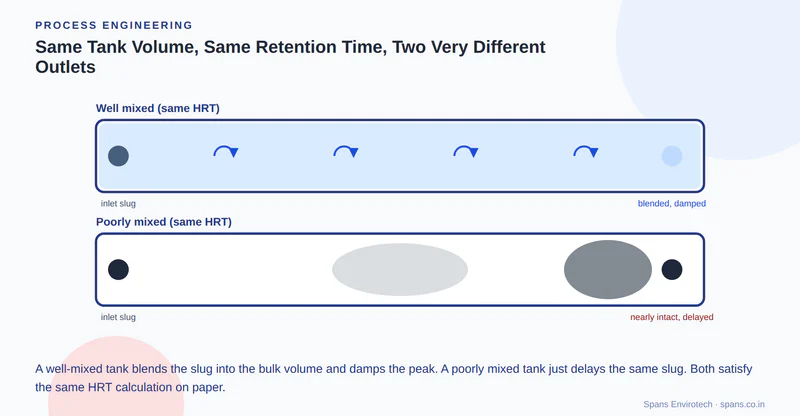
A genuinely well-mixed tank behaves close to what a chemical engineer would call a continuous stirred-tank reactor: the incoming slug disperses rapidly into the full tank volume, and the concentration leaving the tank at any moment reflects a blend of the new arrival diluted into everything already there. The peak concentration gets damped roughly in proportion to how much of the tank volume that slug gets diluted into before it has a chance to move toward the outlet. A poorly mixed tank, even one with identical volume and the same nominal retention time, behaves much closer to a plug flow reactor: the slug moves through largely intact, arriving at the outlet delayed by roughly the retention time but barely blunted in concentration, because it never actually blended with the bulk of the tank's contents on the way through. Both tanks satisfy the same HRT calculation. Only one of them is doing the job the name "equalization tank" promises.
Where this actually shows up on a real plant
Picture a dye house that discharges its spent dye bath in a concentrated, thirty-minute burst: high pH, high colour, a BOD and COD spike well above the plant's average. The equalization tank was sized correctly against the average daily flow, with a retention time that comfortably exceeds that thirty-minute discharge window. On paper, the shock should arrive at the biological stage smoothed into something the culture can handle. In an undermixed tank, what the biological process actually sees is the same thirty-minute spike, delayed by several hours but still recognisably a slug rather than a blend, because the mixing energy in the tank, whether from mechanical agitators or diffused aeration, was never sized against the volume the way the hydraulic retention time was. The downstream symptoms look like a biological problem: a pH excursion, a settling upset, the kind of operational disruption we have written about in the context of sludge bulking, where the biology is reacting correctly to a shock it was never actually protected from. Everyone involved checks the equalization tank's volume against the design brief, confirms the HRT is correct, and concludes the problem must be somewhere else, because nobody thought to ask whether the tank was actually mixing.
This gap exists because the two numbers that matter, tank volume and mixing intensity, get specified by different disciplines at different points in a project and rarely get checked against each other. The civil and process engineers size the volume against flow. The mixing equipment, mechanical mixers or an aeration grid, often gets selected later, sometimes by a different vendor entirely, against a generic "keep solids suspended" criterion rather than against how quickly the tank actually needs to homogenise a slug relative to its retention time. A tank can satisfy both specifications individually and still fail to equalize anything, because nobody specified the relationship between them.
The same gap shows up, in a milder form, on plants that never see a dramatic thirty-minute slug but still run a batch process: a food and beverage plant whose clean-in-place cycle sends a short, caustic, high-conductivity rinse into the equalization tank at a predictable point in every shift. The spike is smaller and more routine than a dye house discharge, which is exactly why it tends to go unexamined for longer: the downstream biology absorbs a muted version of it well enough, most of the time, that nobody questions whether "well enough" is actually "equalized" or just "diluted by sheer tank volume regardless of mixing," a distinction that only matters until the one shift where the rinse runs longer, stronger, or closer to another upset than usual, and the muted version stops being muted enough.
What actually needs checking
Getting this right does not require exotic engineering. It requires treating mixing intensity as a design variable tied explicitly to the tank's actual retention time, not a separate "keep it stirred" afterthought sized against a generic rule of thumb. The honest check is whether the tank's blending time, how long it actually takes a new slug to disperse through the bulk volume, is short relative to the retention time the sizing calculation assumed; if blending takes hours and the retention time is only marginally longer, the tank is doing far less equalizing than the HRT number suggests. On a plant where shock loads are a known, recurring feature of the process, a tracer test, dosing a conservative tracer and measuring how it actually distributes through the tank, is a cheap, direct way to verify this rather than assume it. There is a real trade-off worth acknowledging too: enough mixing energy to blend effectively also has to avoid resuspending settled solids into a plume that then has to be handled downstream, so this is a genuine design balance, not simply "add more mixers."
Correcting an undermixed tank after the fact is rarely a civil problem; it is usually a matter of adding or relocating mixers or redesigning the aeration grid within the existing volume, a far smaller cost than the alternative of living with recurring, hard-to-diagnose upsets downstream in the ETP or STP for the life of the plant. An ETP design checklist that stops at confirming the equalization tank's hydraulic retention time has answered the volume question and left the actual equalization question unasked. The two numbers on the drawing, tank size and mixer rating, were never really answering the same question in the first place, and a plant that only checks one of them can be fully compliant with its own design brief while still delivering an unmoderated shock to the biology every time the process upstream has a bad thirty minutes. If you are reviewing an equalization tank design and want a second set of eyes on whether the mixing actually matches the retention time, that is worth raising before construction rather than after: spans.co.in/contact.
Spans
Spans empowers businesses around the world to grow faster and profitable while using less energy and water.
Visit Site