
A Flow Meter Needs the Pipe to Be Full. Half Your Plant Was Built to Keep It From Being Full.
A magnetic flow meter, a magmeter, is a genuinely good instrument. No moving parts to foul on grit or rag, no orifice to clog, a straightforward output, and it ..

Contents
A magnetic flow meter, a magmeter, is a genuinely good instrument. No moving parts to foul on grit or rag, no orifice to clog, a straightforward output, and it handles the dirty, conductive liquid a treatment plant produces better than almost any mechanical alternative. Specify one, install it, and most of the time it reads exactly right. Install it in the wrong place and it will cheerfully report a number every second of every day, a number with no relationship whatsoever to how much water is actually moving, and nothing on the transmitter will tell you that has happened.
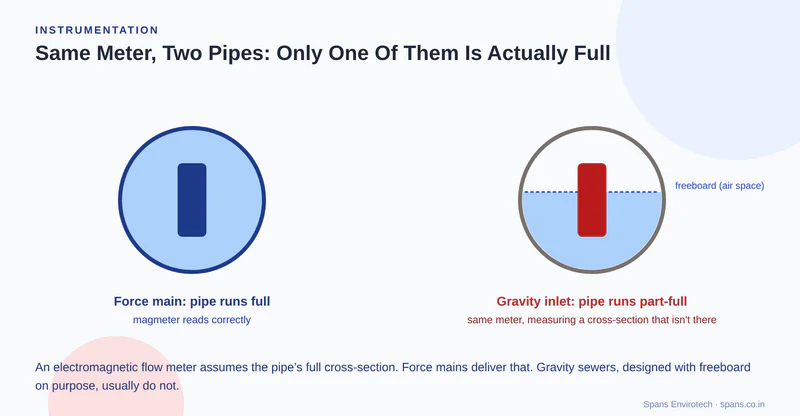
The thing almost nobody states plainly, including some of the people specifying the meters, is that an electromagnetic flow meter has exactly one hard physical requirement before any of its stated accuracy means anything: the pipe has to be running completely full. The meter measures velocity across a known cross-sectional area and multiplies to get flow. If the pipe is only two-thirds full, the meter still assumes the full cross-section, and the number it reports is wrong by whatever fraction of the pipe was actually empty, silently and without complaint.
The part of the plant where this bites hardest
This would be a minor installation detail if treatment plants were built entirely from pressurised, pumped lines that run full as a matter of course. A lot of a plant is exactly that, and a magmeter dropped into a force main or a recirculation loop behaves exactly as the datasheet promises. But a large share of the piping and channels carrying flow through an ETP or STP, particularly anything gravity-fed between unit processes, was never designed to run full in the first place. Gravity sewers and open channels are sized using Manning's equation specifically to keep a self-cleansing velocity at partial depth, with freeboard left above the water line on purpose, partly for ventilation and partly because a pipe that runs completely full under gravity loses the air space that keeps septic gas from building up. The engineering goal for a gravity line is almost the opposite of the condition a magmeter needs to function.
This is not an obscure edge case. It is the default condition at the inlet works, between the primary and secondary stages, and in most open channels anywhere flow is measured before it reaches a pump that will pressurise it. A magmeter specified against the pipe's nominal diameter, installed in a straight run exactly as the manual recommends, electrically grounded correctly, can still report nonsense indefinitely if the channel it sits in runs at sixty percent depth during normal operation. Everything on the installation checklist was done right. The checklist just never asked the one question that mattered.
Picture the typical layout: raw sewage arrives by gravity, passes through screening, and flows by gravity again into the equalisation tank before anything gets pumped. Somewhere in that stretch, a design engineer who knows magmeters are the modern, low-maintenance choice specifies one on the inlet line, sized correctly against the pipe diameter, placed on a sensible straight run away from valves and bends. Nobody in that decision was wrong about the meter. The decision that went unexamined was upstream of the instrument entirely: whether that particular pipe, at that particular point in the layout, was ever going to run full in the first place. On a gravity inlet sized with the normal freeboard, it mostly will not, and the meter will spend its working life measuring a cross-section that is not actually there.
Why this fails quietly instead of loudly
A flowmeter reading garbage because of entrained air or a part-full pipe rarely looks like an obvious fault. It looks like a number that drifts, or one that tracks plausibly with plant activity without ever quite reconciling against a mass balance, or a daily total that is consistently a little low against what the rest of the process suggests should be moving. Because the transmitter has no way to sense the water level in the pipe, it has no basis for flagging anything. Flowmeter installations get this wrong often enough that a meaningful share of magmeters in the field, across industries generally, turn out to be the wrong technology or the wrong size for where they actually sit, and a part-full gravity line is one of the most common reasons why.
The consequence travels further than a confusing SCADA trend. Flow data from a treatment plant is not just an operational convenience; it underwrites the consent to operate and feeds compliance reporting the same way the continuous monitoring data we have written about before does. A load calculation built on a flow number that has been quietly wrong for months, understating or overstating actual throughput, produces a mass balance that never quite closes, and nobody troubleshooting that gap starts by suspecting the one instrument everybody assumed was simply doing its job.
The fix is choosing the right instrument for the actual hydraulic condition
None of this is an argument against magmeters. It is an argument for matching the instrument to the hydraulic condition it will actually sit in rather than to the pipe's nominal size. Where flow genuinely is pressurised and full, a magmeter remains the right, low-maintenance answer, and nothing in this piece changes that. Where the metering point sits in an open channel or a gravity line that is designed, correctly, to run partially full, the honest answer is not a bigger or more expensive magmeter. It is a different category of instrument built for exactly that condition: a calibrated flume or weir, a Parshall flume being the most common, paired with a level sensor reading the head upstream and a standard hydraulic formula converting that head to flow. We have written separately about how much a level sensor's own installation can go wrong, and a flume-and-level pairing has exactly that same dependency, so it is not a free upgrade, just the correct tool for a condition a magmeter was never built to handle. Where a full-pipe reading is genuinely required at a point that is naturally part-full, the civil answer, a short drop structure or a siphon loop engineered to force the pipe full exactly at the metering point, is a known, designed-for solution, not an afterthought bolted on when the first reading looks wrong.
The expensive version of this mistake is not the meter itself; magmeters are not especially costly instruments. It is the months of mass balance data built on a number that was never real, and the compliance reporting built on top of that data, discovered only when someone finally asks why the numbers have never quite reconciled. Before specifying a flow meter anywhere in a plant, the question worth asking first has nothing to do with accuracy class or price: at the exact point this instrument will sit, is the pipe actually full, and if the honest answer is no, what hydraulic condition is it actually measuring instead.
Spans
Spans empowers businesses around the world to grow faster and profitable while using less energy and water.
Visit Site