
An IP66 Panel Keeps the Rain Out. It Doesn't Keep the Plant's Own Air Out.
Every motor control centre schedule we review gets the electrical sizing right: motor horsepower, full load amps, duty cycle, the fault current the local utilit..
Contents
Every motor control centre schedule we review gets the electrical sizing right: motor horsepower, full load amps, duty cycle, the fault current the local utility can deliver at that point, all correctly worked out and correctly selected against. Ask the site electricians which panels actually fail first, though, and the answer is rarely electrical. It is almost always a panel that looks fine from outside and has green, crusted terminals inside.
The enclosure rating on the drawing, typically IP66 in Indian practice (the rough equivalent of the NEMA 4X rating you will see on imported documentation), is a real and useful number. It is tested against rain, washdown water, and windblown dust. It says nothing at all about the one thing a wastewater plant does that almost no other industrial site does: generate its own corrosive atmosphere, continuously, right next to the equipment that has to survive it.
Water is not the enemy that actually gets in
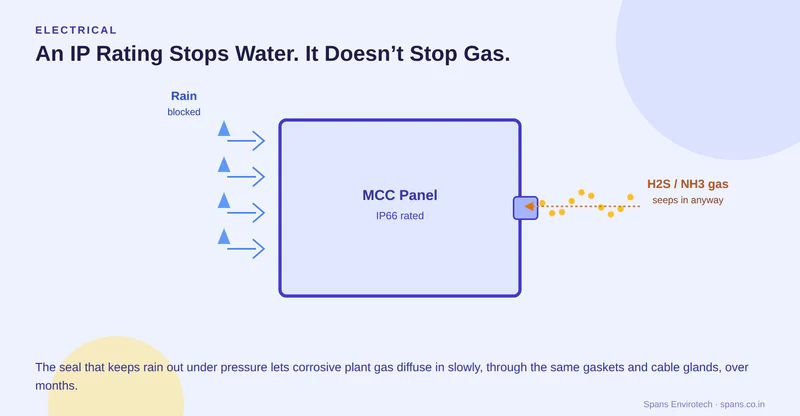
Sewage and sludge handling areas release dissolved hydrogen sulfide and ammonia into the air around them, in concentrations too low to smell strongly from a distance but high enough, over months, to attack copper and silver contacts inside a "sealed" panel. This is a different physical problem than the one an IP rating is built to solve. A gasket that stops liquid water, which is a continuous fluid under pressure, does very little against gas molecules diffusing slowly through the same gasket, through cable gland threads, through the microscopic gap a gasket develops as it ages and compresses over a few monsoons. Water asks a seal to resist a push. Gas asks it to resist patience, and patience eventually wins against almost any static seal.
This is why a panel can carry a correct, generous IP66 rating, pass its commissioning inspection with a clean bill of health, and still show intermittent contactor faults eighteen months later that nobody can reproduce on demand. The contacts are not failing electrically. They are corroding chemically, slowly enough that no single inspection catches it, and the failure reads as "nuisance tripping" long before anyone opens the panel and sees the actual cause.
The consequence travels further than the panel itself. A blower or pump that trips intermittently on a corroding contactor does not fail cleanly; it fails in a way that looks, from outside, like a process upset. If that equipment is reporting into a continuous OCEMS compliance feed, an unexplained trip is exactly the kind of gap a regulator asks questions about, and "the contactor was slowly corroding for a year" is a much worse answer in that conversation than "we caught it at the eighteen-month inspection."
What actually answers this problem
Enclosure rating is necessary and not sufficient. Three things sit above it in a genuinely hostile location, meaning anywhere within the headspace influence of a wet well, a screening channel, or open sludge handling:
- Location first. An MCC room sited upwind of, and physically separated from, headspace sources does more than any gasket can. This is a site-planning decision made long before anyone picks an enclosure, and it is frequently made for civil convenience rather than atmosphere, because the chemistry only shows up a year or two later.
- Positive-pressure purging for the worst locations, where filtered clean air is continuously fed into the panel at a slight overpressure so that air only ever flows out through gaps, never in. This is a different design decision from choosing a higher IP number, and it is the one that actually stops gas ingress rather than merely slowing it. It also needs its own flow or pressure monitoring, because a purge system that has quietly failed is worse than no purge system at all: everyone keeps trusting a protection that stopped working months earlier.
- 316 stainless steel or equivalent corrosion-resistant enclosures over painted mild steel in the worst locations, since the enclosure's own skin is also exposed to the same atmosphere from outside, independent of anything happening at the seals.
Cable entries deserve their own line item rather than an assumption that the enclosure rating covers them. Every cable gland, every unused knockout, and every panel-to-panel trunking connection is a potential gas path that the IP test on the enclosure itself never examines, because that test is run on a sealed, fully wired unit in a lab, not on the version with six extra glands drilled on site to fit cables nobody planned for at the design stage. A panel that was genuinely IP66 on the test bench can be considerably leakier once it is actually installed, cabled, and commissioned, and the gap between the two is almost never re-verified.
None of this replaces correct electrical sizing. The motor load profile, the fault current calculation, and panel construction to the relevant UL or IS standard still have to be right, and getting them wrong causes its own, more immediate failures. But a panel schedule that lists the correct breaker ratings and an IP66 enclosure and stops there has answered the electrical question completely and the environmental question only partially, and partially is enough to lose contactors on a schedule nobody can predict.
The gap between "rated" and "suited"
A panel specification that stops at the enclosure's IP number is not wrong, in the sense that every number on it is probably correct. It is incomplete in a way that only shows up on the maintenance log two years after commissioning, which is exactly long enough that the person who wrote the spec is no longer the person troubleshooting the trip.
If you are speccing a new panel for a wet well, screening area, or sludge handling zone on an ETP or STP, the question worth adding to the usual electrical checklist is simple: what is actually in the air here, continuously, and does this enclosure's protection strategy resist that specific thing, or only the rain. Those are different questions, and a drawing that only answers the first one looks complete right up until it isn't.
If you want a second set of eyes on an MCC layout before it's built rather than after the first unexplained trip, that is a short conversation, not a long one: spans.co.in/contact.
Spans
Spans empowers businesses around the world to grow faster and profitable while using less energy and water.
Visit Site