
The Effluent Treatment Plant Process Is a Relay, Not One Clever Machine
We once watched an operator at an industrial ETP get a pH alarm at 2 a.m., silence it, and go back to sleep. Three hours later the aeration tank's bacteria were..
Contents
We once watched an operator at an industrial ETP get a pH alarm at 2 a.m., silence it, and go back to sleep. Three hours later the aeration tank's bacteria were dying, and the plant spent the next eighteen days limping along on partial biological activity while a fresh culture re-established itself. Nothing exotic failed that night. No membrane burst, no blower seized. A number drifted out of range, and the wrong reflex (silence the alarm, not fix the cause) turned a five-minute correction into a three-week outage.
This is worth sitting with, because it says something about effluent treatment plants that the equipment brochures don't: the plant is not one clever machine, it is a sequence of ordinary steps, each doing one job, in an order that cannot be rearranged. Get the sequence and the discipline right, and a plant built from screens, tanks and blowers will run for years without drama. Get it wrong, and no amount of equipment sophistication saves you, because most of what goes wrong in an ETP is a sequencing failure wearing an equipment costume, which is also the most common thing our team ends up fixing through spans.co.in/contact.
What the sequence actually looks like
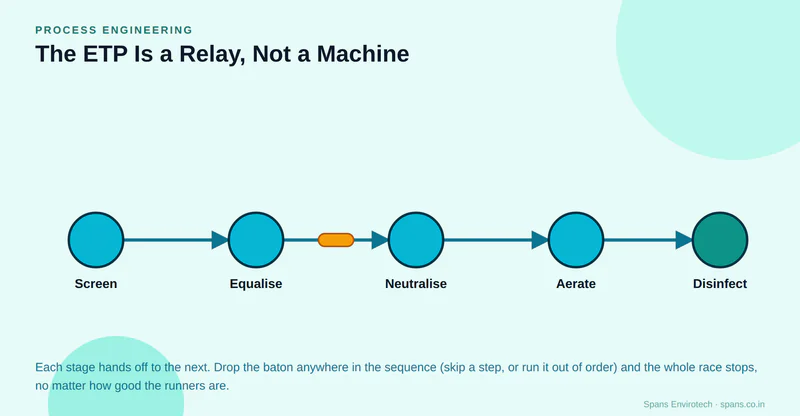
Raw effluent arriving from a factory carries whatever fell into it on the way: rags, plastic, grit, the odd glove. A bar screen catches this before it reaches a pump, because a jammed pump is a mechanical problem with no chemistry in it at all, and there is no reason to let it become one.
From there it moves into an equalisation tank, whose only job is to turn a spiky, uneven discharge into a steady one. Effluent rarely arrives at a constant rate or strength; a factory's peak discharge hour can carry several times the organic load of its quiet hours. Equalisation is not treatment. It is insurance against shock loads reaching stages that cannot absorb them.
(If your plant treats municipal sewage rather than industrial effluent, the same logic holds with different weight on each stage; we've written separately about how a sewage treatment plant works.)
Next comes neutralisation. Biological treatment works in a narrow pH band, roughly 6.5 to 8.5, and effluent rarely arrives there on its own. Acid or alkali dosing, driven off a pH probe, brings it into range before the water meets anything alive. This is the step our 2 a.m. operator effectively skipped by ignoring the alarm, and it is the clearest illustration of the whole argument: the plant does not punish you gradually for getting this wrong. It punishes you in one long, avoidable outage.
Primary treatment follows: coagulant dosing (commonly alum or ferric chloride) neutralises the charge on fine suspended particles so they clump into flocs, which settle out in a primary clarifier along with floating oil and grease. This step matters less for what it removes and more for what it protects downstream. Biological treatment is the most expensive and least forgiving stage in the plant, and every kilogram of suspended solids or oil removed here is a kilogram the bacteria never have to deal with.
The aeration tank is where the real work happens. Air or fine oxygen bubbles keep a population of bacteria alive and hungry, and those bacteria consume the dissolved organic matter we measure as BOD and COD, converting it into more of themselves, water and carbon dioxide. Depending on the design this happens through the conventional activated sludge process, an MBBR where bacteria grow on floating media instead of only in suspension, or a sequencing batch reactor running fill-react-settle-decant cycles in a single tank. Different hardware, identical logic: keep the right bacteria fed, oxygenated and resident for long enough to do their job.
A secondary clarifier then lets this biomass, now activated sludge, settle out. Most of it is pumped straight back into the aeration tank (return activated sludge, or RAS) to keep the tank's bacterial concentration healthy; the surplus the process naturally produces is wasted out to the sludge line. This recycling loop is why a well-run plant does not need a fresh batch of bacteria every week. It maintains its own workforce, provided somebody keeps managing it.
What is left goes through tertiary filtration, polishing out the fine solids a clarifier cannot catch, then disinfection (chlorine or UV) to deal with pathogens before discharge or reuse.
The sludge line is not an afterthought
Every stage that pulls solids out of the water has to put them somewhere. Primary sludge and waste activated sludge are thickened, then dewatered, usually with a filter press or a centrifuge, into a cake that can be transported and disposed of or co-processed under CPCB and State Pollution Control Board norms. Plants that treat this as a side effect of the "real" treatment tend to be the ones where a full sludge pit brings the entire upstream process to a halt on a Friday evening. The sludge line is the other half of the job, not a footnote to it.
Why you cannot reorder any of this
You could, in principle, put the filter before the screen. Nobody does, because the design leans on one piece of logic all the way through: remove what is mechanically easiest first, then what needs chemistry, then what needs a living system, then polish what remains. Every stage is sized on the assumption that the stage before it already did its job. Move a stage, or undersize the buffer between two of them, and you are handing the next stage work it was never built for.
This is also, not coincidentally, a decent description of most durable systems: they do not depend on a genius intervening daily, they depend on someone competent following a correct sequence, checking a small set of numbers, and fixing small deviations before they compound. An ETP that runs on discipline rather than heroics is not a lesser plant. It is the only kind still running the same way in five years, which is a far better trade than surviving on brilliance you cannot schedule.
If you are sizing or auditing one, our effluent treatment plant page and hydraulic retention time explainer are the two starting points we send people to before they buy anything.
Spans
Spans empowers businesses around the world to grow faster and profitable while using less energy and water.
Visit Site