
How to Cut Your ETP Power Bill: The Cheapest kWh Is the One You Don't Blow Into the Tank
If you want to reduce ETP operating cost, here's an uncomfortable place to start: most of the money is going into one thing, and most of that one thing is being..
Contents
If you want to reduce ETP operating cost, here's an uncomfortable place to start: most of the money is going into one thing, and most of that one thing is being wasted on purpose. Not through negligence, exactly. Through a habit so common it looks like good practice.
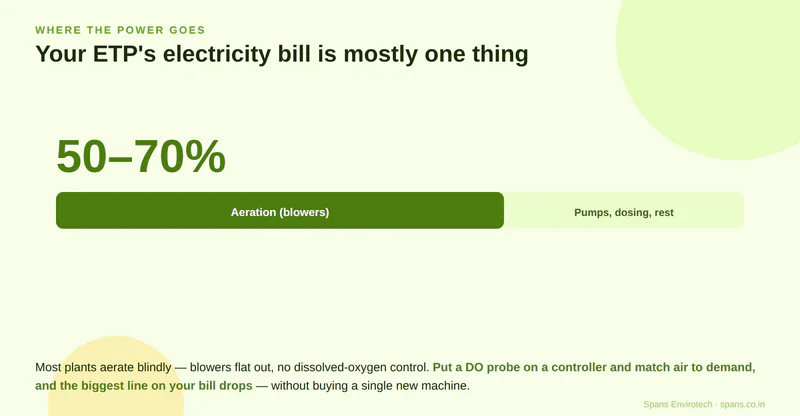
Pull the electricity bill for almost any activated-sludge effluent treatment plant in India and one line dominates everything else. Aeration. The blowers that push air into the biological tank so the bugs can breathe. Depending on the plant, aeration eats somewhere between half and seventy percent of the total power draw. Everything else — pumps, mixers, dosing, the lights — fights over the leftover.
So when a plant tells us it wants to cut its ETP power bill, we don't start with the pumps. We start with the air. That's where the money is, and that's where the waste is, and those two facts are not a coincidence.
Nobody put a probe on the blower
Here's the thing that quietly costs Indian factories crores in aggregate every year. Walk up to the aeration tank and ask a simple question: how does the blower know how much air the tank needs right now? In a lot of plants, the honest answer is that it doesn't. The blower runs flat out, all the time, because that's how it was commissioned and nobody ever gave it a reason to do anything else.
The bugs in the tank need dissolved oxygen — DO — to do their job. Enough, and they happily eat the organic load. Too little, and treatment suffers. But too much, and you've achieved nothing except a bigger electricity bill. Once DO is above roughly 2 mg/l, more air buys you essentially no extra treatment. It just bubbles up through the water, out the surface, and away. You paid to compress it and it did nothing.
And the demand isn't constant. It swings with production shifts, with the load coming down the drain at 3 pm versus 3 am, with temperature, with weekends. A blower running at a fixed output is, by definition, wrong almost all the time — either starving the tank at peak load or, far more often, drowning it in air it can't use during the long quiet hours. Run flat-out around the clock and you spend most of the day flooding the tank with oxygen it isn't using.
The fix is not exotic. It's a DO probe, a controller, and a way to turn the air down — a variable-frequency drive on the blower, or staged blowers, or a modulating valve. You measure the oxygen actually in the water, and you throttle the air to hold it at setpoint instead of at maximum. That's it. That's the single biggest opex lever in most ETPs, and it's usually a retrofit, not a rebuild. We've written the fuller playbook on how to reduce ETP opex, but if you only did one thing, this would be it.
The blower that was never the right size
The second half of the aeration story is the hardware itself. A lot of ETPs are running blowers that were oversized on day one — specified with a fat safety margin, then never revisited as the plant settled into its real load. An oversized blower with no way to turn down is a machine built to waste energy. It has one speed: too much.
There's also the question of how the air gets into the water. Old coarse-bubble diffusers, or a bed of fine-bubble diffusers half-choked with fouling, transfer oxygen poorly — which means you burn extra power to dissolve the same amount of oxygen. The efficiency of that transfer is not a footnote; it's a multiplier on your entire aeration bill. Clean, well-chosen aeration systems can move dramatically more oxygen per kilowatt than tired ones, and the difference goes straight to the bottom line. A lot of what looks like a high wastewater treatment cost is really just poor oxygen transfer wearing a disguise.
None of this shows up on a nameplate. It shows up when someone actually measures — air flow, power draw, DO profile across the tank, oxygen transfer under real conditions. Which brings us to the part most plants skip.
Measure before you spend
The contrarian bit is this: the cheapest way to cut your ETP running cost usually isn't buying anything. It's finding out where the air is going. Plants reach for new equipment because new equipment feels like progress, but you can't fix an aeration problem you haven't measured, and once you measure it the fix is often far smaller than the shopping list you'd have written from a catalogue.
That's what an energy audit is for — not a formality, but a way to see which kilowatts are doing work and which are bubbling out the top of the tank. Our ETP energy audit guide lays out what to look at, and the ETP energy calculator lets you put a number on what over-aeration is costing you before you commit a rupee. A surprising amount of the waste traces back to decisions made at design stage — we've catalogued how poor ETP design bakes in energy costs that then haunt the plant for its whole life.
There's good external footing for treating this seriously. India's own Bureau of Energy Efficiency has been pushing energy audits and motor-efficiency norms across industry, the US EPA has long flagged aeration as the single largest energy consumer in wastewater treatment, and even the basic engineering of aeration makes clear how much oxygen transfer efficiency swings the power you actually need.
The kWh you never spend
So here's the reframe to leave you with. Everyone hunting for savings looks for something to buy — a more efficient motor, a solar panel, a better tariff. Fair enough, those help. But the cheapest kilowatt-hour in your whole plant is the one you never blow into the tank in the first place. It costs nothing, it needs no fuel, it never fouls. You get it simply by not producing oxygen the bugs were never going to use.
Match the air to the demand — measure the DO, right-size the blower, keep the diffusers honest — and the biggest line on your ETP power bill starts shrinking without a single compromise on the quality of water leaving the plant.
If you'd like someone to actually measure where your air is going before you spend on kit, that's a good place to start a conversation. Bring the electricity bill. We'll find the tank.
Spans
Spans empowers businesses around the world to grow faster and profitable while using less energy and water.
Visit Site