
CPCB Effluent Standards: The Hard Part Isn't the Limits, It's Knowing Which Ones Apply
The mistake almost never happens at the numbers. Give an engineer a discharge limit — BOD under 30, COD under 250, pH between 6 and 9 — and they will design..
Contents
The mistake almost never happens at the numbers. Give an engineer a discharge limit — BOD under 30, COD under 250, pH between 6 and 9 — and they will design a plant that hits it. That part is solved. The expensive mistake, the one that gets a plant a closure notice after it's already built, happens one step earlier: the plant designed to the wrong set of limits. It hit its target perfectly. The target was just never the one that applied to them.
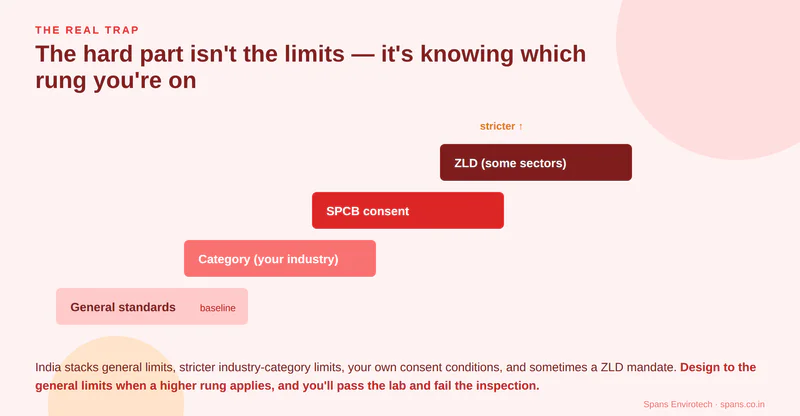
Because here is the thing nobody tells you when you start reading about CPCB effluent standards: there isn't one set of numbers. There are at least four, they stack on top of each other, and the whole skill is figuring out which stack lands on your particular plant discharging to your particular place. Let me lay the layers out, because once you see them the trap is easy to avoid.
Layer one: the general standards everyone quotes
At the bottom sits the general discharge standard — the familiar table under the Environment (Protection) Rules that most people mean when they say "the CPCB limits." It sets baseline values for effluent going to inland surface water, to public sewers, to land for irrigation, and to marine outfalls. Crucially, the limit changes with where the water goes: the number for inland surface water is stricter than the one for a sewer feeding a downstream treatment plant, because the receiving environment does more or less of the remaining work. Same effluent, different destination, different legal number.
This is the layer people design to by default. And for a plain commercial building or a low-impact facility, it may genuinely be the one that governs. The trouble is that a lot of plants stop reading here.
Layer two: your industry may have its own, stricter table
Sitting on top of the general standards are the industry-specific category standards. CPCB publishes dedicated limits for a long list of sectors — textiles, tanneries, distilleries, pulp and paper, pharmaceuticals, dye and dye-intermediate, and many more — and where a category standard exists, it overrides the general one for that pollutant. These are usually tighter, and they often name parameters the general table doesn't bother with, because that industry's effluent carries a specific nasty the regulator wants controlled.
This is the most common place plants get caught. A textile unit designs to the general COD limit, commissions, and only then discovers the textile-category limit is stricter and includes colour and specific metals. The plant works. It just doesn't work to the number that governs it. Knowing your sector's category standard — and knowing that it beats the general one — is half the battle. Which category you even fall into is itself set by CPCB's red / orange / green / white classification, and that classification drives far more than a colour code.
Layer three: the state board's consent conditions
Now it gets local. CPCB sets the national floor, but the Central Pollution Control Board delegates day-to-day regulation to the State Pollution Control Boards, and the SPCB writes your actual Consent to Operate. That consent is a legal document specific to your plant, and it can — and frequently does — impose limits stricter than either the general or the category standard.
Why stricter? Because the state board looks at your specific receiving environment. If you discharge into a river stretch that's already overloaded, into a notified critically-polluted area, or into a catchment feeding a drinking-water source, the board tightens your numbers to protect that body. Two identical factories in two different districts can hold two different sets of limits, purely because of where their pipe ends. The number that governs you is not in any national table — it's on your consent certificate, and if you haven't read it line by line, you don't actually know your limits. You know the defaults.
Layer four: sometimes the limit is "none"
And at the top, for some industries and some locations, the stack terminates in a hard mandate: zero liquid discharge. No discharge number at all, because no discharge is permitted. This has been imposed on highly polluting sectors and on units in water-stressed or critically-polluted zones — and once ZLD applies, the entire conversation about discharge limits evaporates. The question becomes recovery and reuse, not concentration. A plant that designed to meet a discharge standard, then gets handed a ZLD condition at consent, has to rethink from the pump up.
How to actually find your number
So the practical method, in order, is this. Start at moef.gov.in and cpcb.nic.in and pull the general standard for your discharge route — but treat it as the floor, never the answer. Then check whether an industry-specific category standard exists for your sector; if it does, it wins on the parameters it names. Then — and this is the step plants skip — read your SPCB consent conditions in full, because the binding numbers live there and they may be tighter than both tables above. And confirm whether a ZLD directive applies to your category or your zone, because if it does, everything else is moot.
Notice what this means for design. You cannot responsibly size a treatment plant off the general standard and a good intention. You size it off the most stringent applicable value for each parameter, assembled by walking down these layers for your specific case. That's why two plants with identical effluent can need genuinely different plants — one is governed by the general COD limit, the other by a category limit plus a tight state consent on a stressed river.
There's also a quieter lesson buried in here about the parameters themselves. When you read across these layers you'll see BOD in one, COD in another, sometimes both — and they are not interchangeable. Designing to a COD limit while your consent is written in BOD, or vice versa, is its own small trap; it's worth being fluent in what each one actually measures before you commit to a treatment train.
None of this is meant to make compliance sound like a maze you can't cross. It's a stack, and stacks are readable once you know they exist. The engineers who get caught aren't the ones who found the layering hard — they're the ones who never knew there was more than one layer. So before you finalise a single tank size, spend an afternoon establishing which numbers actually govern your plant. It is the cheapest afternoon in the whole project.
If you'd like help untangling which standards land on your specific site and receiving environment, talk to us — sorting the applicable stack before design starts is exactly the kind of mistake that's free to avoid and painful to fix.
Spans
Spans empowers businesses around the world to grow faster and profitable while using less energy and water.
Visit Site