
Your Concrete Cover Thickness Is Specified Correctly and Still Isn't What Determines How Long the Rebar Stays Protected
Every structural drawing for an aeration tank, clarifier, or wet well at an ETP or STP specifies a nominal concrete cover, the distance between the reinforcemen..
Contents
Every structural drawing for an aeration tank, clarifier, or wet well at an ETP or STP specifies a nominal concrete cover, the distance between the reinforcement and the outer face, picked from the exposure-class table against the structure's expected environment. Get that number right and the drawing passes review, the inspector signs off, and the structure gets built exactly to spec. The cover number is correct. It is also, on its own, nowhere near enough to tell you how long the reinforcement inside that cover will actually stay protected from chloride, because cover thickness answers a geometry question and corrosion protection depends on a transport question the geometry alone cannot settle.
A correct cover thickness and real corrosion protection are different claims
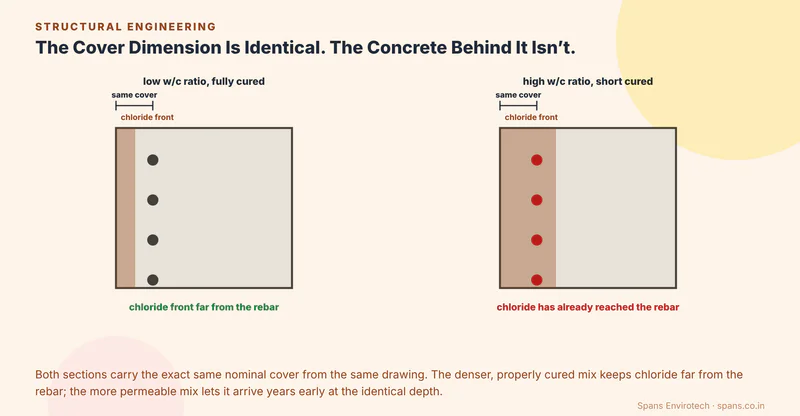
Cover works by putting distance and alkaline concrete between the rebar and whatever is trying to reach it. Chloride ions, present in wastewater and in groundwater at many Indian sites, diffuse through concrete at a rate governed almost entirely by the concrete's permeability, which is in turn governed by water-to-cement ratio, curing quality, and the presence of cracks, none of which the cover dimension says anything about. Two structures built to the identical nominal cover from the identical exposure-class table can see chloride reach the rebar at genuinely different times, sometimes by years, purely because one was cast with a lower water-cement ratio and properly cured while the other was cast wetter for easier placement and cured for the minimum days anyone bothered to check. The exposure-class table that sets cover assumes a reference concrete quality behind that number. A site that hits the cover dimension but not the concrete quality the table assumed has satisfied the drawing and not the protection the drawing was meant to deliver.
Why the cover number keeps standing in for the concrete behind it
Cover is trivial to verify: a cover meter or a simple physical check confirms the rebar sits where the drawing says it should, and that check happens on every reinforcement inspection as a matter of course. Verifying that the concrete's actual permeability matches what the exposure class assumed requires something almost nobody checks on a routine construction site: a rapid chloride permeability test, or at minimum a disciplined water-cement ratio control and documented curing regime, carried through from batching to the full curing period rather than treated as paperwork once the concrete has been poured and looks fine. A site engineer who has confirmed cover on every inspection has every reason to believe durability is handled, because cover is the only durability-related number anyone actually measures after the pour. Reinforced concrete durability research is fairly consistent on this point: the chloride threshold that triggers corrosion initiation, and the time it takes to reach that threshold at the rebar depth, depend on water-to-binder ratio, curing, and cracking at least as much as on cover thickness itself, so a correct cover figure sitting on top of an uncontrolled mix is a protection number with an unknown real value.
This is the same shape of mistake we described in the piece on concrete corrosion in the H2S headspace: that piece was about a different attack entirely, biogenic sulfuric acid dissolving concrete from the outside in the gas-exposed zone above the waterline, while chloride-induced rebar corrosion works from the inside out in the submerged and wetted zones, a completely different mechanism attacking a different part of the same tank. Both pieces share the same underlying lesson: a single specified number (headspace ventilation, or here, cover thickness) gets treated as the whole durability answer when the real mechanism depends on variables the specification never priced in. It is close kin, too, to the piece on RCC tank crack control: a crack that passes a structural strength check can still be a direct chloride highway straight past however many millimetres of cover sit on either side of it, since chloride ingress through a crack bypasses the diffusion-through-sound-concrete process the cover calculation assumed entirely.
Picture two identical wet wells built from the same structural drawing, same cover specification, same exposure class. One contractor batches concrete at the water-cement ratio the mix design actually calls for and holds wet curing for the full specified duration, even though it slows the pour schedule. The other, under pressure to strip formwork and move to the next pour, adds a little extra water on site for workability and curing gets cut short once the surface looks dry. Both wet wells carry identical cover on the drawing and identical cover as built. Within a few years the first wet well's reinforcement sits comfortably inside its protected chloride threshold while the second, with meaningfully higher effective permeability, starts showing rust staining and surface cracking from oxide jacking, the classic sign that chloride has already reached the steel and begun corroding it, years before the cover dimension alone would have predicted.
What actually determines how long that cover protects the rebar
The fix is not treating cover thickness as unimportant, since it remains a genuine, necessary line of defence and the exposure-class table a sound starting point. It is recognising that cover alone was never the complete specification, and that the concrete quality behind it, water-cement ratio control, full curing duration, and crack control together, needs the same discipline during construction that the cover dimension gets at inspection. For a new structure, that means specifying and actually verifying a maximum water-cement ratio and minimum curing period alongside the cover figure, not just the cover figure alone, a detail worth building into the project's wastewater treatment cost planning rather than treating as a free assumption. For an existing structure, a half-cell potential survey or chloride profile test at the rebar depth tells you where the real protection actually stands, rather than trusting a cover meter reading to answer a question it was never built to answer.
A cover dimension that matches the drawing is not the same claim as reinforcement that is actually protected, and the gap between the two rarely shows up until rust staining appears on a structure everyone believed was built correctly. If your plant's concrete structures have never had their actual chloride exposure checked against anything beyond the cover dimension on the drawing, that gap is worth closing with Spans' structural engineering team before oxide jacking turns a durability assumption into a repair bill.
Spans
Spans empowers businesses around the world to grow faster and profitable while using less energy and water.
Visit Site