
A Secondary Clarifier's RAS Rate Can Be Calculated Correctly and Still Lose the Sludge Blanket the Day Flow Peaks
Every activated sludge plant sets its return activated sludge (RAS) rate the same way: run the mass balance at design flow and design MLSS, solve for the RAS fr..
Contents
Every activated sludge plant sets its return activated sludge (RAS) rate the same way: run the mass balance at design flow and design MLSS, solve for the RAS fraction that keeps the aeration tank at its target concentration, and set the pumps to hold it. That number is correct, and it will hold the aeration tank exactly where the calculation says it should on an average day. It says nothing at all about what happens to the clarifier underneath it the first time flow actually peaks, because a mass balance answers a steady-state question and a clarifier's sludge blanket is a hydraulic problem that does not wait for steady state to arrive.
A correct RAS rate and a clarifier that won't wash out are different questions
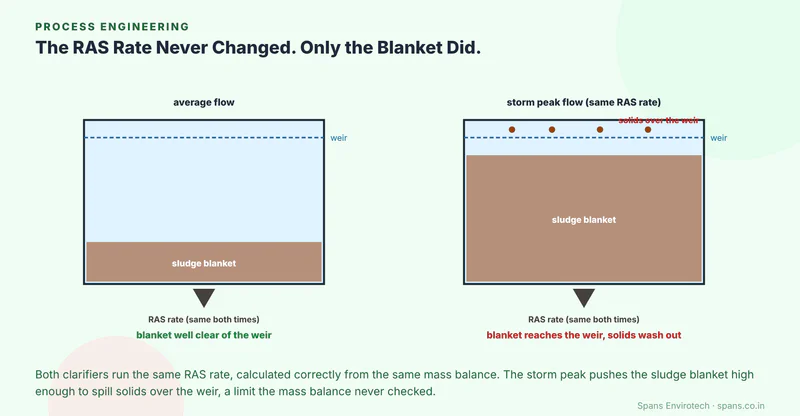
A secondary clarifier does two jobs at once: it clarifies the water above the blanket and it thickens the sludge settling to the bottom, and the RAS rate is the only knob that controls how fast solids leave through the underflow. The mass-balance calculation that sets that rate assumes the sludge blanket sits at some manageable depth and settles at some assumed velocity. Neither assumption holds once flow rises toward a wet-weather peak or the biology has a bad week and sludge volume index climbs, because a real clarifier's capacity is governed by solids flux, the rate solids can actually settle and move toward the underflow, and that flux depends on how well the sludge settles, not on what the RAS pumps are set to. A RAS rate correct for design flow and design SVI can leave the blanket exactly where it should be on an ordinary Tuesday and still be nowhere near enough the day a storm brings in twice the hydraulic load, because the clarifier was never checked against anything but the average case.
Why the mass balance keeps standing in for the hydraulic check
A mass balance is one equation, solved once, filed, and trusted. Checking whether a clarifier can actually handle a flow peak without losing solids requires something most plants never build: a state point analysis that plots the clarifier's actual operating point, set by surface overflow rate and RAS underflow rate, against a settling flux curve measured from the real mixed liquor's settleability, not an assumed one. That curve shifts every time SVI changes, which means a clarifier correctly sized and correctly operated last month can be running close to its limit this month purely because the sludge has gotten a little harder to settle, with no change to flow, RAS rate, or anything an operator would think to check. The RAS rate on the panel reads the same number it always has. The margin behind that number has quietly shrunk to nothing.
This is the same shape of mistake we described in the piece on clarifier weir leveling: a clarifier can satisfy the calculation everyone checks (there, surface overflow rate; here, the RAS mass balance) and still lose solids for a reason that calculation was never built to catch, because a single correct number standing in for an entire unit process always has a blind side. It is close kin, too, to the biological loading question in the piece on SRT and F/M ratio: a plant can have its sludge age and food-to-microorganism ratio exactly where the textbook says they should be and still face a clarifier that cannot physically keep that much biomass separated from the water once conditions turn against it, because the biological target and the clarifier's hydraulic capacity are governed by entirely different physics and neither one checks the other.
Picture two plants running the same activated sludge process at the same design flow, both with RAS rates calculated correctly from the same textbook mass balance. A monsoon storm sends both plants' inflow to 1.8 times design overnight. Plant A has never run a state point analysis and has no idea where its clarifier's actual flux limit sits relative to that peak; the blanket climbs through the night, nobody notices until the morning grab sample shows effluent suspended solids well above consent limits, and by then the washout has already happened and taken several days of recovery with it. Plant B ran that analysis once, knows its clarifier's flux-limited capacity at the SVI it actually sees, and has a documented RAS response (raise the rate pre-emptively, or draw down MLSS ahead of a forecast storm) triggered by blanket depth rather than by an alarm that only fires after the limit is already crossed. Both plants had a correct RAS rate on the day the storm arrived. Only one of them had checked what that rate was actually good for.
What actually keeps the blanket down when flow peaks
The fix is not replacing the mass balance, which remains the right way to set a baseline RAS rate for average conditions. It is adding the check that mass balance was never built to answer: running (or having a process engineer run) a state point analysis against the clarifier's own measured settling flux curve, at the SVI values the plant actually experiences rather than an assumed textbook figure, to find where the real operating limit sits relative to the flows the plant will actually see. Once that limit is known, a sludge blanket depth sensor and a documented response procedure (RAS rate adjustment, MLSS drawdown, or a wet-weather operating mode triggered before the blanket reaches a set depth rather than after) turns a reactive scramble into a planned response, and that response is worth building into the same wastewater treatment cost picture that already prices an ETP or STP's clarifier capacity in the first place, since a washout event costs far more in compliance exposure and recovery time than the analysis that would have predicted it.
A RAS rate that is correct for the average day is not a RAS rate anyone has actually tested against the worst day, and most plants discover the gap the same way: a storm, a bad settling week, and an effluent sample nobody wanted to see. If your plant's clarifiers have never been checked against their own actual flux limit at the flows and SVI you really run, that is worth doing with Spans' process engineering team before the next storm makes the discovery for you.
Spans
Spans empowers businesses around the world to grow faster and profitable while using less energy and water.
Visit Site