The CGWA NOC Has Stopped Being a Formality
A few years ago, getting a CGWA NOC felt like getting a rubber stamp. You filed the form, paid the fee, drilled the borewell, and forgot about it until someone ..
Contents
A few years ago, getting a CGWA NOC felt like getting a rubber stamp. You filed the form, paid the fee, drilled the borewell, and forgot about it until someone asked for a copy during an audit. Nobody treated the groundwater NOC as a live constraint on how the plant ran. It was a document, not a decision.
That era is quietly over, and most of the factories we work with have not fully registered it yet.
The Central Ground Water Authority regulates who may draw groundwater and how much, and its posture has hardened as the aquifers underneath India's industrial belts have fallen. The Central Ground Water Board classifies assessment units as safe, semi-critical, critical or over-exploited, and a large and growing share of the country's blocks now sit in the stressed end of that scale. NITI Aayog's water index has been warning for years that national demand is drifting past supply. When the resource gets scarcer, the paperwork guarding it gets stricter. That is what has happened to the groundwater NOC.
What the NOC actually is now
Strip away the acronyms and the CGWA NOC is a permission to abstract a specific quantity of groundwater from a specific place, granted on conditions, for a limited time. Any industry, infrastructure or mining project drawing groundwater is expected to hold one. You apply online through the CGWA portal, declare your extraction, and the authority attaches obligations to the grant.
Those obligations are the part people miss. A digital, tamper-resistant flow meter on the abstraction structure is compulsory, and you report through the portal. Draw above a modest daily threshold and you are expected to sink purpose-built observation wells, piezometers, and log the water level every month. Rainwater harvesting is written in where the water table has fallen far enough. And you pay a water conservation fee, sometimes called an abstraction or restoration charge, that is not a flat sticker price. It scales with two things: how much you pump, and how stressed the block you are pumping from already is. Draw a lot from an over-exploited area and the charge climbs on both axes at once.
Then there is renewal. The NOC does not last forever. It carries a validity, and you are expected to apply for ground water NOC renewal well before it lapses, typically a season ahead. Miss the window and you are not merely late on a form. Extraction without a valid NOC invites environmental compensation calculated off your abstraction, and in the worst case, sealed borewells. We have watched a plant discover, mid-expansion, that its lapsed NOC had turned a routine capacity increase into a compliance emergency.
So the honest way to read the current CGWA guidelines is this: the more groundwater you rely on, the more expensive, more monitored and more precarious your NOC becomes. The document now has a running meter attached.
The cheapest litre is the one you never pump
Here is where most of the industry's energy goes in the wrong direction. Faced with a tighter NOC, the instinct is to get better at asking, better consultants, cleaner applications, faster CGWA NOC online submissions, tidier justification for the volume requested. All of that helps at the margin. None of it changes the number you are asking for.
But the number you are asking for is the whole game. The water conservation fee scales with abstraction. The monitoring burden scales with abstraction. The renewal scrutiny scales with abstraction. Every one of the pressures bearing down on your NOC is indexed, one way or another, to how many litres you draw. Which means the single most powerful lever you have over your groundwater NOC is not on the application form at all. It is inside your effluent treatment plant.
Think about where your water goes. A large fraction of what you pump does not get consumed or shipped out in product. It gets used, contaminated a little, and sent to the drain. That stream is not waste. It is groundwater you have already paid the CGWA charge to extract, already metered, already accounted for. When you treat it and send it to the drain, you throw away a litre you fought to be allowed to pump, and then you go pump another one to replace it, and pay for that too.
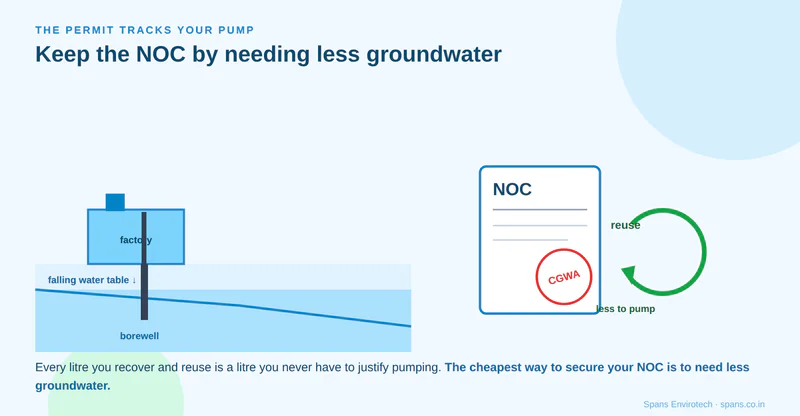
Recover that litre instead and something quiet but significant happens to your NOC. Every cubic metre you reclaim from your own wastewater is a cubic metre you do not have to abstract, do not have to meter, do not have to pay a conservation fee on, and do not have to justify at renewal. The recovered litre is invisible to the CGWA because, from the aquifer's point of view, it was never taken.
This is why we have come to read the NOC differently. On paper it is a licence to extract. In practice, the smarter way to treat it is as a prompt to recycle. The regulator is effectively pricing your dependence on groundwater and raising that price every year. The rational response is to lower the dependence, not to get better at paying for it.
What recovery actually looks like
None of this is theoretical. The engineering to close the loop is mature and it is being run at Indian plants today. A well-designed effluent train followed by RO for industrial wastewater reuse can return a large share of your effluent as water clean enough for cooling towers, boiler feed, floor washing or process make-up. Push it further and zero liquid discharge recovers nearly all of it, leaving only solids. Between those points sits a whole spectrum of industrial water reuse, and the right target is rarely the maximum. It is the point where the cost of recovering the next litre matches the cost of pumping and permitting a fresh one.
That break-even has moved. As the conservation fee rises and NOC volumes get harder to defend, the reused litre gets cheaper relative to the pumped one every year. Reuse projects that did not pencil out five years ago pencil out now, precisely because the CGWA has put a price on the alternative. The regulator, without meaning to, has become the business case for wastewater reuse in India.
It is worth doing the arithmetic for your own site before your next renewal. A rough water reuse calculation against your current abstraction and the charge you are paying will usually show a smaller NOC is not a compliance cost. It is a saving you have not collected yet. The Central Pollution Control Board and CGWA are pushing the same direction from different sides, and the plants that get ahead of it are the ones that stopped treating water as free the day it came out of the ground.
The NOC is not going to get looser. The water is not going to get deeper. The one variable genuinely in your control is how much you need, and that one you can start shrinking this quarter. If you want a second pair of eyes on where the recoverable litres are hiding in your process, we are happy to look.
Spans
Spans empowers businesses around the world to grow faster and profitable while using less energy and water.
Visit Site