
A CETP Is Only As Good As Its Worst Member
When a common effluent treatment plant lands in trouble with the board, everyone looks at the plant. The operator gets the show-cause notice. The engineers get ..
Contents
When a common effluent treatment plant lands in trouble with the board, everyone looks at the plant. The operator gets the show-cause notice. The engineers get asked why the outlet COD spiked. Consultants get called to audit the aeration basin. And almost none of it helps, because the plant is usually working exactly as designed. The problem walked in through the inlet channel weeks earlier, from a member unit nobody was watching.
That is the uncomfortable thing about the shared model. A CETP is not really one plant. It is a treaty between forty or eighty or a hundred and thirty factories, and like any treaty it holds only as long as everyone keeps their side of it.
What a CETP actually is, and why the idea is sound
CETP is short for Common Effluent Treatment Plant. The full form gives away the whole design intent: instead of each small factory in an industrial estate building and running its own effluent treatment plant, the cluster builds one large shared plant and pipes everyone's wastewater to it. The Central Pollution Control Board and the state boards have promoted this model for decades, mostly for micro, small and medium units, and the logic is genuinely good.
A standalone ETP needs land, capital, a skilled operator, chemicals bought in small quantities, and a lab. A tiny electroplating shop or a small dyeing unit cannot carry that overhead well. Pool a hundred of them and suddenly the numbers work: one competent operating team, one well-instrumented plant, real economies of scale on power and chemicals. That is the difference people mean when they ask about CETP vs ETP. An ETP treats one factory's waste. A CETP treats a neighbourhood's, and spreads the cost of treatment across everyone who uses it.
On paper this is one of the better ideas in Indian environmental policy. In practice, a striking number of CETPs run chronically overloaded and out of compliance, and it is worth being precise about why.
The failure is at the inlet, not in the basin
Here is the part that gets missed. When a designer sizes a CETP, they do not size it for "whatever the members send." They size it for a defined inlet: a specific flow, a specific organic load, an assumed BOD and COD and TSS and oil-and-grease at the gate. Those are the CETP inlet norms, and they are not decoration. The biological stage is grown to eat a certain amount of organic load per day. The equalisation tank is built to smooth a certain swing. Give the plant the wastewater it was designed to receive and it will hit the discharge standards reliably.
The inlet conditions exist precisely because a shared plant cannot treat anything at any strength. That is why every member's consent carries the same quiet obligation: pre-treat your effluent to inlet quality before it enters the common drain. The state board, often with CPCB's concurrence for the cluster, sets those limits, and members are meant to fit flow meters at their own inlet and outlet so the discharge can actually be measured.
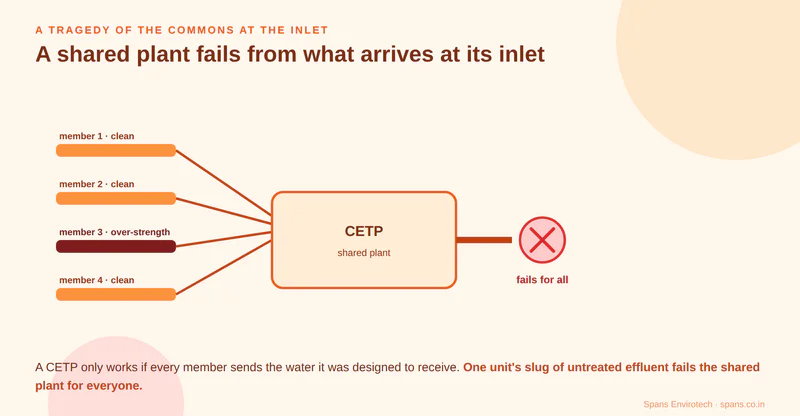
Now watch what happens when a few members stop honouring that. A dyeing unit skips its own pre-treatment and dumps raw, high-colour, high-COD effluent into the shared line to save on chemicals. A metal-finishing shop lets a slug of chromium or a solvent batch go down the drain one night because nobody is metering it. None of these units breaks the plant. What they break is the assumption the plant was built on. The biological stage was never designed for that load or that toxicity, so it destabilises, the outlet drifts out of limits, and the operator, who did nothing wrong, holds the notice.
A commons, and its usual tragedy
If this pattern feels familiar, it is because it is one of the oldest failure modes in economics. The shared inlet is a commons, and it behaves like every other commons under stress. Each member has a private incentive to under-treat. Your pre-treatment costs are yours alone; the damage from skipping it is diluted across every other member and blamed, conveniently, on the operator. Cheating is cheap and nearly invisible. So people cheat, quietly, and the shared plant absorbs the aggregate until it can't.
The result is that the CETP fails not from bad engineering but from arithmetic. Twenty disciplined members and five who don't pre-treat can still put the whole plant out of compliance, because the plant treats the sum, not the average of good intentions. The best-run common effluent treatment plant in the country cannot out-engineer a member who treats the inlet as a bin.
This is exactly why the boards have hardened their stance. Rather than only chasing the CETP operator, the National Green Tribunal and the state boards now go after the special-purpose vehicles that run these plants with real penalties, and increasingly they push the load back upstream: tighter inlet enforcement, mandatory member pre-treatment, and in stressed clusters, particularly textile and dyeing belts, a nudge toward captive zero liquid discharge for the units that pollute hardest. Where the sector sits in the red-orange-green-white categorisation shapes how hard that push comes. It is a rational response to a commons problem: if the shared resource is being abused, you make the abuse expensive at the point where it starts.
Where the compliance duty really sits
So the honest answer to "who is responsible for a CETP's compliance" is not "the operator." It is every member, at their own boundary wall.
We say this to units all the time, and it lands badly at first, because the whole reason a factory joined a CETP was to not have to think about treatment. But joining a CETP was never a way to outsource the problem. It was a way to share the second half of it. The first half, getting your own effluent down to inlet quality, stayed with you the whole time. A modest, well-run pre-treatment step at your gate, screening, oil-and-grease removal, neutralisation, a primary knockdown of the loads specific to your process, is not a burden the CETP saved you from. It is the price of admission you agreed to and perhaps forgot.
The units that understand this stop treating pre-treatment as a cost centre and start treating it as insurance. When the board audits the cluster after an outlet excursion, the member who can show a working pre-treatment train and honest inlet-outlet meter logs is not the one who gets shut down. And if you are unsure whether your discharge actually meets the inlet norms your consent commits you to, that is a cheap thing to check and an expensive thing to guess about, which is a conversation we're happy to have before the board has it for you.
None of this is an argument against the shared model. The shared model is sound. Pooling treatment for a cluster of small units is still one of the most sensible things an industrial estate can do, and a good CETP remains cheaper and cleaner than a hundred struggling little ETPs. The argument is narrower and harder to dodge: a shared plant can only ever return what its members feed it. Build the common plant as large and clever as you like. It will still be only as good as its worst member's inlet.
Spans
Spans empowers businesses around the world to grow faster and profitable while using less energy and water.
Visit Site