
Biogas from Wastewater: You're Paying to Destroy Your Own Fuel
There's a moment we enjoy in a lot of factory site visits. We're standing next to an aeration tank the size of a swimming pool, blowers roaring, motors pulling ..
Contents
There's a moment we enjoy in a lot of factory site visits. We're standing next to an aeration tank the size of a swimming pool, blowers roaring, motors pulling serious current, churning a high-strength effluent into froth. And we ask the plant manager what all that electricity is doing. The honest answer is: it's destroying something. Specifically, it's spending power to burn off the organic load in the water. And that organic load — the thing being destroyed at some expense — is fuel.
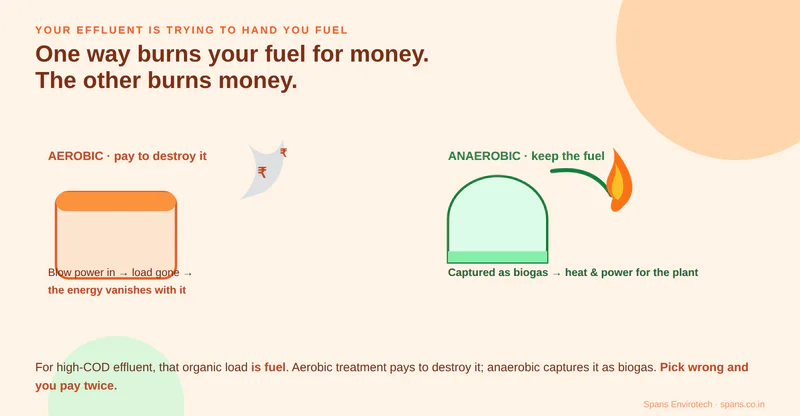
That's the whole essay, really. For a certain kind of wastewater, aerobic treatment isn't just a running cost. It's a running cost you incur in order to throw away energy you could have captured. You pay twice: once for the power to aerate, and once for the fuel you decided to burn instead of keep.
What the COD actually is
We measure the strength of an effluent as COD — chemical oxygen demand — and we tend to think of it as a problem to be reduced. High COD, bad. Low COD, good. Discharge the low number, sleep well.
But COD is just a measure of how much oxidisable organic matter is dissolved in the water. Sugars, fats, starches, alcohols, proteins — the leftovers of whatever the factory makes. And organic matter is chemical energy. A dairy's whey-laden washings, a distillery's spent wash, a food plant's process water, a starch unit's effluent — these aren't merely dirty. They're dilute fuel. High COD doesn't only mean "hard to treat." It also means "energy-rich."
Aerobic treatment takes that energy-rich water and does the thermodynamically wasteful thing with it: it uses electricity to blow oxygen in so that microbes oxidise the organics to CO2 and water, releasing the energy as low-grade heat nobody captures. You spent power to get rid of fuel. It's a bit like paying someone to pour your diesel down the drain because the drum was in your way.
Anaerobic treatment does the opposite
Anaerobic digestion flips the logic. Instead of pumping in oxygen and burning the organics, you keep oxygen out and let a different community of microbes break the organics down in its absence. The by-product of that breakdown isn't waste heat. It's biogas — a methane-rich gas you can actually use as fuel.
So the same COD that cost you electricity to destroy aerobically now does two good things at once. It gets treated — the organic load comes down, which is what you needed anyway — and it hands you back energy on the way out. No blowers screaming. Anaerobic reactors sip power compared to aerobic tanks, because you're not paying to dissolve oxygen into water, which is one of the more stubbornly inefficient things you can ask a machine to do.
That's the reframe. The difference between aerobic and anaerobic isn't only "which one is cheaper to run." It's that one of them spends energy to get rid of the load and the other captures energy from it. We've laid out the head-to-head in more detail on aerobic vs anaerobic treatment, because the choice deserves more than a rule of thumb.
When anaerobic-first actually makes sense
Now, the honest part — because anaerobic is not a miracle you bolt onto every ETP. It pays when the water is strong and warm and biodegradable, and it disappoints when it isn't.
The sweet spot is high-COD, readily biodegradable, warmish effluent with reasonably steady flow. Distillery spent wash. Dairy and food-processing washings. Starch, brewery, sugar, and slaughterhouse streams. Here the COD is high enough — think several thousand mg/l and up — that the gas yield is worth capturing, and the organics are the kind microbes take to easily. For these, anaerobic-first is often the obvious move: you knock down the bulk of the load cheaply while making gas, then polish aerobically to hit discharge limits. Anaerobic does the heavy lifting; the small aerobic stage just tidies up.
It makes much less sense when the effluent is weak. A dilute, low-COD stream simply doesn't hold enough energy to justify a digester — the gas trickle won't repay the tankage, and you're better off aerobically. It struggles with cold effluent, because the bugs slow right down as temperature drops. It's unhappy with anything toxic or heavily inhibitory to methanogens, or wildly swinging in load, or laden with sulphates that turn part of your gas into corrosive hydrogen sulphide. And anaerobic effluent still carries residual COD and nutrients, so it almost always needs an aerobic finishing step before discharge. Anaerobic-first, not anaerobic-only.
The way to tell which camp you're in isn't gut feel — it's the numbers. What's your COD, your flow, your temperature, your biodegradable fraction? Run those and the answer stops being a matter of opinion. Our biogas yield calculator gives you a first-pass estimate of how much gas a given stream could throw off, and our note on biogas feasibility walks through the conditions that make or break a project before anyone commits capital.
The energy was never waste
Here's the thought we'd like to leave you with. The organic load in your effluent was never the problem you thought it was. It was mislabelled. You've been carrying it on the books as a liability — a number to push down, a reason the pollution board might call — when for the right streams it's an asset you've been paying to destroy.
Recover it as biogas and it can run a boiler, offset furnace oil or LPG, or be cleaned up further into compressed biogas for vehicles or the grid. Point being: it goes back to work instead of up in wasted heat. That's the whole logic of treating waste as value rather than as something to spend money making disappear. There's solid ground for this shift in policy too — India's push under the Ministry of New and Renewable Energy and the way the US EPA frames anaerobic digestion both treat wastewater organics as a recoverable energy resource, not merely a pollutant.
So before you approve another set of blowers for a strong, warm, biodegradable effluent, it's worth asking one question: are we treating this water, or are we paying to burn our own fuel? If you're not sure which of your streams could carry a digester, tell us what you've got — the COD, the flow, the temperature — and we'll help you work out whether the energy is worth keeping.
Spans
Spans empowers businesses around the world to grow faster and profitable while using less energy and water.
Visit Site